League Match: Kirby Castlers 2 vs. Anstey 3 (23rd March)

The quiet before the storm. Not a lot happened before the matches started. Oskar helped to set up the boards with the Kirby players, and some people were slightly late getting to the venue as it can be quite hard to find and traffic can be a nightmare. Nonetheless, everyone made it to the match and everyone was able to play a solid game of chess.

It isn’t necessary for Anstey 3 to win this, but it would be great as we have drawn most of our matches and have stayed in the middle of the leader board for the whole season. The Kirby Castlers were not doing very well throughout the whole season staying at near the bottom of the board, so it would be ideal for Anstey to win as this would help to maintain our position in 5th place.

Board 1: Mike Griffiths plays white; John Walker plays black

Mike started off with the english and the game proceeds as a king’s english variation where white fianchetto’s the king’s bishop. Mike launches b4 onto the board along with a4 and then b5. White’s knight and black’s light bishop get traded off. Black takes the b5 pawn and Mike retakes, which now allows the c file to be fully open. Both players make small positional improvements and they trade knight for knight. Mike keeps his fianchettoed bishop, which now slices through the board. Black offers a queen trade, which is considered a blunder by the computer, and Mike takes the queen trade. I suppose this is a blunder because of how powerful Mike’s bishop is and he has control of the only open file for rooks to use, which Mike takes full advantage of and wins a pawn. Black decides to trade a pair of rooks and Mike keeps control of the open file and keeps his very strong bishop.

Both players fidget around with their pawns a little bit, again making small positional improvements to control certain squares. Mike then attacks black’s centralised dark bishop and a centre pawn, black trades pawns and Mike offers a dark squared bishop trade, which black accepts. Black then places his rook on the c file in front of Mike’s light squared bishop, which blockades the c file. Although, this allows Mike to gain a very advanced past pawn on the a file, and black stops this briefly but Mike finds the best moves and black can’t stop the pawn from queening. Black resigns.

Board 2: Nigel Wollen plays white; Bob Grindrod plays black

Bob starts with a french defence and it turns into the exchange variation. Bob fianchetto’s his dark squared bishop and castles king side. Both players make improving moves and white offers a trade of dark bishops, which Bob doesn’t act on and white chooses to trade bishops. Both players continue to make small improving moves. White trades off a knight for a knight, and again both players continue to make small improving moves before Bob offers another trade of pieces, this time offering a light squared bishop for a light squared bishop. White immediately takes it. Bob then blockades the only open file (the e file) with a knight. White dances his knight around the board, and while the white knight dances Bob makes more improving moves.

White trades off knights and Bob retakes with a rook, and white doesn’t want to trade rook for rook so he makes Bob trade rooks. The e file remains open and Bob makes sure that white can’t take advantage of it by placing his king close to the file in case white forces a queen trade. A couple more improving moves later, Bob tries to gain some control of the e file with his rook contesting the white rook on e1. White threatens a pawn capture, but Bob defends. Both players agree to a draw. Upon analysis, both players had played over 90% accuracy according to the chess.com game review feature.

Board 3: Noor “The Prodigy” Datoo plays white; Charlie Clynick plays black

Noor starts off the game as an Italian and the game proceeds as a two knights italian. Noor makes a small inaccuracy and allows d5, which Noor has to take otherwise he loses a pawn. Black retakes with the f3 knight and Noor trades light squared bishop for the knight. Noor tries to get rid of black’s centralised queen with c4, but this allows black to check Noor’s king with the dark squared bishop. Noor has to block with his queenside knight and Noor castles getting rid of the pin. Black trades bishop for knight and black applies more pressure to Noor’s position by attacking Noor’s vulnerable d3 pawn. Noor pushes the pawn to d4 but black castles queenside and once again threatens to win a pawn. Noor again pushes his pawn to d5, but black continues with knight to a5 attacking the c4 pawn. Noor defends and attacks the knight with queen to a4, black defends the knight with his b pawn.

Noor tries to protect one of the doubled c pawns with his rook, but black again attacks Noor’s pawns this time with a skewer of pawn and rook. Noor is forced to give up a pawn, but he pushes the c pawn to attack black’s queen an black takes the pawn on d5. Noor tries to pin black’s bishop to the black queen with one of his rooks, black offers a queen trade but Noor refuses and moves his queen. Black advances his e pawn to attack Noor’s knight. Noor moves his knight and defends with his dark squared bishop which also blockades the open d file. At this point Noor is in quite an unpleasant position and the odds are against him, but black blunders and allows either Noor’s knight to take the light squared bishop or for Noor’s c pawn to take on b6. Either of these moves would bring the game back to also equal, unfortunately Noor doesn’t see these moves and the advantage remains in black’s favour.

However, black makes a couple of positional blunders in a row and the advantage changes greatly in Noor’s favour! Noor manages to force black’s queen away from an undefended knight and Noor wins a piece! An amazing turn around for Noor and an amazing spot. Noor continues to attack and make some small positional changes to make it easier for him to attack black’s vulnerable king. Noor does make a couple more inaccuracies, but nothing too significant to allow black back in the game. Although, Noor keeps making inaccuracies and eventually he makes a positional blunder by allowing black to push a pawn to e2. Noor continues to try to rip apart black’s king with pawns, but Noor sacs a rook in the process and now has a bishop for a rook.

A few moves later Noor realises the trouble he’s in and he resigns when a checkmate in inevitable. An unfortunate loss for Noor, but it was against a very strong and underrated opponent. Both players looking like they will be 1700 in the future or even higher, and it was a spectacle of a game where both players had chances and it wasn’t such a straight forward game.

I shall put a link to the game here (https://www.chess.com/a/JmiFkdDxJdyp?tab=analysis) in case any readers wish to analyse it.

Board 4: Dan Watson plays white; Yuvraj “The Silent Detroyer” Sadhra plays black

The game starts as an italian and develops into a giuoco piano game. White chooses to pin Yuvraj’s knight to the queen and white trades the bishop for the knight as Yuvraj plays h6. Yuvraj centralises a knight on d4 and white counter attacks with knight to b5, and Yuvraj retreats his queen to d8 to deal with the threat of losing a rook. White gets rid of Yuvraj’s central knight by playing c3 and Yuvraj chooses to take white’s knight on f3. White recaptures with his queen, which means his queen and bishop are threatening mate in 1. Now Yuvraj of course sees this and defends it by playing c6, which attacks the b5 knight. Black gets scarred of losing the knight so he plays knight to a3, which misses mate in 1. Yuvraj now defends against mate once again by playing queen b6, which does defend against mate but it allows white to force Yuvraj to move his king without castling.

White then traps Yuvraj’s bishop and Yuvraj fires back by hitting white’s bishop. White take Yuvraj’s bishop but Yuvraj has to move his queen and Yuvraj is unable to retake, so he is down a piece. White increases the pressure on Yuvraj by lining up a rook to black’s king and Yuvraj pawn grabs with check. Black does the same later on, and white castles 22 moves into the game. Yuvraj lines up his rooks to white’s king and attacks once more with his light squared bishop, meaning white has to move his pawn forward, but white plays g4 which allows Yuvraj to sac his bishop for a devastating attack. White doesn’t retake and runs his king back to the centre of the board. Yuvraj keeps on attacking and checking, and a few moves later black blunders his queen with check, and white resigns.

Board 5: Oskar Rudczenko plays white; Nigel Smith plays black

Oskar starts with the scotch game, and black centralises his knight but Oskar attacks with his f pawn and black puts his knight back to c6. This gives Oskar more tempo and a bigger space advantage, but black does fire back by putting pressure on Oskar’s centre pawns. Oskar retreats to defend the pawns and castles queenside. Black’s knight lunges forwards to g4 attacking Oskar’s dark squared bishop, but Oskar finds a nice tactic to avoid giving up the bishop for a knight, and forces black’s knight to move to h6 where is it trapped. Black castles queenside too, and Oskar encourages a knight for bishop trade leaving Oskar with two bishops and black has a dark squared bishop with a still trapped knight.

Black pushes his pawn forward to d5 and Oskar takes with his e pawn, but this allows for a very good move from black where Oskar is almost forced to accept a queen trade and lose a piece. However, Oskar has an intermezzo where he forks black’s rooks with his bishop. Black trades queens and takes a free bishop, but Oskar takes a free rook. After the exchanges, Oskar keeps black’s h6 knight out of the game with g4, which makes f7 and g8 the only squares for the knight. Oskar checks the black king and forks two pawns with his rook on the 7th rank. Black defends the c pawn but not the h pawn, which means Oskar can take the h pawn and a free knight. Black tries to make some counter play with checks and tries to go for a few tactics to win a piece, but Oskar avoids blunders and still is up a significant amount of material. Oskar then delivers a forced mate in 3.

Board 6: Edda Walker plays white; John Graham-Brown plays black

This game starts off as a petrovs three knights defence, but in a very strange move order with knight to c3 and e4 being played first. Both players trade off a couple of centre pawns and John blockages the e pawn from pushing with his knight on e5. Both players make small improving moves and white hangs a pawn, but then pins John’s knight to his queen and threatens to win the knight with a rook and bishop. White threatens a knight fork on the queenside, but John stops this and white blunders a piece. John does take a piece and white retakes, but white’s knight hangs out on d4 and John is the one to blunder a piece.

Both players make improving moves and they trade pawns in the centre and queenside, which leaves the d and c files open. White grabs some pawns with her queen and John attacks with a queen and bishop battery on white’s king. John keeps checking and white blocks the checks but John just takes the blocking pieces. John takes another free piece which means he is now a piece up on white. White threatens a queen infiltration and John proudly castles kingside 31 moves into the game with both his g and h pawns on the 5th rank!

White tries to attack John’s queen, but John checks white’s king with one of his bishops and white blocks with a rook, but John takes anyway and keeps checking the white king. Soon after, white resigns.

Final Words

What a spectacle of an evening. So many eventful and exciting games by so many of Anstey’s players, and we finished the evening with 4.5 points to Anstey and 1.5 to Kirby, which keeps Anstey in 5th place in the division 4 league! Anstey 3 are now only one point behind Leicester University and only two points behind the 3rd team in the division: Braunstone 3. Anstey have now got two games against Heathcote arms one after the other, and Heathcote aren’t doing too well being 8th place out of 9 in the division. This means if Anstey can win either one or two against Heathcote then we have a strong chance of being 4th place. Anyway, that’s all from us today. I hope you all enjoyed the read, and see you next time.

Spell of luck for Anstey 2 as they get an important win against Latimer

In a close match where our second team looked lost halfway, the grit and determination of the B-team shined in the latter stages and they sealed a 4-0 win

On the International Women’s day, our second team travelled through blistering cold and snow to play against Latimer in the home team venue, the Latimer Ward Conservative club. The B-team suffered two big blows in the days prior to the match with El Presidente Ben and Brian The Griller dropping from the fixture, but the always reliable Just Mick and Mike (M&M) joined the leftovers of our second team in Bob and acting captain on the first third of the evening Boris The Toaster (BnB). Making their own way, M&M and BnB met in front of the venue at 19:25, discussed the weather for a couple of minutes and went to meet their opponents on the night. Latimer made two changes from the reversed fixture, with bottom board Roy Gurney replacing David Gamble, and the top two boards swapping places. Anstey 2 outrated their opponents on paper by a total of 515 points and they were higher rated on every board, but history has shown that this Latimer side is a lot more resilient than the rating shows. With the bottom two boards not in their best series of results and the top two boards inconsistent in their performances this season, the match looked to be a lot closer than the ratings were showing, and truth be told, apart from Just Mick every other board was looking bleak at times. Nevertheless, M&M and BnB showcased great grit and determination and not only sealed the win for our second team, but achieved the full score, getting their second “clean sheet” of the season. The match saw a single spectator in our chairman Ben, who managed to get to the venue in spite of not feeling 100%, relieving The Toaster from the captain duties about a quarter into the match.

Just Mick (Anstey 2) vs Michael Garland Sr. (Latimer) 1 – 0

After receiving the news that Brian The Griller was not playing on the night, Mick was as usual first to raise his hand and volunteer to help the B-team. Boris and Just Mick agreed to keep the board order based on experience rather than rating and our top board on the night deservedly had the rare opportunity to play with the white pieces. Across our teammate sat Michael Garland Sr. from Latimer, a solid player who was unfortunate to lose a completely drawn game against Boris The Toaster. The players started sharp engaging in the Sicilian, whereby the home team player decided to create a backward d-pawn quite early, giving our teammate a +1.1 advantage with equal material. It will be fair to say that Just Mick only built up from then on, never going back to a situation where he does not have the advantage. The players developed their pieces, with Black taking a conservative approach of keeping his pieces close to the kingside (K-side) while Mick placed his army in a position to support K-side pawn pushes and castled queenside (Q-side), creating a queen-led battery on the d-file in the process. Black accepted the challenge for an interesting game and castled short, which was welcomed by our teammate with an immediate g4-g5, followed by h4, looking to demolish the pawn wall in front of the black king.

Looking a little flustered by the attacking style of Just Mick, the home team player tried to block the pawns with g6 and then to challenge them with f6, but the white armada of pawns, well supported by the white bishop pair, marched on to occupy g5 and h5, giving Mick a +4.9 advantage with equal material. Completely suffocated by the white army, Black tried to hold the fort by bringing his rook to the seventh rank, which gave our teammate the opportunity to place an amazing knight on d5, eyeing four important squares in the enemy territory and blocking the said backward d-pawn. Finding nothing better to do, the home team player exchanged his light-squared bishop for the great-looking white knight and gave our teammate a tactical opportunity to win the exchange which Mick executed swiftly, exchanging his light-squared bishop for one of the black rooks. Interestingly enough, our teammate missed an opportunity for a Mate in 8 combination, starting by giving a check on h8 with his tower-looking piece, securing an infiltration of the white lady into the back ranks of Black’s position which is then sacrificed to ensure an Opera mate. Nevertheless, with those combinations a player find themselves more often than not in a pickle rather than winning, so Just Mick cashed in with the exchange and infiltrated the black back ranks with one of his rooks instead.

Early in the endgame, our teammate picked up one of the doubled isolated g-pawns and looked to put pressure on the black pieces when his opponent rather strangely provided Mick with the opportunity to exchange a pair of rooks and the dark-squared bishops, winning another pawn in the process and emerging from the combination a pawn and rook versus a knight. Never losing his advantage from then on, Just Mick brought his king to the party, pushed his Q-side majority and completely restricted the clumsy black knight. His opponent tried to activate the black king, but a slow and steady progress, combined with great work from the white rook to restrict both the black king and knight, saw the black pieces getting suffocated. Realising that the game is lost, the Latimer player threw the towel and congratulate our teammate for what truly was a dominant game.

Great win for Just Mick who showcased again that when it comes to attacking play with the white pieces, he is on a completely different level.

Brian Slater (Latimer) vs Borislav The Toaster Lazarov (Anstey 2) 0 – 1

Boris The Toaster found himself playing with the black pieces for a fourth time in a row, and was scheduled to play against the top board from the reversed fixture for Latimer, Brian Slater, who in spite of having a significant time advantage against Brian The Griller in that November fixture, did not find a way to get the draw for his team. Looking to redeem himself against Boris, the Latimer player opened with a Queen’s Gambit setup (like in the Netflix series, jump there and watch it, if you haven’t already), which was met with the usual solid defence from our teammate. The players exchanged their light-squared bishops swiftly and positioned their armies in a typical way for this opening, with White releasing the tension in the centre rather quickly and taking extra space on the Q-side. Both players castled K-side and The Toaster started bringing his pieces to the centre while White was looking to repel any tactical jumps with a3 and h3.

The middlegame started with a couple of important pawn pushes – White naturally started pressing on the Q-side which was answered by our teammate by a timely e5 which the home team player was obliged to take. The players exchanged a pair of knights as well when White offered a queen trade. Boris thought for a few moments and decided that he does not like the exchange just yet, so withdrew his queen to e6. The Latimer player exploited the newly created weak a1-h8 diagonal by creating a possible battery with his queen and bishop, but Boris parried the threat in its origin by centralising his f8-rook and placing his dark-squared bishop there instead. Unsure as to what to do, White played a waiting move in Ba1, when The Toaster decided to play Ne4, leading to exchanges of the remaining knights and the queens.

With the start of the endgame, the home team player offered another exchange, this time of the rooks, as well as a draw. Our teammate looked at the other boards and instead exchanged the rooks, keeping the play going as the bottom two boards looked rather bleak at the time. White started gaining some small advantage with better positioning of his pieces, but Boris led the game back to a complete draw with the exchange of the remaining bishops, after which the players brought their kings to the centre before our teammate offered another exchange, this time of rooks. After a couple of pawn moves, White exchanged the rooks and the players ended with symmetrical pawn structures which unfortunately for our teammate gave his opponent the opposition, resulting in a +1.0 position. Luckily for our teammate, White did not see the best play and after a nice triangulation from Boris, he ended with the opposition in the same position. After a couple of pawn-moves on the Q-side, The Toaster did the same triangulation, this time emerging with a -1.1 advantage. His opponent mentioned that the position is stalemate, when with wide eyes Boris replied that there are at least two pawns which the Latimer player can move, much to the surprise of the latter who was too occupied with his king’s position. The players engaged in the final endgame battle whereby our teammate was an important move ahead of his opponent but still managed to get himself in a losing position. Nevertheless, his opponent miscalculated the position himself, and lost his e-pawn in the process, although after picking up our teammate’s c-pawn, the game was level again. One more blunder from our teammate gave his opponent more fighting chances, but the Latimer player completely miscalculated the ending and gave our teammate the opportunity to create a queen and then deliver a final checkmate at move 82.

Another great resilient performance from The Toaster who finds himself in a rare unbeaten run this season.

Bob Grindrod (Anstey 2) vs Granville Hill (Latimer) 1 – 0

Bob returned for the second team on board 3 in the absence of El Presidente Ben. Our regular player from the B-team was scheduled to face Granville Hill who was unfortunate against the chairman in the reversed fixture. The game opened with the Hartlaub-Charlick Gambit line of the Englund Gambit (based on chess.com Opening Explorer, the author is quite confident that both players were aware of the opening line’s classification, origin, and main plans). Our teammate called the bluff and took the extra pawn which was followed by a rather passive development from him, while the Latimer player brought his pieces to active positions in line with the gambits’ philosophy. Bob decided to waste a tempo with a rather dubious attack on the black queen, while Black rushed to castle long and before long stroke in the centre with f5. Our teammate took the pawn and managed to hold on the black initiative, albeit at the expense of a rather passive position, but still holding a nice +1.6 advantage. Unfortunately, he lost it in a matter of a couple of moves, and suddenly Black found himself in the middlegame with a nice queen-led battery along the e-file, with pressure on the white pieces, and only needing his g8-knight to enter the game in order to start a promising attack.

Lacking quite a bit of space, our teammate exchanged one of his knights for his opponent’s light-squared bishop and rushed to castle after a dubious Kd7 move from Black which dropped a -1.7 advantage for the home team player. The white lady was attacked and she found an active shelter on d1, eyeing the misplaced black king. The Latimer player looked to attack the white king, but Bob found the second best move to repel the initial attack, only to miss a nice Bb4 move to pin the black bishop and attack it with the white queen. Unfortunately for our teammate, he eventually found the move in the worst possible moment, basically dropping his own bishop after a neat check from his opponent, leading to a -4.87 advantage for Black in a bishop vs pawn position. The home team player rushed to exchange pieces, starting from the queens. After some pawn and rook shuffling on both sides of the board, Black found a neat tactic to pick up a pawn, exchanging knights in the process, entering a -5.6 endgame a full piece up.

The home team player continued to harass Bob’s position and offered another exchange, this time of rooks, but our teammate, knowing that there is nothing to lose, tried to be solid and braced for impact. Bob managed to get his rook and king on slightly more active positions and attacked the black dark-squared bishop with his rook which led to his opponent dropping the piece for a pawn. Still having a -3.3 advantage, Black decided to step back a little and instead of activating his own pieces, he tried to defend his extra pawn material advantage. Our teammate’s endgame superiority showcased itself on the board, and Bob played active moves, threatening multiple targets at once. A couple of moves after the bishop was gone, Black closed his king on the queenside, returning the evaluation bar to 0.0 with extra pawn. Bob continued to harass the black king and activated his king. Under some considerable pressure, Black dropped a couple of pawns, and in spite of still being in a theoretically drawn position, the significant change from completely winning to barely holding the position proved to be too big of an excitement for the Latimer player and he resigned.

A long-deserved win for Bob, who often finds himself losing a game from a winning position, but with the help of fate finally wins a game from a losing one.

Roy Gurney (Latimer) vs Mike Griffiths (Anstey 2) 0 – 1

Finding out that two players from the second team are not available, Mike was another one to raise his hand and step up to the occasion. Our teammate was scheduled to play the Latimer sub Roy Gurney, who reportedly played at the rather admirable age of 90+ years old. We wish Roy to play like that when he is 100+ as well, and wish ourselves to get to his age and play at least half as good. Back on the game itself, the players found themselves in a very peculiar situation whereby the board was turned around, the white pieces were on the 8th rank, and their black counterparts occupied the first. Nevertheless, quite brilliant notation from Mike, who managed to follow the newly invented order without getting many wrong. The players engaged in the Sicilian (or maybe some sort of a weird Bird defence, where Black has the first move), Smith-Morra Gambit, where our teammate played a rather dubious d6 move which gave White a +0.7 advantage on move 3. The players started positioning their armies, White decided to take the centre with pawns and pieces, bringing knights and bishops to their most natural squares, and tucking his king into safety on the K-side. Mike decided to “fianchetto” his dark-squared bishop on the long a1-h8 diagonal and place his pieces in natural, albeit slightly passive squares, ending in what appeared to be a Pirc-ish setup. With the central control, king safety and space advantage, White missed the perfect moment for the e5-push, which gave Mike time to castle short himself, and before long, the evaluation bar dropped below +1.0. Following fundamental chess principles, our teammate used a gifted tempo to start pushing pawns on the Q-side, while White tried to play in the centre.

The middlegame started with a long, five-move (five for both sides, totalling ten moves) combination, which included two knight, two pawn and one rook exchanges to leave the players with two bishops, queen, rook and five pawns each. White had an advanced, albeit isolated, passed pawn on the fifth rank (or fourth rank if we follow the actual board’s coordinates, quite confusing this game), which along with the slightly more active pieces granted the Latimer player a +1.8 advantage by move 21. The home team player picked up a pawn, then forced the exchange of the dark-squared bishops, picking up a second pawn in the process. Our teammate tried his best to hold on the white army and brought his rook and queen to the K-side in an attempt to create a fortress. White brought his rook to the party, and in the good traditions of solid chess, created tactical conditions to exchange the rooks and the bishops, entering the endgame with a queen and five against queen and three for Mike.

The endgame began with Mike activating his king and playing under the pressure of +2.8 advantage. The situation for our second team player looked quite desperate, but somehow his opponent managed to greatly misplay the last six moves, much to the delight of Mike and the overseeing El Presidente Ben. Starting from an unnecessary, yet useful queen exchange, the home team player gave away his advanced d-pawn. The players activated their kings in a situation where White had an extra pawn, and engaging the kings on the Q-side would grant him the win by creating a passed pawn on the K-side where the white majority was. Fortunately for our teammate, the white king completely abandoned the Q-side, unaware that the black b-pawn (on the night g-pawn) will be a lot faster than the slow and steady attack from the white majority on K-side. Nevertheless, on move 39 White still had the opportunity to launch his f- and g-pawns in an attempt to create the “passer” but a moment of hesitation with a king move granted Mike the opportunity to snatch the white b-pawn and ensure a clear shepherding corridor for the “golden sheep” on b5 (g4). Realising the gravity of the situation, the Latimer player graciously resigned.

Excellent comeback for Mike who in spite of playing under +5.0 or worse evaluation, endured the storm to emerge victorious and grant the “clean sheet” for the B-team.

The match ended 4-0 for Anstey 2 in front their rather delighted captain, the chairman himself. This win places our second team temporarily on the second position with the two teams around them with a game or two at hand. Nevertheless, another brilliant performance from the B-team, who in spite of the odds are still playing toe-to-toe with the big guns in the division. Anstey 2’s next fixture will be against Ashby 3 at home on the 6th April. A well-deserved break for the busiest team so far who have only three games left to play.

Anstey 1 Drop Point in Market Harborough Mishap

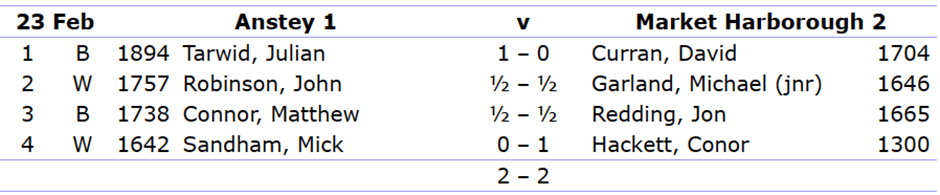
Thursday 23/02/2023. Anstey 1 welcomed their friends Market Harborough 2 to the Methodist Church Centre for this LRCA Division 2 4th vs 9th fixture. It would be fair to say that the 2 sides, both promoted from division 3 last season, had fared differently in the league so far with Anstey challenging in the play-off places and Market Harborough rooted to the bottom of the table. But anyone can beat anyone on any given night of course!

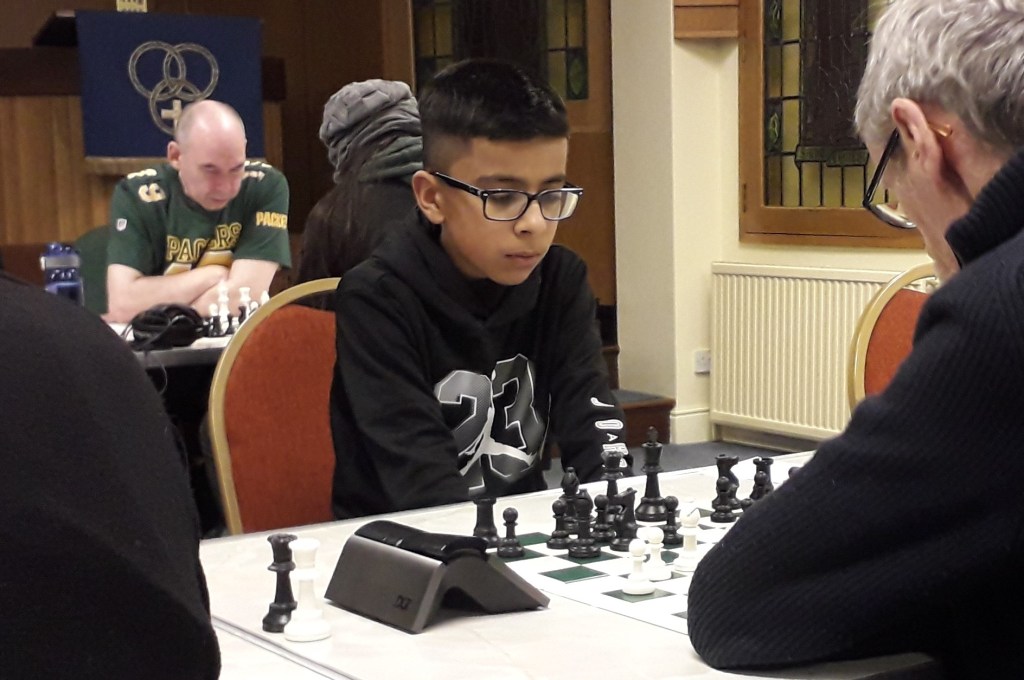
With John returning from ill health Anstey fielded their regular side against a slightly weakened (on paper) Harborough. Anstey looked to have the edge with a rating total 7,031 vs 6,315. Posing for the photoshoot the players shook hands and battle commenced.

Julian’s game against David Curran on board 1 was the first to finish. Coming out of the opening roughly level, Dave, with white, took advantage of Julian’s automatic h6 in response to Bg5 with a nice tactic to win a pawn:

Position after 8. Bg5xf6 Qd8xf6 9. Nc3xd5

With the c-pawn pinned of course. Julian got some activity for the pawn deficit and white wasn’t able to castle. Play continued with white maintaining a slight advantage (+3.5 at one point) until Julian managed to coordinate his rooks and start harassing the white king. Dave pinched another pawn but then blundered retreating his bishop to f5 and then again to g4:

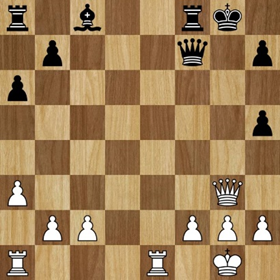
Position after 29. Bf5-g4??

Allowing mate in 3 with 29. … Bg3+. 29. Rf1 was better but black, despite still being a pawn down, would have had the edge. A slightly lucky point for Julian and Anstey. Anstey 1 – Market Harborough 0.

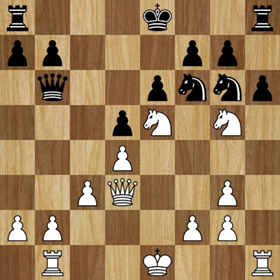
In John’s latest comeback game, he faced off against Harborough’s captain Michael Garland (Jnr) on board 2. Mike equalised easily out of the opening and had a slight edge when John made a mistake allowing a nice queen move to threaten a fork and win a pawn:

Position after 17. … Qd6-b6!

Play continued 18. Nd1 Rxc2 giving black a near winning position. After the queens and one pair of rooks came off Mike picked up white’s loose a-pawn. With black’s king coming over to the queenside to assist, John set up a final trap:

Position after 40. Na4-b2

Threatening the cheeky Nxc4+. Mike saw it and played 41. … Kc5 but after 42. Na4+ Kd6 43. Nb2 Kc5 43. Na4+ Kd6 44. Nb2 a draw by repetition was agreed. Of course, instead of moving back to d6 black should have played 42. … Kb5 and as long as he avoids 43. cxb4+ Kxa4?? 44. Ra1# he is still 2 pawns up and should be winning. So, a lucky half point for John and Anstey. Anstey 1½ – Market Harborough ½.

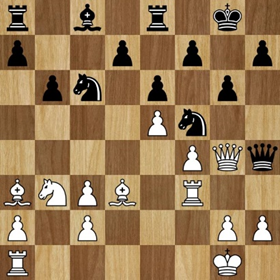
Mick played against Conor Hackett on board 4, a rematch from Market Harborough 3 vs Anstey 2 a few weeks back. That was a sharp game in which Conor triumphed, Mick was out for revenge this time with the white pieces. It was another sharp opening but Mick seemed to have it under control (witnessed by Matt on the next board when Mick said aloud that he’d play the odd-looking, un-developing but book move Bf1 on move 6…). Conor deviated from book giving Mick a +1 advantage but unfortunately a series of inaccurate moves followed and gave Conor a decisive advantage.

Position after 10. … Nc6-d4

Mick blundered with 11. Bxd4??. Play continued 11. … exd4 12. Nge4 Qe5 with a -7 advantage. Conor kept up the pressure, swapping off all the minor pieces and hassling white’s king with his major ones. He did let his foot off the gas slightly swapping his two rooks for white’s queen but with advanced pawns on a5, b4 and c3 was still in control. Mick managed to rustle up a little counterplay but ultimately his rooks weren’t coordinated enough and eventually he dropped one to a queen fork. One of those horrible games when you’re on the ropes for most of it but well played Conor. Anstey 1½ – Market Harborough 1½.

This left Matt’s game against Jon Redding on board 3. Matt slightly misplayed the opening but actually got an ok position going into the middlegame. He pushed pawns in the centre and the queenside before mistakenly swapping pawns with cxb3. White’s space advantage gave him the edge and it was easier for Jon to manoeuvre his pieces forcing Matt into defensive duties. Matt missed a couple of opportunities to make a fight of it then played a couple of inaccurate moves in time trouble. With a minute left on the clock and his position deteriorating (and Mick’s game having just finished so the match score was level) Matt cheekily offered a draw. Jon though for a couple of minutes before accepting to secure the draw for his team. Another lucky ½ point for Anstey. Anstey 2 – Market Harborough 2.

A good result for Harborough:

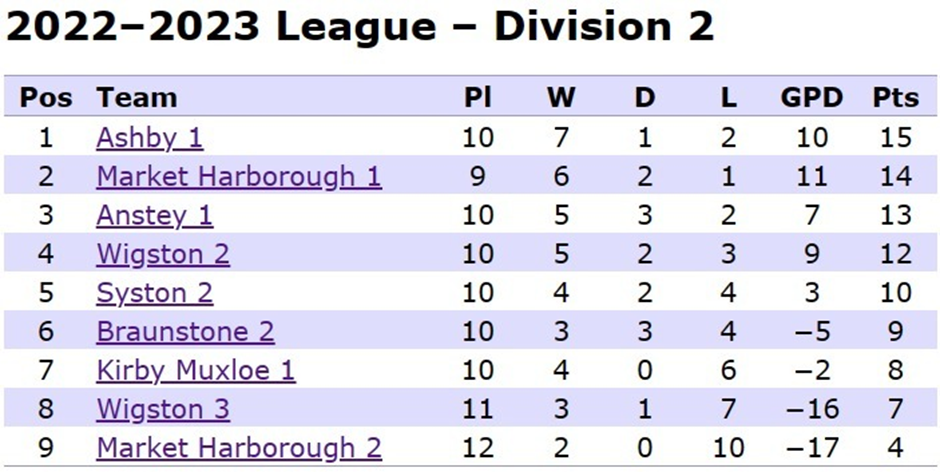
Anstey miss the chance to move back up to 3rd in the (still hotly-contested) division:

League table as at 23/02/2023

Anstey’s next game is against Wigston 3 on the 16th March.

Anstey captain Matt Connor told Woman’s Weekly:
I’m very disappointed. In my last post-match interview, I warned about complacency against the division’s bottom 2 teams and that’s exactly what’s happened tonight. Having said that we could easily have lost this one so maybe it’s a point salvaged. We still have to play the 3 teams above us so there’s still a chance in the division.

League Match: Anstey 3 vs. Melton Mowbray 3 (23rd Feb)

Photography is credited to Oskar Rudczenko

Another night; another match. This time Anstey 3 play a home match against Melton Mowbray 3, but this time we’re hoping to get a win. Last time these two teams clashed it was a draw, but hopefully that doesn’t happen tonight as Melton have to default a board which means the score is already Anstey 1 – Melton 0 before the match even starts. Already a promising start for Anstey, and morale was boosted by the presence of the Anstey team 1 players as they play at home too.

For this match, Anstey 3 have Mike Griffiths, Noor “The Prodigy” Datoo and Yuvraj “The Silent Destroyer” Sadhra. All three are good players, but all three players are significantly outmatched by at least 80 elo points and with the most being 180 points. Who will win tonight? There’s only one way to find out, it’s time for the match to start!

Board 1: Ian Farquharson plays white; Mike Griffiths plays black

The game starts with an open sicilian, as Mike’s c pawn gets traded off for Ian’s d pawn. White develops his pieces on the queenside first, where as Mike tries to get his knights out and then prepare to castle. Just before white castles black trades knights with white and then both sides castle. Ian throws his kingside pawns at Mike’s king, which Mike doesn’t take very kindly to and sacs his light bishop to try and skewer Ian’s queen and king. Unfortunately there is no skewer as white can trade dark squared bishops. White manages to push his h pawn all the way to black’s kingside, and leaves it wedged between the h7 and g6 pawns making it an annoying thorn in Mike’s side.

White threatens mate in 1, which Mike spots and blocks it with his knight also serving to recentralise the off side knight. White threatens a fork and attacks Mike’s queen which Mike swiftly avoids and offers a queen trade. White repeats moves with his knight a couple of times and black trades queens and white retakes with a rook. Quickly after this, Mike moves his rook to c8 to take the semi-open c file, but white’s light bishop is monitoring the c8 square, which white promptly takes. Mike still has the c file, but is down a rook. Mike tries to win a pawn with his knight, but white offers a rook trade forcing to make Mike take or risk losing pawns. Mike resigns, which puts the score on equal terms.

Anstey 1 – Melton 1.

Board 2: Noor “The Prodigy” Datoo plays white; Peter Smith plays black

The game starts as an exchange philidor defence, where Noor retakes with the queen instead of the knight. Black of course develops his knight to c6, but Noor pins the knight with his light squared bishop. After black defends the pin Noor trades his bishop for the knight. Noor finishes his development and castles queenside. Peter shoves his c pawn into Noor’s face to attack the white queen, but Noor simply wipes it off by retreating his queen. Noor then presses the attack with e5, which forces black to take and offer a queen trade as Noor as a dangerous queen and rook battery all the way down the open d file.

Instead of trading queens, Noor moves his queen to the e file in front of his other rook, and black moves his to a5, which allows Noor to release a devastating and disgusting tactic of playing knight takes f7. Black cannot retake with his king otherwise he’ll lose both bishops, but he can’t retake with his light bishop otherwise it’s mate, so the only other move he can play is castles kingside. This minimises the damage a little as this is only a trade of a knight and bishop, but white is winning by a landslide. The computer thinks Noor’s current position is +13 in Noor’s favour. Although, there was a way Noor could try to win the bishop, which was to play knight to h6 check, which does still hang the knight, but if Peter takes it with his g pawn he opens up his king leading to a very dangerous attack against the black king.

The game continues with black pressing his pawns forward on the queenside, and Noor gathering his minor pieces around black’s king. Noor begins by trading his knights and then trading dark squared bishops, whilst black continues his pawn storm on the queenside. At this point, black doesn’t seem to care and is just allowing Noor to smash black off the board. Noor now uses his rooks to check the black king, and tries to create a mating net which Noor successfully does. After a rook trade, black continues his attack on the queenside, and at this point it’s now mate in 7, which Noor does find! Noor bring his other rook to the fifth rank, and one final blunder from black where he plays f5 and bring the position from mate it 7 to mate in 2. Noor finds it again, and black resigns. A very impressive performance from an already impressive player! Well done Noor!

Anstey 2 – Melton 1

Board 3: Steve Martin plays white; Yuvraj “The Silent Destroyer” Sadhra plays black

The game starts as a giuoco piano game, with Yuvraj’s dark squared bishop getting attacked by a couple of pawns before landing on b6. A move later white’s kingside knight goes back to it’s home square, which allows Yuvraj to threaten mate in one with queen to h4. Steve plays e2 and Yuvraj attacks the white queen with bishop to g4 and white responds by blocking the attack and attacking the black queen with knight back to f3. Yuvraj retreats his queen and trades his bishop for the knight and then trading queens to damage white’s kingside pawns structure. Although, white uses the double pawns to double pawn break through black’s centre on e5.

White continues to apply small amounts of pressure to black’s position, but finally Yuvraj manages to castle. Yuvraj centralises his queenside knight onto d5 with a check, so white moves his king to d2, which blunders a knight fork on b3. Yuvraj is now up an exchange which is a good improvement to his position. Yuvraj then goes after the lonely h pawn, but when white centralises his knight, Yuvraj tries to force a trade by checking the white king and attacking the central white knight. White’s king side steps the check and Yuvraj takes the white knight, allowing white to gain a protected past pawn.

Yuvraj then offers a bishop trade, but then white checks the black king and attacks a black rook. However, Yuvraj makes a fancy move by moving the other rook to c8 which offers a rook trade no matter how white takes. White refuses the trade and moves his rook, but this allows for Yuvraj to advance his rook with tempo on the white king. Yuvraj now moves his rook, but white makes another attack by threatening to win a pawn. Yuvraj doesn’t have to move his king to defend, but he does and he moves the wrong way, it’s now mate in 2 for white!

White takes the pawn with the rook, Yuvraj only has one move, but white doesn’t find the mating move! Instead of playing bishop to e7 check he plays rook to d7 check trying to find a discovered check on the black king to win some material. The discovered attack doesn’t quite work for white, as black can move the king to defend, but only now does white play bishop to e7 check and white loses a rook for free! White resigns and Yuvraj wins by the skin of his teeth! A bit of luck is all a chess player needs sometimes.

Anstey 3 – Melton 1.

Final Words

Finally Anstey 3 get another win! Which means we’re now in 5th place on the leaderboard rather than 6th! Well done to all the players of the third Anstey team for this great result! The next match we’ll be playing is on the 16th of March and we’ll be playing against Ashby 4, which is the top team in the league by 4 points, which is a huge margin. Not sure how we’ll do in that match, but we have been drawing a lot of teams, we have even drawn against the current second and third team (Loughborough 3 and Braunstone 3). We did have a close game the last time we played against Ashby 4 too, so who knows what will happen on the 16th.

Anyway, see you all after the 16th! I’m sure there’ll be some good games had not matter what happens, Ashby are always a good team to play against.

Important away win for Anstey 2 as they continue their hunt for the top spot in Division 3

Following a disappointing result in the reverse fixture, a determined El Presidente secured the win for his team

Last Thursday (16/02/2023) our second team travelled to Ashby for their away game against the hosts’ second team. A strong team on the night was elected by El Presidente Ben, who was joined by Brian The Griller, Boris The Toaster and the super-sub Just Mick. After a request from the home team to arrive slightly earlier in order to avoid disturbing the snooker players, The B-team was ready and set for their games at 19:25, waiting for the home team to take their places. The Ashby team was on paper (admittedly, based on September ratings) equal to our own Anstey 2, with average ratings of 1665 to 1660 in favour of the home team. The rating equality showcased itself over the board as well, with three games finishing with a draw on the night, but the valiant efforts of our chairman El Presidente secured our team the win on the night.

Brian The Griller Foreman (Anstey) vs Christopher Tipper (Ashby) 0.5 – 0.5

Our regular top board Brian The Griller was scheduled to play the solid Christopher Tipper who he drew in the reverse fixture. The home team captain played the Dutch against our teammate’s d4 which The Griller attacked with the Staunton gambit. Both players took their knights out to challenge the centre and Brian threw another pawn in the battle for the centre, exchanging it for Black’s e5-pawn. The pair of light-squared bishops left the board to hit the chess pieces’ pub and the players continued the battle for the centre. Brian’s knights put significant pressure on Black’s doubled isolated pawns on the e-file which his opponent tried to ease by opening the d-file and exchanging queens. After eleven moves of knight and pawn battle, the players found themselves in a completely drawn position (literally 0.0 engine evaluation based on Stockfish 15, depth = 20, powered by chess.com) when The Griller decided to castle kingside (K-side). Both players finally decided to start developing their armies with the Ashby player castling queenside (Q-side), and with the open central files and still plenty of pieces on the board along with opposite side castling, it looked like there will be fireworks on board one, albeit in a drawn position based on the engine evaluation. Surprisingly, Brian decided to offer his opponent a draw and being the captain of his team, the Ashby player went to check the other boards. With the second board players already agreed the draw and gone through the game analysis, he was not satisfied with the match situation and decided to think about it, only to eventually succumb to the pressure and accepting the half point.

Although it was a shame to stop the game at a dynamic point after only 15 moves have been played, brilliant strategy was showcased from The Griller which eventually paid off.

Paul Gibson (Ahsby) vs Borislav The Toaster Lazarov (Anstey) 0.5 – 0.5

Although Boris The Toaster found himself in the same team as Just Mick, the close rating between the two players granted the latter the opportunity to get the white pieces only for the third time this season. And in all fairness, there was fire on board 3 throughout their game which will be discussed below, but in a nutshell Boris was scheduled to play on his regular spot on board 2. The website maintenance guy was facing again Paul Gibson in a rematch from the reverse fixture. The Ashby player opened with the king’s pawn which was met by Boris with his regular Caro-Kann defence. White engaged in the Exchange variation and played an early Bf4 which was followed by normal development from both players, following book lines until move 9 when the Ashby player decided to retreat his dark-squared bishop to g3 following an exchange offer. Our teammate took the bait and doubled his opponent’s pawns on the g-file, and after a quick “engine move” a6 and White castling K-side, The Toaster played a rather dubious b5 instead of tucking his king to safety with 0-0 (K-side castling). White hurried to occupy e5 with his knight which led to the light-squared bishops shaking hands and leaving the board, followed by a pair of knights. Looking to quickly equalise (completely oblivious of the fact that he already had secured a slight advantage a few moves earlier before the dubious b5), Boris offered an exchange of queens. White instead attacked the black g-pawn, and with the open f-file and the threat against the f6-knight in cases of short castling or the rook protecting the pawn, The Toaster’s only good move was to move his king to f8, which surprisingly he found. Our teammate followed with another best move to kick the queen away, and then gave his opponent a 1.9 advantage with equal material with a weird-looking Ke7. Fortunately for Boris, his opponent never looked on the queenside to activate his knight and pawns, and instead shuffled his major pieces, trying to create double and triple batteries on both the e- and f-files. The Toaster brought his major pieces to the party and held the fort throughout a shuffling sequence of four moves for each player, with our teammate offering a draw (still at +1.9 evaluation) which was refused with the words “Too early”. On move 24, White finally decided to bring his knight to b3, aiming at rerouting it to c5, only to face an exchange offer with Nd7 from Black. The Ashby player decided to exchange the knights, losing a fair chunk of his advantage based on the engine evaluation. With White trying to challenge the black pawns on the open files, it took four moves until the evaluation was complete equality, and after a couple more moves, at evaluation of 0.0 the Ashby player said “I would take that draw if it is still on offer” and the players shook hands.

A solid draw for our teammate who managed to escape a defeat with some timely play.

Just Mick Sandham (Anstey) vs Lawrence Hayden (Ashby) 0.5 – 0.5

Super-sub Just Mick was scheduled to play the solid Lawrence Hayden whom Ben drew in the reverse fixture. Unlike the top boards, Mick and his opponent engaged in a sharp battle, which was so intense, the board 4 players spent considerable time spectating. Our teammate’s e4 was met by the Petrov’s defence, led down the Four Knights game road and taken onto the Scotch route by the Anstey player. Black snatched the d-pawn, probably expecting from Mick to take back with his c3-knight, but the Anstey Tiger threw in his surprise weapon – the Belgrade Gambit. Looking at the sharp position on the board, the Ashby player mumbled that he has no idea what to do in this position, to which Just Mick graciously replied that he is completely lost and both players had a short chuckle, joined by their neighbours on board 4. (The Toaster probably would have laughed too, but he was busy trying to survive his opponent’s attack) Black brought his knight to b4, challenging the strong white d5-equivalent in the hope that Mick will take it and give Black the opportunity to develop his dark-squared bishop. Our teammate took the black d4-pawn instead and after a series of exchanges, two knights left for the stables and Just Mick emerged a pawn down. Although the engine evaluation slightly favoured Black early in the opening, Mick played energetically and started pointing all sorts of pieces towards the opposing king, developing his dark-squared bishop and queen quickly, and castling Q-side with the idea to start his typical K-side attack. Black managed to “park the bus” and stay solid, deterring the white pieces from storming just yet. Just Mick slowed down just for a second, playing h3 instead of the recommended by the engine h4, giving again slight advantage for Black based on engine evaluation, after which the Ashby player managed to ease up the pressure slightly by exchanging the second pair of knights. This gave our teammate the opportunity to gain a tempo against Black’s light-squared bishop, followed by a queen swing to the Q-side, looking to infiltrate the back ranks of Black’s position. The Ashby player looked to activate his bishops which were aiming at the white king from their long diagonals and pushed f5, giving our teammate a slight advantage (still a pawn down), but Mick missed the opportunity to either bring his light-squared bishop to the party or open the position in front of the white king, and instead pushed his g-pawn, giving back the advantage to Black. Nevertheless, the energetic play from our teammate had his opponent on the back foot, and Black tried to exchange queens and ease up the tension. Unfortunately, in the crucial position Just Mick missed two interesting ideas – pushing a4 to control b5 (preferred by the engine) and continuing the K-side expansion with h4. Instead, Mick played his rook back to d1, X-raying the black queen, but easing the pressure exerted on the black light-squared bishop. This gave Black the opportunity to push his d-pawn and bring his queen to the party, eyeing now the fort in front of the white king with all his diagonal controlling pieces. Our teammate tried to shuffle his queen out of danger on an active square, threatening infiltration on the Q-side, but with a few pawn pushes the Ashby player cleared out the danger on the Q-side, gaining a crucial tempo in the process to pick up the white rook on h1. Just Mick finally developed his light-squared bishop on c4, hitting the black equivalent on e6, and the black queen on h1. There was only one good move for Black – Qb7 which would have given him a -7.7 advantage, but low on time the Ashby player did not find it and instead took the second white rook on d1, followed by a bishop exchange on c4, ending in a +1.3 position for our teammate. With both clocks running down, the players were moving quickly, and Mick missed the crucial pawn push b4, challenging the Q-side pawn structure to open lines for the powerful white queen, and instead gave his opponent a tempo to bring the black a8-rook into play. At the end, in a -0.8 position, two points of material down, and hearing that about 0.87 seconds earlier Ben had won, our teammate offered the draw. His opponent thought of taking is straight away with about 3 minutes left to play (quite tricky when you have a queen vs two rooks on the board), but the home team captain reminded him that this would mean a loss for Ashby. There was a short discussion between the two of them, and eventually the Ashby player took the draw.

Another spectacular game from Just Mick, who is looking very sharp over the board these days. And the author must admit, games like this and the following one are what brings him joy when doing the reports.

Les Fancourt (Ashby) vs El Presidente Ben Vaughan (Anstey) 0 – 1

The bottom board game was El Presidente Ben against Les Fancourt. Our chairman was looking to get a revenge for the loss in the reverse fixture and it is fair to say that he did just that in a splendid manner. Our captain met the 1.e4 from his opponent with his characteristic French (used to be, now he plays the Scandinavian). The players engaged in the Advanced variation, with our teammate challenging the centre immediately and bringing his b8-knight into the action. His opponent played the Paulsen attack with Nf3, and El Presidente replied with Bd7, leading the game into the Euwe variation, easily equalising, albeit with less space. The players continued their development with Bd3 and Qb6, and after White took on c5, giving Ben the opportunity to develop his dark-squared bishop with a tempo, the Ashby player castled K-side. Our captain on the night immediately put pressure on the lonely e5 pawn which had to be supported by a rook move. White looked to create counterplay by expanding on the Q-side, but El Presidente’s “engine move” a6 stopped the expansion before it went too far into Black’s territory. The players focused again on the central battle, with the white dark-squared bishop and black e7 knight joining the party, when Ben decided that his king needs to be moved somewhere safe and also castled K-side. Finding himself with almost a +1 advantage at the end of the opening/beginning of the middlegame, White developed his last minor piece with Na3 in an attempt to continue his expansion on the Q-side. Our teammate shuffled his pieces and created a battery on the c-file, while White continued to push his Q-side pawns, losing his advantage and gaining it again in a matter of a couple of moves. The white c-pawn kept marching down the board in an attempt to restrict the black dark-squared bishop, but our teammate created a nice battery on the b8-h2 diagonal, hitting the still lonely and weak white e5-pawn. Instead of going after full expansion with the engine recommendation h4, White decided to push his b-pawn and the battle on the Q-side started. El Presidente wisely decided to bring his e7-knight back to the queenside with a timely Nc6, blocking the white light-squared bishop and leaving his opponent with a close to terrible pawn structure, with weak e-pawn and isolated a- and c-pawns. Looking a little flustered by the great manoeuvring skills from the Anstey captain, the Ashby player blundered his a-pawn and gave our teammate a -1.4 advantage after the dark-squared bishop picked up the pawn with a tempo. on the e1-rook. Unfortunately, Ben lost a fair chunk of his advantage after he brought his bishop back, although he himself knew that Bb4 is the correct move (which was reflected on his scoresheet where he wrote “Bb4?”). The players shuffled rooks and queens in a four-move sequence where El Presidente had two opportunities to pick up the e5-pawn, but none were executed. Eventually, the pressure on the Q-side proved to be too great for the player with the white pieces, and he exchanged his light squared bishop for one of the black knights, giving our teammate a -1.4 advantage, with White being down a pawn, and having two big weaknesses on c5 and e5. Ben immediately attacked the c5-pawn and in an attempt to defend it, his opponent blundered the exchange by lining up his queen and rook on the d1-a4 diagonal, waiting for the black light-squared bishop to attack them, but our captain saw what he described as “ghosts from Qxb7” which otherwise led to a queen exchange, followed by Bxc2 Nxc2, leaving Black in a winning position at -4.6 evaluation. Instead, El Presidente attacked the a3-knight with a queen-led battery, which his opponent defended with Rc3, only to be hit by the top engine move d4, followed by Be4, restricting the d3-rook’s ability to defend the knight and X-raying the second white rook on b1. Seeing that the exchange is lost, White attacked the black queen with his knight, losing the c5-pawn, exchanging the knight for the black dark-squared bishop, and losing the exchange in a resulting position, evaluated at -7.0 by the engine with Black up four points of material. Naturally, our teammate immediately offered a queen exchange which was naturally declined, only to be seconded by a forced rook exchange on the weak back rank. The rooks were swapped off and Ben mercilessly started pushing his d-pawn towards d1, supported by his queen and rook. With the white minor pieces paralysed on f3 and g3 since move 13 (currently at move 36), the white queen tried its best to contain the pawn, but it was too little, too late. White shuffled his queen on the first rank, but eventually sacrificed the knight for the d-pawn, moving the minor piece for only the second time that evening. Finding himself with a bishop, a queen and four pawns against the overwhelming combination of a queen, a rook, a knight and five pawns (one of them a passed pawn), the Ashby player threw the towel.

Another excellent performance from our chairman, who is having a great season so far and deservedly occupies the second place in the Anstey performance rankings.

A happy team left the venue shortly after 10pm and headed to the team buses. After this result, Anstey 2 find themselves on third position in Division 3 of the Leicestershire Chess League. In their next fixture, the team will be playing against the leaders Loughborough 2 who are flying high with their youthful talented team, but after a narrow loss in the reverse fixture, the B-team will be looking to get another win under their belt.

League Match: Loughborough 3 vs. Anstey 3 (8th Feb 2023)

Playing Loughborough yet again with a similar team, as last time we had Noor, Mike and myself playing against Loughborough. This time we’ve got Yuvraj and Bob playing with myself, Mike and Noor. Not much of an eventful start. The venue for the Loughborough club normally opens at about 7:30pm, so there’s a bit of a rush to get all the boards set up. Once everything is set up, it’s time to start playing!

Photo credited to Noor’s dad, which was taken just after the games started.

Board 1: Bob Grindrod plays white; Ben Carpenter-Friend plays black

The game starts with what looks to be a kings indian defence at first, but then black plays d5 on his third move, which turns this into a grunfeld defence. Bob plays this like a queen’s gambit with connected d and e pawns with a c pawn attacking black’s centre. Although, the game starts to get zesty as black plays c5 counter attacking white’s d pawn. A couple of trades occur and black moves his queen to a5 to retake on c5. Bob mis calculates the position and plays e4, which falls into black’s favour as Ben takes on e4 with his knight. Bob’s knight is pinned to his queen by the black queen. To try to counter this Bob attacks Ben’s queen, but Ben goes down a forcing line with exchanges the queens off the board, but leaves black up two pawns.

Bob does manage to castle and develop his bishops, but they are stuck on the edge of the board not really doing a lot. Black starts advancing his pawns on the queen side and Bob tries to create counter play for himself, but black shuts this down and locks the queenside for a few moves before black rotates his knight to force Bob to move his light bishop and forcing a Bob to trade his bishop for a knight. In an open position with no bishops is quite bad for white, as black still has a bishop, which are regarded as snipers of the chess board. A couple of moves later a Bob blunders a bishop skewer of his knight and rook. Bob chooses to keep his knight alive and take two pawns in exchange for the rook, but Bob throws in the towel as black forces a rook trade, which would leave Bob in a rookless end game with a knight against black’s bishop and rook.

Loughborough 1 – Anstey 0. Bob not having a good streak of games over the last month, but with losses comes experience and knowledge. I’m sure there’s a win somewhere down the line for Bob.

Board 2: Peter Hickman plays white; Mike Griffiths plays black

The game starts off with d4 d5 and e3 e6 with some piece development on both sides. White ends up with a stone wall kind of set up with f4 being played and Mike ends up with a queens gambit set up that would normally occur when playing white. A few moves later Peter has castled and Mike trades his c pawn and develops his dark bishop. Mikes also castles and white plants his knight on e5 with the support of his f and d pawns. Whilst Mike reroutes his knights Peter starts throwing his kingside pawns towards Mike’s king, which is quite weakening but it is a fairly closed position so there is a chance that white’s king is fairly safe. Mike trades knights and white ends up with connect 4. Mike then hits the head of the pawn link with f6 and trades the pawns off, then Mike trades the knights off and further improves his position before starting to make trades with white.

Firstly, Mike trades the dark bishops, then he chooses to trade off one of his rooks and then Mike brings his last rook into the fight. Peter decides to trade the last of the rooks off the board and offers a queen trade, which Mike doesn’t mind but he plays g5 first. After this both players agree to a draw.

Loughborough 1 1/2 – Anstey 0 1/2. Mike does seem to like his draws.

Board 3: Noor “The Prodigy” Datoo plays white; Keir Hayden plays black

The game starts as an italian with black developing both his knights, then Noor develops his queenside knight but black executes the centre fork trick, which means black took Noor’s only centre pawn, Noor retook with a knight and black played d5 to fork the c4 bishop and knight on e4. Noor takes the d5 pawn with his bishop and retreats his knight to c3 which attacks the now advanced black queen. Keir retreats his queen and plays bishop g4, which pins Noor’s knight to his queen. Black castles queenside, Noor develops his last minor piece and Noor captures black’s advanced knight on d5, which offers a queen trade. Black doesn’t refuse this offer, but takes one of white’s knights instead and then takes white’s queen.

The game continues with both players dancing black’s light bishop with white’s knight across the queenside. Black develops his last minor piece and Noor castles. Noor starts to march his queenside pawns towards black’s king, but Keir stops this by counter attacking Noor’s pawns and Noor engages in a pawn trade. Noor also offers a dark bishop trade which black does accept, and protects his b pawn with his black rook. Noor attempts to double rooks but black refuses to let this happen and advances his b pawn to attack white’s knight. Noor moves his knight back but Keir keeps advancing his pawn right in front of Noor’s rook. Noor simply places his knight back to c3 and continues to double rooks.

Black tries to counter attack Noor’s protected e pawn, but Noor simply captures black’s over-extended b pawn and captures the other pawn with check. Black advances his other rook into Noor’s position and pins the white knight to the only white rook. Noor tries to advance his kingside pawns, but black pushes in the centre. Although, his opens up a rook trade for Noor as he moves his knight and both rooks stare at each other, but if black takes the white rook Noor can fork the rook and king. Quite the fancy manoeuvre, but this is in black’s favour as the computer says it’s -4 for Keir. However, black takes the wrong way and ends up trading a rook for a knight, so if black traded rooks he would’ve been winning as he would have a past pawn. This version of the game doesn’t allow black a past pawn, and Noor is now winning with +2.6 as the computer evaluation. At this point, Keir cheekily offered Noor a draw, which Noor instantly declined.

In the next few moves, Noor simply advanced his rook to the black side and started cutting down black’s pawns with check, and once he did that he aimed his rook at the black bishop which was defending a pawn that stopped Noor’s c5 pawn from queening. There wasn’t much that black could do, as Noor advanced his passed g pawn and black could not stop both pawns from queening. Noor sacrificed his rook for the bishop and pushed his c pawn, and all black could do was resign.

Loughborough 1 1/2 – Anstey 1 1/2!

Board 4: Michael Bordiak plays white; Yuvraj “The Silent Destroyer” Sadhra plays black

The game starts with white playing the london system, and Yuvraj plays symmetrically and a mirrored position occurs on the board on move 6, but on move 7 white plays h4 and Yuvraj plays queen to a5. Michael develops his queen to the queenside as well, and both players trade a pawn and a piece. Black then puts more pressure on white’s pinned knight, which white deals with by castling. Yuvraj takes the c3 knight and again on c3 as white retakes with his queen. Black castles and white trades pawns and Yuvraj retakes with his knight. Both players continue to develop their pieces and improve upon their positions, but suddenly Yuvraj takes white’s weak c pawn and it’s sufficiently protected. Yuvraj mistakenly took on c3 and is now down a piece!

Black continues to gently improve his position and double rooks on the open c file, which white occupies with one rook. This plays into quite the plot twist as white moves his king to f2, which blunders a rook! What on earth is going on?! Such a crazy start to the game. The computer is taking a rollercoaster ride by evaluating the position as +4 for white only a few moves ago, but now it’s -4 for Yuvraj!

Afterwards, the game continues with Yuvraj’s rook getting behind enemy lines and assisting black pawn marches down the kingside. White tries to harass the black rook with his bishops (white’s only remaining pieces), but Yuvraj simply moves his rook out the way and into a safe spot. White tries to create some play on the kingside too, but it falls flat when black counters the counterplay. White tries to attack with his king, but black uses his king to solidify the position and white struggles to defend against black’s free resigning rook. After a bit of “pawn grabbing” Yuvraj now has two passers on the queenside, and white can try to hold off the avalanching pawns but eventually Michael will have to sacrifice his bishop and black will be completely winning.

The game finishes just as white tries to stop the a pawn from promoting and black pins the white bishop to white’s king. Michael resigns leaving Yuvraj the silent victor of the game.

Loughborough 1 1/2 – Anstey 2 1/2!

Board 5: Oskar Rudczenko plays white; Stuart Gordon plays black

The game starts off as a closed sicilian with both players developing their knights and white pinning black’s knight to his queen. Black then plays queen to a5 which dodges the pin and pins one of white’s knights. A big trade then occurs in the middle of the board where Oskar sacrifices a knight in exchange for another one of black’s knight and as the dust settles white’s queen is on d4 and black has no g pawn and doubled f pawns. Black shoos white’s queen away from the centre and white tries to castle queenside. Luckily, before castling, black plays bishop h6 which would have skewered the white king and queen, so Oskar simply moves his queen out the way and attempts to castle kingside instead. Stuart struggles to know what to do and tries to lift his rook up and fianchetto his light bishop to castle queenside.

At this point, Oskar missed that he could’ve trapped black’s queen with b4, and only sees it after he grabs a pawn, but the computer evaluates that Oskar is winning by +3.5. Stuart sees that his queen can be trapped and moves the queen out into fresher air before castling queenside. However, Oskar mounts up the pressure as he doubles his queen and rook on the d file targeting black’s backward d pawn. Black defends well, but Oskar keeps going forwards with b4 and knight to d5 with check. Stuart tries to poke at the white position, but Oskar defends well himself and black trades off the powerful knight helping Oskar to make connect four on the queenside.

Stuart tries to break up the connect four with b5, but Oskar gladly takes the pawn as this opens the c file for his rooks and queen. The computer evaluation is now +6.5. Oskar brings his rooks and queen to the c file immediately and makes alekhine’s gun, which is where the queen teams up with both rooks on one file of the board. Black tries to make counter play, but Oskar wins black’s bishop, so now black has a queen and a rook vs a rook, bishop and queen. It is +10! Black starts to grab pawns and tries to make counter play. Oskar makes room for his king and sets up a trap to win black’s queen, but Oskar doesn’t realise his rook hangs, and now the evaluation goes from +63 to -5. Oskar tries to stay in the game, but there’s not much he can do as black threatens checkmate, and the only thing Oskar can do is sacrifice his queen to avoid the checkmate. A devastating blunder; one that Oskar will feel for a while.

Loughborough 2 1/2 – Anstey 2 1/2; the final result is a draw.

Final Words

It’s another draw for Anstey 3, which is not what we’re looking for but it is not a loss at least. At the moment the third Anstey team are still in the middle of the div four league table in 6th place out of 9, which is not too bad still as a couple of wins will get us in the upper half of the leaderboard and possibly in the top 3 of the division! All I can say for my team is it’s been a good hustle so far and we can make it into the top half of the division! I believe that we have the potential as players and as a team!

The next match Anstey 3 have will be against Melton Mowbray 3 on the 23rd February and Melton are in last place of division four, so we can beat them! We have 6 matches left and 4 of those are against teams in the bottom half of the division, so the future looks promising for the third Anstey team!

See you all after the 23rd, and thanks very much for reading!

Anstey 1 Conquer Kirby to Return to Winning Ways


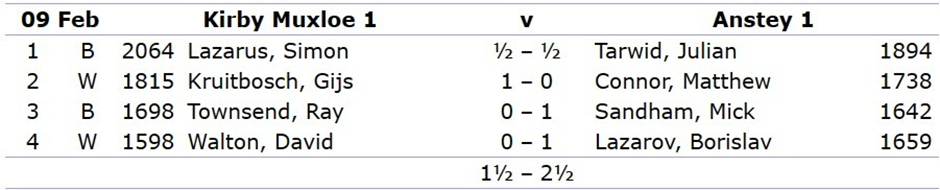
Thursday 09/02/2023. Anstey 1 made the long, arduous journey to the bowls club in Kirby Muxloe for this LRCA Division 2 fixture against friendly rivals Kirby Muxloe 1 (although one town’s very like another when your head’s down over your pieces, brother). Without the services of John Robinson due to ill health (we wish you all the best John), super-sub Boris Lazarov was once again called-up.

As the venue very slowly began to warm up, the captains exchanged team sheets. With the teams evenly matched on paper (7,175 vs 6,933) it was going to be a close contest. The players shook hands and battle commenced.

Mick Sandham’s game against Ray Townsend on board 3 was the first to finish. In a repeat of the reverse fixture Mick was hoping to do the double over Ray. Coming out of the opening with more space and a lead in development, Mick brought his queen into the game and starting probing black’s defence to make weaknesses. Ray brought his queen over to defend and to try an exchange of queens but was so focused on it he dropped a piece, oops.

Position after 16. … Qd8-h4??

Which fails to 19. Bxf5 of course. Ray carried on blitzing out moves to try and rattle Mick and create some counterplay on the queenside. Mick calmly ignored it, kept the pressure up on the kingside and then set a nice discovered attack trap to win black’s rook for a knight. A rook down, Ray resigned. Kirby 0 – Anstey 1.

Boris played Dave Walker on board 4. In what can only be described as a masterclass of handling the black pieces (91.2% accuracy), Boris calmly defended Dave’s attack and lured him into a tactical mistake:

Position after 15. Nf3-e5?

Black’s h-pawn had been pinned for a couple of moves, Dave missed that 14. .. Ne7-g6 defended the pin. Play continued 15. … hxg5 16. Rxh8 Nxh8 and a piece up Boris proceeded to swap off the remaining white pieces and picked up an extra pawn in the process. In a hopeless position Dave resigned. Kirby 0 – Anstey 2.

In another re-match from the reverse fixture Julian Tarwid played Simon Lazarus on board 1. Coming out of the opening the position was fairly even but with Julian (as white) play more attackingly (is that a word?). Simon made a couple of mistakes but Julian didn’t take advantage, making a few mistakes his own. Julian sacrificed a piece for 2 pawns and an exposed black king but Simon defended well. In the end after a few queen checks from white a draw was agreed even though black appeared to stand better despite his dodgy pair of h-pawns:

Final position after 24 Qb3-g3+

The draw was sufficient to secure match victory so well done Julian. Kirby ½ – Anstey 2½.

Matt Connor’s game again Gijs Kruitbosch on board 4 was the last to finish. Matt had told the team going into the match that the game plan was to win with white and draw with black. Unfortunately, he took that a little too much to heart, opting for a really passive setup from the opening. This allowed Gijs as white to freely develop and slowly build up pressure. In an effort to get some play Matt expanded on the queenside but missed the opportunity to try and open files. White’s knights then got in behind the pawns and black was squeezed hard, really hard. As time ran short Matt missed a move that would have kept the defence up for longer but then blundered in time trouble giving Gijs the deserved win. Kirby 1½ – Anstey 2½.

Anstey move up to third in the (still hotly-contested) division:

Anstey’s next game is against Market Harborough 2 on the 23rd February, a game in which they cannot afford to drop any points to keep their title aspirations alive.

Anstey captain Matt Connor told Inside Bowls:
I’m very disappointed with my personal performance after contemplating a much more combative line but a massive shout out to Mick and Boris whose wins brought home the bacon. With 6 games to go there is still all to play for! We just need to make sure we don’t slip up against the bottom 2 teams and we’ll be in the mix come crunch time.

Anstey 2 scrape through against under-strength Market Harborough 3rd team

Wednesday 1st February

Anstey’s 2nd team were involved in their first game for nearly a month as they made the long haul trip over to MH to face their 3rd team, El Presidente had selected a bit of a makeshift team, albeit a good team as making the trip over to MH was The Griller, Just Mick, El Presidente and The Prodigy. Boris the Toaster, Mike and Daddy Valdas were all unavailable for selection so Just Mick stepped in, along with Noor.

On arrival, we were let into the venue by Robert Mills – one of the nicest guys on the chess scene in the County who was only too happy to play doorman. We met up upstairs in the room, with MH3’s skipper Rene Butler (another sound guy) announcing that the MH team were understrength for the evening and that El Presidente would be facing him in the battle of the skippers. Indeed Anstey did heavily out grade MH on paper – we all know that the game isn’t played on paper.

Board 1

(B) Ron Cooper (1518) v The Griller

The Griller on board 1 was facing up against Ron Cooper who, according to Rene, has ties to Northamptonshire chess and was helping MH3 out on this occasion. Regretfully, I do not have any notation from the game – maybe I can add this at a later date. All that I did see was that towards the end of the game The Griller had 3 pawns advancing to the first rank, backed up by a Rook and well placed Bishop, defended only by a Rook and Knight which eventually led to Ron buckling and throwing in the towel.

Board 2

(W) Conor Hackett (E1300) v Just Mick

Just Mick on board 2 was facing off against young Conor Hackett – a face that I have never seen before. Mick had the black pieces, which I am reliably informed he does not get black very often!? The game was incredibly sharp with Mick applying his favoured opening and young Conor really took Mick on, advancing his pawns to try and break up Mick’s structure. This led to Knight sac on f7, enforcing a fawn pork, gaining back the piece. Fireworks followed in the middle game with pieces being exchanged and Conor was lucky that an Ne4 move followed by Qd4+, hitting King and Knight, could be met with Nf2, blocking the check and not losing the piece.
What followed was a couple of inaccuracies from Just Mick, which allowed a crucial move Ng5, hitting Queen and Rook and thus led to material loss. What followed was a lost endgame for Just Mick and he resigned in a lost position.

Board 3

(B) Rene Butler (1294) v El Presidente

El Presidente and Rene faced off in the battle of the skippers on board 3. Many an online game had been played between the two, particularly in friendlies during lockdown and after. The game was a Sicilian Najdorf and El Presidente employed his favourite attack against it but slightly mixed up the move order. Rene played very well out of the opening and even picked up a crucial e-pawn. Rene had a choice between material and practical gain and went for material which post game hindsight might have been inaccurate. Rene looked to consolidate and later in the game played the inexplicable Ke7 (post game chat revealed that e7 was the wrong square – perhaps a mouse slip!), which allowed El Presidente the chance to attack the cramped position. Rene offered a draw after Qb6+ and after El Presidente had considered the other boards, was declined – for now. El Presidente centralised Rooks and spent around 15 minutes calculating Rxe5 when perhaps Bxf6 was cleaner and better – even more so after Rxe5 Kd7 was played.
Having spent so much time on Rxe5, El Presidente had no time to find the correct moves after and with Rene declaring that the ‘draw offer was still open’, this was taken with El Presidente down to 3 minutes on the clock.

Board 4

(W) Robert Mills (1338) v The Prodigy

Again, your report author hasn’t seen much of the game but having had sight of the scoresheet, the game took a Queen’s Gambit declined, Marshall defence. Unfortunately, the Prodigy played a move order inaccuracy which lost The Prodigy a piece and a significant advantage for his opponent. There is a slight notation error mid-way through the game but at this point, Noor is +8 down – practically speaking it doesn’t look that bad, albeit black is a piece down. What I saw was The Prodigy was still losing but the Bishop and Rook of White were trying to contain the centralised connected passed pawns of The Prodigy – far from easy. The game concluded with the Bishop being given up for the two pawns and instead of advancing his own a+b pawns, Robert walked into a checkmate in one on the h file.

El Presidente told British Chess Magazine:

“Credit to MH, they fought very hard – epitomised by their captain – and it was a tough game. Very happy to come away with the match win for the team and the two points against a team in the top 3”.

League Match: Braunstone 3 vs. Anstey 3 (25th Jan 2023)

Credit to Oskar “OskarRud” Rudczenko and Borislav “Bobideco” Lazarov for writing this report.

Our second match against the third Braunstone team. Braunstone do have quite high rated players, but some of our players are quite under-rated so it might just be an equal match. Anstey had Bob Grindrod, Leo Abraham, Noor Datoo, Yuvraj Sadhra and Oskar Rudczenko for this away match. Anstey got to the venue and mostly were ready to play by the time the Braunstone team got to the venue, which had happened last season we played against them. At least the venue was quite warm, and the games played were certainly of good quality.

With everyone ready and set to go, we’ve got Bob on the first board.

(Photo credited to Noor Datoo’s dad. Taken just after the games start.)

Board 1: Bob Grindrod plays white; Martin Steel plays black

Bob was scheduled to play with the white pieces 20 points higher rated Martin Steel from the home team. Our teammate’s Queen’s Gambit (yes, like in the series, go and check them out on Netflix, if you haven’t) was met by a Dutch defence from the Braunstone player. Both players developed rapidly and in the spirit of their opening choice until Black decided to double his pawns on the d-file while dubiously exchanging his dark-squared bishop for its white counterpart. Bob happily exchanged the bishops, getting a significant advantage (based on Stockfish 11 +1.73 evaluation, depth=20, powered by chess.com) by move 7. Unfortunately, our teammate missed the opportunity to fix his opponent’s pawn weakness with d5 straight away and naturally castled in anticipation of opening of the centre, thus giving a crucial tempo for Black to play d5 and either take the centre or fix his pawn structure while opening the long h1-a8 diagonal for his light-squared bishop. After a couple of pawns were exchanged and Black slightly over extended himself on the queenside (Q-side), the Braunstone player finally castled his king, giving Bob the opportunity to play d5 and try to rupture his opponent’s central pawn structure in spite of losing a pawn. Our teammate instead opted for the natural development of his rooks in an attempt to prepare the d5 push, only to give Black the opportunity to develop his last piece and equalise comfortably by move 16. The knight squeeze from the Braunstone player continued and after a pair of “horses” were exchanged, the remaining black knight found a lovely home on e4, harassing White’s back three ranks. Although the home team player missed the opportunity to put more pressure on Bob’s position, the Anstey player made a couple of inaccurate decisions, first giving up the c-file to Black and then trying to chase the black knight which found a beautiful square on c3, protected by his own rook and putting pressure on the white rook. In the resulting position, Black managed to trap the white knight, emerging a full piece up albeit with slightly exposed king by move 26. Our teammate was initially squeezed by his opponent on the back rank, with Black greedily munching on the white pawns but our teammate tried to create some counterplay on the dreaded c-file by exchanging rooks and then activating his queen on the c1-h6 diagonal. Unfortunately for our teammate, the Braunstone player managed to get his queen into a ‘must exchange’ situation of attacking both white king and queen, and met with the perspective of facing two passed pawns supported by their light-squared bishop, only armed with his lone king, Bob resigned. A hard day in the office for Bob again, as he was unfortunate to miss some engine moves, for which no one could blame him.

This was Braunstone 1 – Anstey 0, on the second board was Leo “The Lion”.

Board 2: Vijay Gulab plays white; Leo “The Lion” Abraham plays black

Leo was scheduled to play the tough nut and very solid player Vijay Gulab, who was Braunstone’s top board versus “Big Daddy” Valdas in the home fixture. Unfortunately, the authors only received a brief description of Leo’s game by the player himself and cannot lead you through the depths of his game on the night. Nevertheless, the players opened the game with their king’s pawns and continued in a common drawish development. White managed to get doubled rooks, attacking a file, but our teammate was defending it well. Moreover, “The Lion” used his excellent board vision to gain a pawn, but oversaw a simple tactic losing one of his rooks for free. Unfortunately, our teammate never managed to recover and came out on the wrong side in this occasion. A tough lesson for Leo, who is currently pressurised by GCSE preparation, but we are sure that after he gets his excellent grades he will be back in form bringing fire on the board with a cool expression.

With Braunstone 2 – Anstey 0, the situation is looking bleak, but our top-performing player is on board 3.

Board 3: Noor “The Prodigy” Datoo plays white; Shaun Wilkinson plays black

In-form Noor was scheduled to play more than 300 points Shaun Wilkinson. Our teammate’s e4 was met by a Pirc type setup from Black, and after “The Prodigy” had occupied the centre, he decided to harass the f6-knight with an early e5-push. The players exchanged the queens and our teammate found himself with a +1.6 advantage by move 8 with equal material on the board. The young Anstey player continued to squeeze his opponent and completely paralysed Black’s pieces with an early g4-push but Black started manoeuvring his pieces in an attempt to get them into play. Our teammate was having none of it and quickly exchanged his dark-squared bishop for the h6-knight and then blocked the fianchettoed g7-bishop with a solid, albeit slightly extended pawn chain on e5, f4 and g5. Black tried to get some counterplay on the Q-side but his very first pawn push was met by an excellent reply from “The Prodigy” forcing the Braunstone player to undevelop all of his Q-side pieces on move 17 in order to protect the c6-pawn. While Black spent the next four moves trying to untangle his pieces, he completely ignored the white h-pawn who kept marching unopposed, only to get to h6 and trap the already paralysed g7-bishop, like a spider paralysing his prey before tangling it in its web only to eventually have a nourishing meal. In one last attempt to trick Noor, the Braunstone player exchanged his knight for the remaining white bishop trying to line up an attack with his own light-squared bishop against the two white knights. At this stage of his chess life, though, “The Prodigy” would not fall for simple tricks and simplified the position to emerge by move 24 with a two point material lead resulting in a +4.6 advantage for himself. At this point his opponent realised that there is little point in continuing the torture and resigned. No surprise this season, another amazing win for “The Prodigy”, who finds himself fighting toe-to-toe with 1500+ players and really looking to challenge for the spots in the second team.

Some hope for a decent result for our team as Noor’s win makes it Braunstone 2 – Anstey 1, let’s see what “The Silent Destroyer” is doing on board 4.

Board 4: Guy Closs plays white; Yuvraj “The Silent Destroyer” Sadhra plays black

The game starts off with a roy lopez, and Yuvraj plays the unconventional knight to d4. Guy takes the knight and Yuvraj has an advanced d pawn. Guy stops Yuvraj’s pawn from advancing any further forwards and Yuvraj defends his pawn with his dark bishop on c5. White castles and black swats white’s bishop away with c6. Yuvraj develops his kingside knight which white immediately pins with bishop to g5, possibly looking to win it by playing e5, as the knight is pinned to the queen.

Yuvraj doesn’t fall for this and plays the correct h6 to swat another bishop away and Yuvraj goes even further by playing g5, which completely vanquishes the pin on the knight, but this makes Yuvraj’s position very weak. Yuvraj then strikes in the centre with d5, but his king has still not castled which weakens his position even more than he already has done. White opens the centre and immediately takes advantage by taking control of the e file with his rook.

Black has to retreat his dark bishop to cover the check on his king. White puts more pressure on the bishop with his own bishop and attacks the undefended f6 knight with his queen. Yuvraj again retreats another one of his bishops to protect the knight, but finally manages to castle on the queenside. However, his king is still quite exposed to threatening attacks.

A big trade occurs in the centre of the board with bishops and queens being traded. What is left is that white has a dominant bishop on g3, which cuts right through the board and white has control of the only open file. White certainly has the upper hand, but can Yuvraj pull this back in his favour?

The game continues with white winning black’s d5 pawn, and slowly making more space for himself by trading more pieces and cracking black’s queenside open just enough to try and squeeze a pawn through. Yuvraj of course tries his best to defend, unfortunately though Guy manages to queen his a pawn. Yuvraj keeps playing down a queen, but eventually he feels obliged to resign.

Braunstone 3 – Anstey 1. Unfortunately this is a loss for the team, no matter what sort of magic Oskar can pull out, but we can still see how his match went against Steve Barlow.

Board 5: Oskar Rudczenko plays white; Steve Barlow plays black

The game starts with a three nights petrov defence, which leads to both e pawns being traded off as well as the c3 knight and black’s dark bishop. The game continues with Oskar developing his light bishop with tempo by attacking the knight on e4, but Steve plays f5, which weakens black’s kingside slightly as the black king starts to become more exposed. Oskar pins the knight with queen to e2, and black responds with queen to e7. Oskar then plays knight to g5, which again puts more pressure on Steve’s knight, and black takes on g5. This leads to both queens being traded and both knights, but black can’t castle and white develops his dark bishop by taking the knight on g5 with check.

Now Oskar castles queen side, and both players put their rooks on the e file. Steve initiates a rook trade giving Oskar control on the e file. Oskar pushes his kingside pawns to attack Steve’s king, and putting more pressure on pawn that is pinned by Oskar’s light bishop. This leads to a very devastating loss for Steve if he isn’t careful, as white can win a piece if Steve plays this wrong. However, Steve doesn’t see the threat, so after a pawn trade Oskar checks the king with his rook to force black’s king away from the bishop and loses said bishop. The evaluation for this position is +6 according to a computer.

Steve tries to carry on a make a draw, but he keeps offering piece trades which is in Oskar’s favour. White has now got two bishops against black’s knight. Oskar has to win by getting his bishops behind black’s pawns, but he doesn’t realise this. Instead, white tries to break through black’s kingside pawns with pawn attacks, which does help to trade more pieces off, but it’s not a winning strategy. Black had got his knight trapped in the corner, but finally moves it and white takes immediately. With black being down a piece, it is very difficult to defend against white’s king and bishop attacks all at once. Both players make a few more moves, and as soon as white’s king gets behind black’s pawns black resigns. A very good victory for Oskar, as Steve was rated 1375 and Oskar was 1138.

Braunstone 3 – Anstey 2. A less than decisive victory for Braunstone with the Anstey players putting up a good fight, especially from Noor!

Final Words

An unfortunate loss against Braunstone, which will drop us down a place on the leader board, so now we’re on the lower side of the middle of the board. This is still okay though, considering how many new players we have, who are maybe not familiar with league chess or notating with a clock. We’re still in a good fighting chance though of moving up a place or two again. So far we’ve played against most of the top teams in the season, and the last few matches we’ve got are mostly against teams on the lower end of the scoreboard this season.

Also, I personally think we’ve done pretty well, because draws are not wins but they’re also not defeats either. We are still gaining points when we draw too, so we are still making progress.

Anyway, we’re got our next away match two weeks from now (8th Feb 2023) against Loughborough, which we may win as Loughborough have not performed well in past seasons. Although, they are third this season, so this could go either way! We’ll see when we play against them. Until next time, see you later folks.

League Match: Anstey 3 vs. Ashby 5 (19th Jan 2023)

Credit goes to OskarRud and Bobideco for this report.

Quite a nice evening of chess this was, and a little celebration as Yuvraj had won the minor section of the Atkins Congress rapidplay in Mountsorrel on the 15th January. Everyone clapped as he entered the club, even the Ashby 5 players clapped for him; no hints for future away teams visiting Anstey ;).

Anyway, the games started just before 7:30pm, and each team had six players this time. Those fighting for Anstey (in board order starting at board one) were Bob Grindrod, Noor Datoo, Aarav Sinha, Yuvraj Sadhra, Oskar Rudczenko, and John Graham-Brown. It was a fairly evenly match night, with Bob outgrading his opponent by 130 rating points. Like in a lot of the Anstey 3 matches, a lot of our boards were outgraded by their opponents but still a strong team as we have drawn 5 of our 8 matches so far. Hopefully we’ll win one or two, which should help us to finish in the top half of the scoreboard.

So let the games begin! I wonder how Bob on board one will do.

Board 1: Mick Brown plays white; Bob Grindrod plays black.

With Ashby requesting six boards, Bob from the B-team stepped up to the occasion and played against Mick Brown from Ashby. Our teammate met his opponent’s d4 in the Trompowsky lines with his usual d5-based reply, only for the players to see a transposition of the Bg5 Classical variation of the French (“El Presidente” will be proud of you, Bob). Bob’s opponent decided to exchange his bishop for the f6-knight and expanded on the dark squares, thus squeezing the range of the Bob’s own dark-squared bishop. Our teammate replied by chasing away the white e4-knight with a pawn push after a few developing moves, and before long, the players had castled opposite sides in anticipation of a hectic attacking game. Our teammate tried to prepare his pawn storm, but after some manoeuvring from White, our teammate found himself in a piece shuffling battle instead. Both players tried to gain some sort of positional advantage through the latter shuffling with White attacking Black’s c-pawn while Bob was trying to get his pieces on active attacking squares while not blundering anything. Eventually, the bishops and a pair of rooks were exchanged and found himself controlling the open file, our teammate rushed with his knight to start the attack, falling victim to the Steinitz rule and freeing the remaining white minor piece, which laded on d6, supported by the long chain of pawns starting from h2. Due to the restricted area of influence of the black pieces, our teammate could not start a successful pawn storm and after evaluating the draw-ish nature of the position (in spite of the engine liking White more with +1.0 evaluation) the players decided to avoid blunders in time trouble and shook hands agreeing to a draw. A solid draw for Bob.

Anstey 0.5 – Ashby 0.5, next was Noor with an almost certain win (because he basically always wins this season)

Board 2: Noor “The Prodigy” Datoo plays white; Eden Watts plays black.

Flying high, in form Noor was scheduled to play 150 points (on paper) higher rated Eden Watts. Always the tactical player, “The Prodigy” opened with e4 and leads the game into the Italian opening. His opponent immediately gave up the advantage with slightly dubious pawn pushes and having the superior development, Noor offered a bishop exchange early in the game which Black covered with his knight. Our teammate missed the opportunity to engage in a long forcing sequence, emerging a full rook our of it, and instead exchanged his bishop for the opposing knight and immediately put pressure on Black’s advanced e4-pawn which he subsequently won with one of his knights. Black tried to pressure our teammate’s knight, creating a battery on the g1-a7 diagonal, only to find his bishop trapped and only able to exchange itself for the white knight. A beautiful tactic followed by Noor who temporarily sacrificed his light-squared bishop for a the remaining black e-pawn, only to take it back after a check which both disrupted Black’s king safety and restored the material advantage for our teammate. The Ashby player activated his rook and started harassing the white lady, but after some outstanding manoeuvring, “The Prodigy” tucked his queen into a safe position, preserving his g-pawn and material gains in the process. Given plenty of tempi by his opponent, Noor seized the opportunity to consolidate his position and activate his pieces and before long the white queen activated itself and picked up the black b5-pawn. Flustered by the power of the white lady, the Ashby player tried to create a counterattack against the white king, only to fall victim to a beautiful checkmate in one, delivered swiftly by “The Prodigy”. Another win for Noor who is flying high in the Leicestershire league this season.

Anstey 1.5 – Ashby 0.5. Aarav was on the next board looking to come back on the winning path.

Board 3: Neil Roberts plays white; Aarav Sinha plays black.

Aarav was scheduled to play 180 points higher rated Neil Roberts from the opposing team. The players opened with their King’s pawns and before long our teammate found himself facing the Ponziani Opening – an opening previously regarded as dubious but regaining popularity nowadays, with IM Eric Rosen being one of its famous proponents. Aarav replied with (I am fairly certain he is perfectly aware of this) the Jaenisch Counterattack (as per chess.com evaluation), and the players started mobilising their forces. While White was busy trying to support his weak(ish) e4-pawn with his queen and d-pawn, our teammate decided to castle quickly and strike in the centre with d4. The Ashby player pinned Aarav’s knight with his dark-squared bishop, only to be chased away to an unwelcoming diagonal and after the black lady unpinned herself, White found nothing better to do than to push h3 and wait for the Anstey player to lead the game. Found himself with a slight advantage based on the Stockfish 11 (depth = 20, powered by chess.com) evaluation, Aarav chose to advance his d-pawn, giving his opponent the opportunity to close the centre. White ignored this opportunity and instead decided to go after Black’s e-pawn, currently weakened by the positioning of the f6-knight, but this plan ended up being too slow, as our teammate started an expansion in the centre, trading his dark-squared bishop in the process and placing an amazing knight on d4, attacking both the white queen and light-squared bishop. Moreover, the remaining white knight was completely stuck on the first two ranks, resulting in an evaluation of -3.67 in Aarav’s favour. Unfortunately, Aarav missed the opportunity to force open the centre and pick up White’s d-pawn and continued his Q-side expansion instead. The Ashby player finally managed to equalise at move 17 after tucking his king away on the K-side, but our teammate continue to be active, bringing his a8-rook into the game and continue with pushing his Q-side pawns. However, White manged to activate his knight, supporting his a-pawn and stopping the backward black c-pawn in the process while also putting pressure on e5. The Ashby player decided to give up the good positioning of his knight in order to pick up the latter, and after some solid defence from Aarav he managed to activate his position himself and attacked the white king position with his queen. After White defended, our teammate offered a queen exchange which the Ashby took, having the extra pawn. Unfortunately, Aarav missed the opportunity to take a huge advantage by picking up the white bishop with a check and instead took back the queen with his h-pawn. In a few moves, White accumulated a significant advantage, only to fall victim to his greed and lose the exchange due to a beautiful knight fork from Black. The players entered a tricky endgame where material was equal, but immediately the evaluation bar started playing a tennis game as both players were struggling to navigate the best plans according to the engine. Nevertheless, after a rook exchange Aarav managed to equalise and did a lovely tactic to win one of the bishops. Unfortunately, with the time going, White managed to consolidate his position with a7 and Bb8, leaving Black only the option to try and checkmate the white king with his rook and king with limited help from the remaining black bishop, but under the time pressure, the players agreed to a draw. Nevertheless, an excellent comeback for Aarav in a very hard fought game.

Anstey 2 – Ashby 1, next was “The Silent Destroyer” on board 4.

Board 4: Yuvraj “The Silent Destroyer” Sadhra plays white; Joshua Cherrington plays black.

The game starts with e4, e5 and the opening is a four knights game along with bishop c4 and bishop c5. Both players mirror each other, or black mirrors white for a few moves. However, we get some differences when black decides to castle kingside, and white puts his queen on e2. We get a couple of different pawn moves as well and we get another mirror with both players offering a bishop trade with bishops going to e3 and e6. Yuvraj castles queenside and black takes a trade of light bishops. Both players refuse to trade dark bishops and Yuvraj pushes his c pawn in front of black’s dark bishop forcing Joshua to play bishop a5, which points the bishop towards Yuvraj’s c3 knight. Yuvraj doesn’t move his knight and instead plays queen to b5, which means when black takes white’s knight Yuvraj ends up with a slightly open king, which is more vulnerable to attacks.

Now this is where a lot of trades happen: Yuvraj takes most of black’s queenside pawns, and Joshua takes white’s centre pawns. Afterwards, Yuvraj trades his dark bishop for one of black’s knights, and takes another pawn. Then black offers a queen trade, but Yuvraj refuses and his rook and knight get forked by a pawn. Yuvraj then moves his rook to assist his queen, and Joshua takes on g2 with tempo (attacking white’s rook on h1). Yuvraj pins black’s knight to his queen and there isn’t a way to save the knight, but black plays queen to a6 which attacks the a2 pawn and covers f1 which is also covered by black’s rogue pawn on g2. Yuvraj doesn’t see this and he has to sacrifice a rook for a queen, which black gets back after the g2 pawn promotes.

From this point forward, it is checkmate in 13 moves for black. To Joshua’s credit he does follow the mating line very accurately for 5 moves and being 1200 that is quite impressive. However, Joshua trades queen’s instead of trying to carry on mating Yuvraj, which makes sense because black is up a rook, which means he can still win even without a queen. Black threatens mate in 1 and Yuvraj sacs his rook to make a getaway for his king, which is the best move according to computer but it’s not a great position for white. After some rook shuffling and pawn pushes, Yuvraj resigns. Yuvraj did do quite well throughout the game, but I think it was his greediness to capture black’s pawns that got the better of him.

Anstey 2 – Ashby 2. How is el captain getting on?

Board 5: Graham Bird plays white; Oskar “El Capitan” Rudczenko plays black.

The game starts off with d4 and d5. Graham plays an unusual bishop to e3, and the game transitions into a french defence for black. However, Oskar doesn’t take on d4 with his c5 pawn, he pushes the pawn to c4, which locks down white’s position and makes it quite difficult for him to move his pieces on the queen side. White launches a knight forward to e5, and Oskar castles his king out of harms way. As Oskar retreats his queen to c7, Graham moves his knight forward to fork black’s bishop and queen. However, Oskar can check white’s king, which is still on e1, and unless white wants to lose the knight he has to move the knight back to c3.

Oskar then takes the lonesome knight on e5 and gains a pawn for his troubles. Then, Graham moves his bishop off of e3 and right to d4 to offer a trade of bishops, which Oskar is okay with, but he moves his knight to defend the bishop so he can trade on his terms. The bishops then have a short starring contest, until Graham throws a punch with f4 trying to dislodge Oskar’s bishop and it works. Oskar has to move his bishop or trade, which he admits he should’ve done instead of keeping the bishops on the board as the bishop starts to get quite annoying.

Graham then threatens a check mate in one, then tries to pry open black’s position with f5. However, Oskar moves his knight in to attack the queen, which Graham gladly trades off with his bishop. Although, Graham doesn’t manage to follow up on his attack, so tries to defend but this gives Oskar some time to defend his position and fix his pawn structure. Both players start to shuffle their pieces, but white then sacrifices a rook for a bishop and pawn. However, Oskar wins back the pawn straight away, and pushes a pawn up to f4, fixing his bishop into white’s position.

Oskar takes the open file with a rook, and white moves the knight forward which he must’ve been glad for because Oskar moves the other rook and blunders a fork on his rook and king. Down an exchange, Oskar replaces the locked bishop for the rook, and white moves the queen but this blunders a piece. With one push of his pawn this opens Oskar’s queen on white’s king whilst the pawn attacks another piece. Suddenly, this leads to a mate in 6, but Oskar doesn’t have to take the piece to checkmate. It’s a simple queen move to g3 to start the mate, but Oskar doesn’t see it (being a human not a computer) and takes the piece because why not.

A few moves later, Oskar offers a trade of queens to help his chances of winning, but black declines and moves his king out of the pin to move his queen. This is even worse, as Oskar can now pin the queen to the king with a rook. After some consideration, Graham resigns in a position that could lead to a mate in 8 moves. What a game, and Oskar had the advantage for most of the game according to the computer. White had a good chance in the middle by playing e4. This would make black’s centre pawns would crumble as Oskar had insufficient defending pieces on his d5 pawn. Lucky for Oskar white didn’t see this, as this would have been disastrous for him.

Anstey 3 – Ashby 2. Finally, lets take a look at the enduring John on board 6.

Board 6: John Graham-Brown plays white; Brian Wood plays black.

The game starts off with a sicilian defence style of opening with John putting his pawns in the centre and black opening lines for his bishops to develop quickly. John plays quite principled chess and Brian plays quite defensively, and John immediately being aggressive with e5, kicking the f6 knight away and black places it on e4 with the support of the fianchettoed bishop on b7. They trade knights and John castles whilst trying to create black weaknesses by trading pawns with his opponent and repositioning his knight to double attackers on the lonesome c5 pawn. As he repositions the knight, white’s knight attacks the over extended black bishop, which black has to retreat, allowing John to improve his position more so without much challenge.

Black tries to open the position, even though his king is still on e8. John sets up a bit of a trap to win a pawn, however, black places his queen on f6 allowing John to fork a bishop and queen, which forces black to trade a bishop for a knight. This occurred with John’s rook on d1, black’s bishop on d6, and John’s knight on d2. Although, according to the computer, it may have been better to play knight to b3 as this is winning material (a pawn) rather than trading material… probably. The computer is a lot stronger than most people, so I don’t really know; I’m just guessing. Just like everyone else really.

Anyway, John activates his rook and Brian finally castles. John wins the pawn anyway, and Brian threatens mate in one. John swiftly deals with this by playing g3, and black tries shuffling his bishop a couple of times as John relocates his queen. John hits the queen with his bishop, and goes for a very nice sequence of trades. John’s bishop x-rays a black rook through a white rook, and John’s rook can take a black bishop, so this allows John to trade a rook for a bishop but then trade a bishop for a rook. Quite fancy looking, and I’m quite glad and surprised John spotted this. John really is showing us how he has improved at chess, and John even had the upper hand for most of the game (quite a big upper hand too).

Although, with a couple of moves and pawn pushes later, John hangs a bishop, then a pawn, and then a rook. Not a great turn of events, but John does not resign. Again, John’s endurance shows itself, even in the face of a mate in 8, which Brain doesn’t spot as he’s not a computer; he is only human. On move 34 black had a mate in 6 and he started to follow the mating pattern, but it is quite a difficult mate to spot as the position doesn’t look like there is an imminent mate. However, the game continues and black does not know how to mate John. John stays fighting even when his king is in the centre of the board, and after almost 60 moves John is mated in the centre of the board. One eventful king chase that left the white king literally running for his life.

Anstey 3 – Ashby 3. Lets take a look at how this has effected the Leicestershire league scoreboards.

Final Words

Unfortunately, Anstey could not get a win, however the team’s position in the league doesn’t actually go down and nor does it stay the same. Anstey actually go up a place on the board as Leicester Uni haven’t played their 9th game yet, so briefly this puts Anstey in 5th place out of 9 teams. Considering how Anstey have faired in previous seasons, it’s a lot better of a season than they might’ve imagined.

Once again, Ashby were a good set of players and had great sportsmanship too, not allowing their graceful reputation to budge. It was a great night of games, and an Ashby player stayed later than the rest to, so a couple of us played some games with him. We had a laugh after the match, tasting some polish jaffa cakes with the resident ginger GM.

The next match Anstey has is an away match against Braunstone 3, and this too might be a good match as we have some good players and Braunstone have some good players. For now, it’s a good bye from us, and we hope you enjoyed the read. Take care folks!