Anstey’s second team warm things up with a narrow win over Latimer

Anstey Chess Club’s second team scored a narrow home victory to exercise the demons that Latimer are in fact our bogey team. This dates back to the pre-COVID era where Latimer always seemed to beat us or draw with us – much to our frustration!

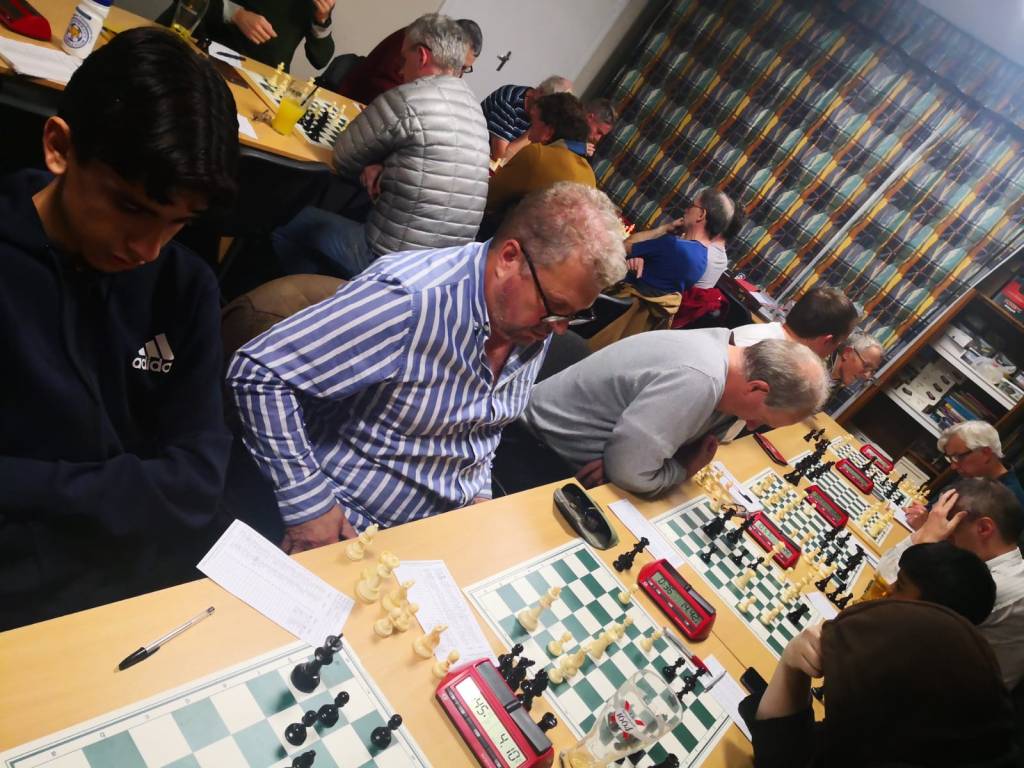
The evening started off in bizarre fashion – the visiting Latimer team commented on how cold the venue was. Indeed it was a little bit on the chilly side but for one of the teams who have the coldest venues in the County to tell us it was cold, it must have been so! The visitors swiftly gathered around the radiator that was in the middle of the room and huddled, as if to symbolically tell us it was cold. Once everyone arrived and with the warming words from El Presidente that the room would soon warm up – keeping everyone’s ears warm at least! – battle commenced just after 7:30.

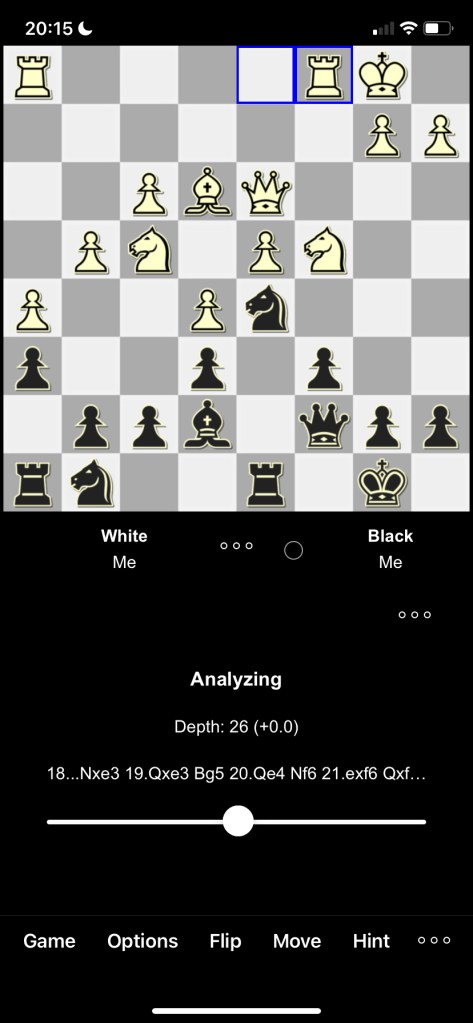
First to finish was Boris The Toaster with the white pieces facing off against Mike Garland Senior, father to the Junior version (of course!) but just as sound a Gentleman as his son. The game started with Boris’ trademark 1. d4 opening and the game transcended into a London but with black playing a rapid Bd6 in an effort to trade off the dark squared Bishop. In reply, Boris’s e3 led to Bxf4 exf4 and doubled f pawns. What followed was some very sensible chess, developing pieces to better squares, along with pretty much every trade being accepted, leading to doubled b pawns for black. The Toaster managed to get his Rooks doubled on the open e file which surely yielded an advantage but Mike Snr was able to get his own Rooks traded off with his opponents superior counterparts. In order for Mike Snr to exchange Rooks, he had to manoeuvre a little bit and The Toaster used this time to advance his Kingside pawns. The only real position to show is the one that eventually won Boris the game:

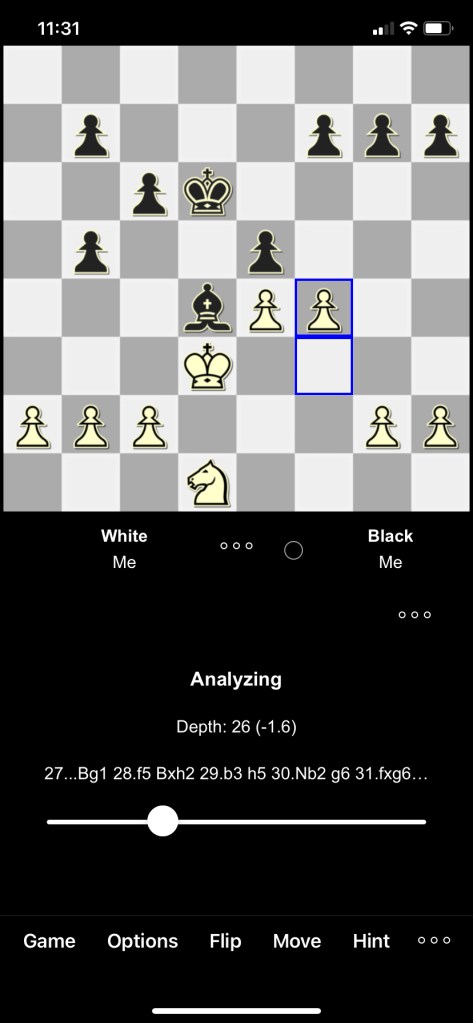
Here, white had played 42. g5 and after hxg5+, 43. hxg5, black simply plays anything but fxg5+, which instantly loses as the advanced white King shepherds his f pawn counterpart to Queening after taking the black g pawn, or after the re-captures, white’s King has the opposition and picks up the remaining black pawns and there is nothing black can do.

Unfortunately for black, Mike Snr played fxg5 and very soon, (as quickly as the pieces had come off the board in the first place), The Toaster had forced a resignation from Mike when Mike was in a completely lost position.

A good win for the Toaster and a well deserved one.

1-0 to Anstey.

Next to finish was Bob on board 4 playing with the white pieces against David Gamble. David is a tricky and slippery customer and there are 1 or 2 members of the club who have come a cropper against him.

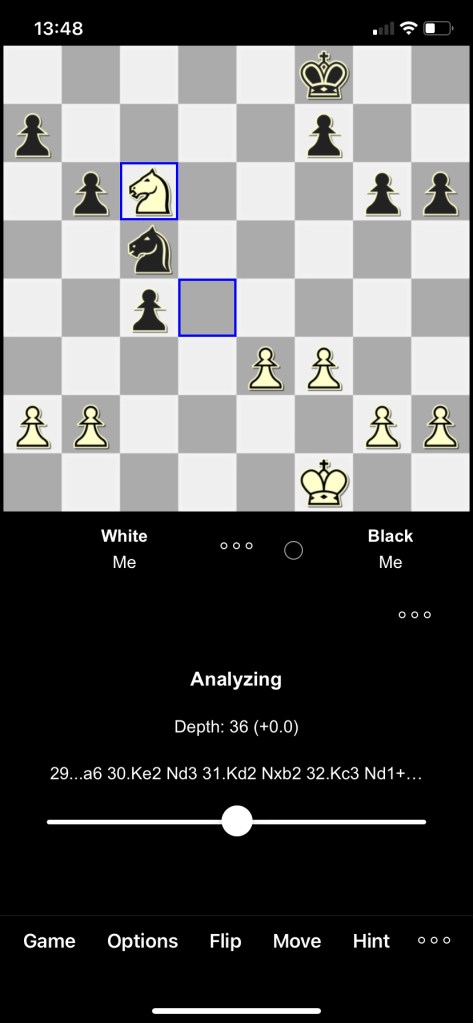
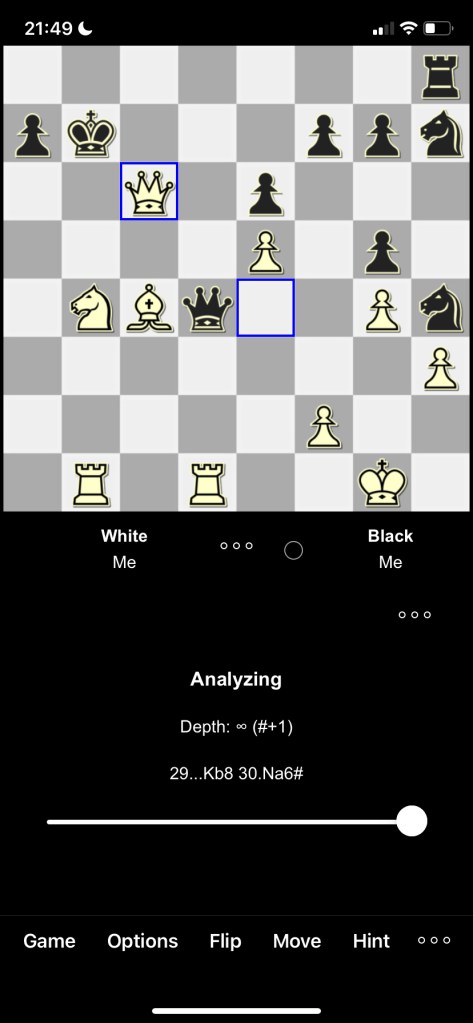
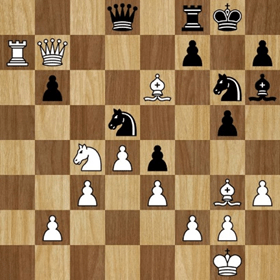
The game started with 1. d4 – Bob clearly has been to the 1. d4 section of the club – I was sure he’d played 1. e4 before. Anyway, the game meandered down the Marshall variation of the Queens Gambit Declined and the first out of book move came from Bob with 6. Be5 – planting the dark squared Bishop on a good square and daring black’s counterpart to trade. Eventually it was traded which led to Bob fighting to defend his e pawn as black freely developed his pieces. Looking at his scoresheet, Bob has questioned some of his own moves. Most seem unjustified as the engine (source Smallfish on an iPhone) agreed with some of his moves but the crucial trade down was after the Queens came off, along with black’s light squared Bishop and white’s f3 Knight, leaving Bob with doubled f pawns and a -2.0 position. Despite this seeming disadvantage, Bob pressed on but unfortunately got his pieces into a bit of a tangle and according to his notation, Dave Gamble missed a piece win but did manage to get a good Knight vs a slightly inferior Bishop. Bob carried on fighting and towards the end of the game, had an advantage (assuming that the previous notation was correct):

As we can see, Smallfish sees an advantage for Bob and I think it’s important that he knows this and that d5 was the move here, to undermine the Knight once more, as he had tried to do with f4 previously.

After h4 in the position on the right, the h file got opened and this was the beginning of the end for Bob as the Rook on g8 shifted to h8 and after a rook double, the end was nigh and the fat lady started to clear her throat. With disconnected Rooks, Bob was unable to parry the attack and by his own admission, should have shifted his pieces to defend earlier.

A tough loss for Bob but time to recharge the batteries for him as he’s off to Lanzarote soon for a well deserved holiday.

1-1 and scores are level with 2 to play.

Third to finish was El Presidente who was facing off against his old friend/adversary Granville Hill with the black pieces on board 3. Granny and Ben have played a few games and after initial dominance from Granville, El Presidente has started to even up the scales going in to the match.

The game started with the French defence: Schlechter variation that El Presidente had slipped up on in the past. Knowing this, he changed the move order a bit and played dxe4, going for Bxe4 and developing the f6 Knight with tempo and Bf3 being played – thus meaning that white had moved the light squared Bishop 3 times in the first 5 moves. Black was never really in any trouble after this apart from how his light squared Bishop would get in the game and try to trade it’s white counterpart off and when to play e5. Happily the opportunity to play e5 presented itself which meant white replied d5, blocking in said light squared Bishop. Play ebbed and flowed as pieces found homes. Granville tried to attack first with 12. Ne4 which meant an advantage to black and although El Presidente misplayed the move sequence (thinking he was trapping the light squared Bishop when he wasn’t), black never looked back, retaining a slight advantage until picking up the c pawn for nothing that had advanced too far to be defended. Granville did make El Presidente sweat a bit with a dangerous Knight hopping around the board and protecting key squares and causing trouble with his rooks, forcing defence from El Presidente and level positions every now and again.

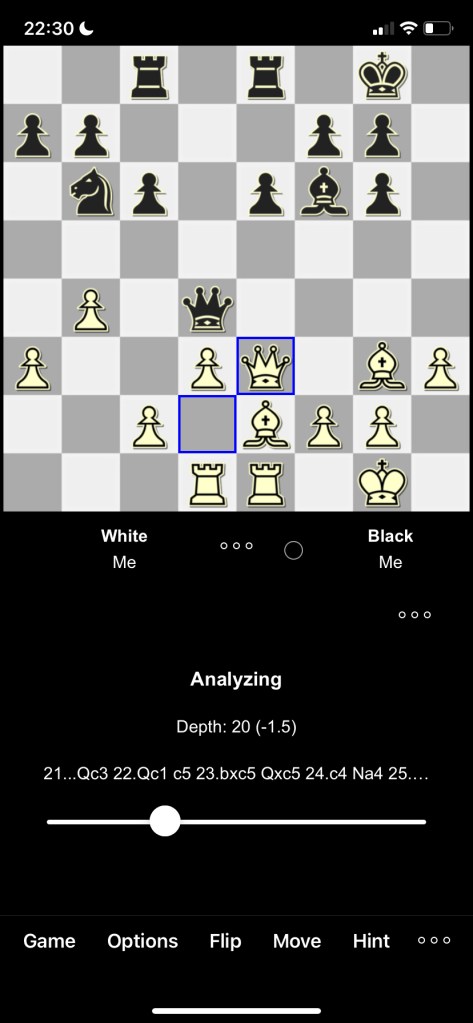
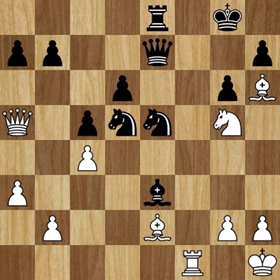
El Presidente was simply trying to get the Rooks off and the pawn ending was won. After 46. Kc4 from Granville in the position on the left, the opportunity presented itself and it was taken.

White had the passed a pawn but El Presidente knew that white’s King would be on c5 and too far away from the e and f pawns and it was time to find a breakthrough with f4 followed by e3.

El Presidente’s King was always ‘in the square’ to stop the a pawn, and as soon as Granville tried to push his a pawn, e3 was played and a resignation followed.

A good win for El Presidente – 2-1 to Anstey.

Finally we go over to the Griller Brian on board 4. 2-1 up with his board to play, he was facing tough opposition in the shape of Brian Slater with the black pieces.

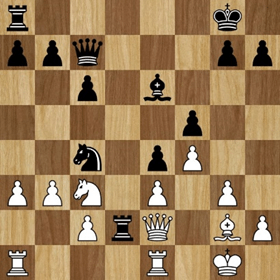
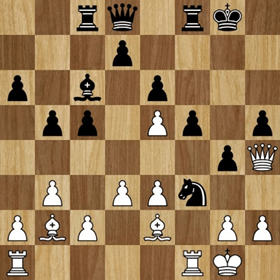
Starting with 1. d4, Brian replied with his favoured Slav defence, fianchettoing is dark squared Bishop. The players set about developing their pieces with white successfully trading off black’s light squared Bishop and not castling until move 17. The Griller got a well-timed e5 followed by e4 into the game whilst white completed development. A few piece trades followed whilst a battle for the b file was in operation and at point, Brian was in a poor position of +4.2 in whites favour at move 27. The Griller must have felt under the cosh as at move 29, he sacced a Knight for two pawns, hoping for some play. The engine (not Julian) didn’t like it but it isn’t unreasonable, if only to get inside the head of his opponent:

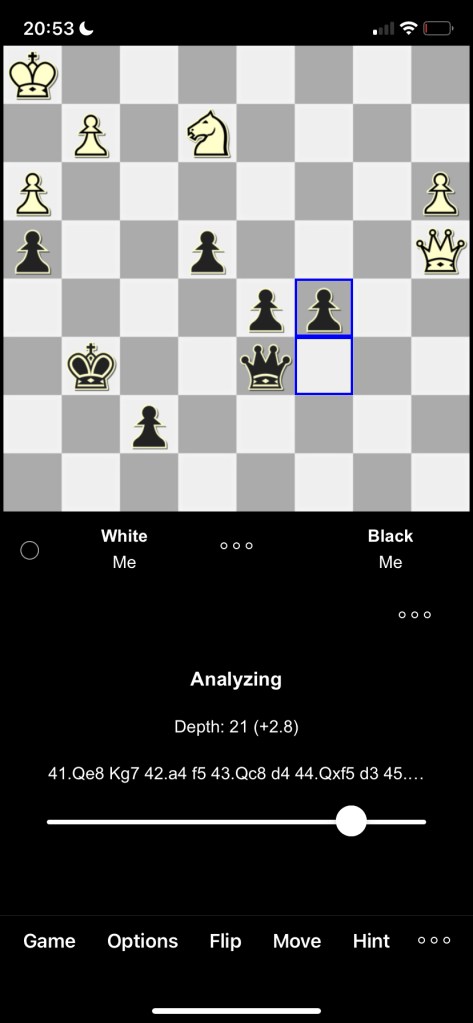
As The Griller stopped notating, he had played c5 which is visible to the right. We can see that those connected c, d, e and less so the f pawns are very dangerous and with the Queens on the board, anything was possible.

Sure enough, the Griller got the pawns rolling and whilst Latimer’s Brian was trying to beat The Giller on time to claim a team draw, The Griller emitted a calm persona whilst using the time that was accruing with his increment.

A slightly unsavoury incident occurred with Latimer’s Brian claiming a 2 minute time penalty to add to his 26 minutes on the clock, after The Griller pressed his clock too early. Indeed, this is the first time that a time penalty has been requested this league season and followed through with, so El Presidente wanted to ensure that it was done correctly. We are sure that both Brian’s had chance to calculate the position on the board and El Presidente reminded Latimer’s Brian that he had to notate, which whilst trying to beat the Griller on time, had seemingly escaped his attention.

As the Griller manoeuvred one of his passers to the second rank, Latimer’s Brian was forced to repeat moves by repeatedly checking Brian’s King and a draw was amicably agreed, securing the match for Anstey.
El Presidente told Sky Sports’ chess channel:

Relieved to get over the line to be honest – Latimer have been and probably always will be our bogey team and to come out the right side of it is very pleasing. They’re such a tough team to play. Well done to the team and to Brian the Griller for holding his nerve and delivering for the team in a precarious position, despite telling me at the end that he was freezing cold!
League Match: Leicester University vs. Anstey 3 (16th November 2022)

The next opponent the third Anstey team face are the young students from Leicester University, and the students currently stand on the third place in the league leader board so they’re no slackers. The live ratings for the students for a couple of them are 1500, one who’s about 1400 and the last who’s about 1260. The first two players for the Anstey side are Mike Griffiths and Leo Abraham, two of the strongest players Anstey has, who regularly play for the third team, so this maybe an equal pairing. Leo is 1360 but he has proven himself a worthy opponent against 1500 and occasionally 1600 opponents before, so a worthy opponent for a 1500.

The next two players for the Anstey side are Noor Datoo playing against the 1300 and (again) no slacker at all; Noor has faced off against 1300 and 1400 rated players, so an equally matched board 3. Finally, on board 4 for Anstey, is Oskar Rudczenko, who is rated 1100 but he’s starting to show some growth as a player, so possibly an equal match, but we shall see.

Board 1: Mike Griffiths plays white; David Reid plays black

Mike opens with the english playing c4 and d3; black responds with Nf3 and d5 attacking straight away. Mike does like to trade pieces as soon as he gets the chance, so a pawn trade it is. Both players continue to fight for centre control and another trade of pieces occurs, this time with knights being exchanged. Mike fianchettos his light-squared bishop and black uses his own light-squared bishop to counter the fianchetto. Mike castles kingside and black castles queenside. Black takes Mike’s fianchettoed bishop. Mike pushes his b pawn up, supported by the a pawn, to attack the c6 knight provoking it to move. Black moves his knight to the d4 square, supported by the e5 pawn, and Mike instantly goes for the trade hoping for a rook endgame.

Mike soon gets what he’s looking for as black trades dark-squared bishops and takes an offered queen trade; we’re now in endgame territory. Black pushes his kingside pawns to rain down onto white’s king, and Mike responds with small pawn moves to wait for the pawn storm and lock up the structure. This shuts down black’s play on the kingside, which forces black to make some play with his pawns on the queenside, where the b and c files are semi-open. Mike’s only pawns on the queenside are the a and d pawns, which means his pawns will be under slightly more pressure than usual especially if it starts to rain pawns.

Mike soon trades his a pawn off for the b pawn, and black has a past a and b pawns. Although, Mike has two past d and e pawns, and as both players occupy the c file with their rooks a trade of rooks occurs, leaving Mike’s d and e pawns disconnected. As black storms the queenside, Mike rushes his king over to c2 as his rook blocks the b pawn from promoting. Another trade occurs, this time with rooks, and black attempts to break through on the kingside, which he succeeds in doing. However, Mike has a past e pawn, so it’s a race against the rain with both pawns and both pawns queen.

However, Mike is barely out of the woods, as black can make a second queen. Mike gives a few checks, but blacks king runs down the board to his pawns and with the queens help black makes another queen. Mike feels forced to resign. The score starts off with Leicester Uni taking the first point, but this match is far from over!

Board 2: Jake Howard plays white: Leo Abraham plays black

Leo opposes the queens gambit, and plays a slav defence type of set up for his defences, and he loses a pawn a few moves into the game. Although, one pawn doesn’t make too much of a difference, especially at the start of a game so Leo pushes on to try his best being a pawn down. The game continues with Leo trying to make some counter play on the queenside, advancing his queen to pin the c3 knight to the white king and putting more pressure on the knight with his dark-squared bishop. However, white prevails and manages to castle without much damage to his position.

White then proceeds to further evolve his position by attacking Leo’s light-squared bishop, and successfully trading it for a knight. Another trade of minor pieces occurs and we are in a rook and queen game. Now, with Leo being down a pawn, and pieces getting traded off the more Leo will feel that one missing pawn. The game was now made up of a queen and two rooks for each side, and white kept pushing his positional advantage to win some pawns. Leo tries his best to defend his clumsy position, but he was still falling short of equalizing the game.

Eventually, it came down to a queen and a rook for both sides, and Leo was about to get overwhelmed as he fell into a few tactical traps and his opponent managed to find a mating pattern and followed through with it quite well. Unfortunate loss for Leo, but you can’t win them all. The score is now two points to Leicester Uni, but it’s not over yet. Lets see how Noor did.

Board 3: Noor Datoo plays white; Gnanvardh Pentakota plays black

Noor starts the game with e4, and his opponent responds with e5. Knights come out on c3 and c6, and Noor pulls his bishop out to c4. After this, black fianchettos his dark-squared bishop on the kingside and castles kingside, whereas Noor continues development of his other knight and bishop. Noor lines his queen and dark-squared bishop together to strike at the fianchettoed bishop on black’s side. Black advances his f6 knight to counter the strike, so Noor moves the bishop to attack black’s queen. Black blocks with the dark-squared bishop, but Noor plays h6 to dislodge the knight on g4. Both players trade dark-squared bishops, leaving Noor’s f6 knight on g5, and black sacs the g4 knight to trade knights and pick up a pawn in the process.

A few pawn moves later a queen trade occurs, and Noor castles queenside. Black then starts raining pawns down the board as Noor calmly rotates his knight from queen to kingside, and centralises his light-squared bishop, which also pins the black knight to a rook. Noor develops his d rook to a more active square, and black fianchettos his light-squared bishop, stopping the pin on the knight, but the bishop is undefended. Noor starts poking around the black king’s position with h4 h5, and moves his knight closer to blacks vulnerable king. The black king then hides on h8, with Noor starting to surround the black king, and black snaps by moving his knight out of the the pin, but blundering his bishop.

Black makes a few strange moves after this blunder, as he sacs his knight and checks Noor’s king on e2, but then moves the same rook a few more times in a thoughtless kind of manner, only really using his pieces to attack rather than improve his position. Black even trades his rook for a bishop for not much reason. This lets Noor improve his own position and grasp around the black king, as he is very close to mating, he just needs to spot a knight move to e6 and his doubled rooks can start checking the king. Noor doesn’t spot this, but does trade his rooks for black’s only rook and queens a pawn to start to check mate his opponent. Black resigns soon after, which leaves the score two points to Leicester Uni and one to Anstey. One more point and it will be a draw, which is a better result than a loss.

Board 4: Steven Cheung plays white; Oskar Rudczenko plays black

The game starts off as a classical Roy Lopez: Berlin defence, with white castling on the fourth move. Oskar then plays for a6 and b5 to get rid of the annoying light-squared bishop, and Oskar then fianchettos his light-squared bishop. Then, black tries to pin the other knight to the queen, which Oskar stops with bishop to e7 and proceeds to castle kingside. White prepares a pawn attack on the queenside, and Oskar asks what white’s dark-squared bishop is going to do as he plays h6. White decides to retreat his bishop to e3, possibly preparing a pawn advance in the centre of the board.

Oskar starts to look for break-throughs in the position, and starts with a pawn advance on the queen side of the board, but that gets shut down. Then, Oskar goes for a centre break through, and after some calculation he thinks it’s the right, which is the best computer move in the position. This causes a series of trades, which leaves a semi-open d file and a very weak d pawn in white’s position. With the help of a rook, a queen trade occurs, and Oskar starts to move his pieces forward to constrict his opponent. Black rooks are now doubled and Oskar opens the position even further with another pawn, but black makes a move that complicate the position: he takes a defended h pawn with a his dark-squared bishop.

Although, Oskar is surprised by the move, he doesn’t phase and finds the best computer move once again: checking the king with his own dark-squared bishop and if the king moves it will be mate in one. Steven is shocked by what Oskar plays, so he moves his bishop back to defend his king, which results in a bishop and rook trade. However, Oskar then finds a deadly knight fork, checking the king and attacking a pinned knight, which is pinned to an undefended rook. Another trades happens, but this one leaves Oskar up a full bishop. White tries to defend his position, but it’s only a matter of time to fall when you’re a piece down, or a blunder from your opponent. Oskar doesn’t blunder a piece, but he does lose a pawn, which luckily doesn’t matter too much. A few moves later white resigns leaving the score two-all for the uni students and the rural outsiders.

Final Say

Another draw for Anstey 3, which is okay again a draw is better than a loss. Also, it does mean we are gaining a point per draw, so we will be climbing above teams that are losing a lot, and when we do win one or two matches we’ll start to really climb on the leader board! For now though, Anstey 3 are in eighth place out of nine, due to an illegal team that was played against Ashby 4, which is disappointing, but if we win one or two, we’ll be in fourth or third place as a win counts for two points on the league table. Our next opponent is Kirby Muxloe 2, who aren’t doing too well so we will hopefully win against them, and it will be a good match as we’ve got seven players lined up for each team! See you all soon.

Anstey 1 Wallop Wigston 3 to Extend Unbeaten Run to Four Matches

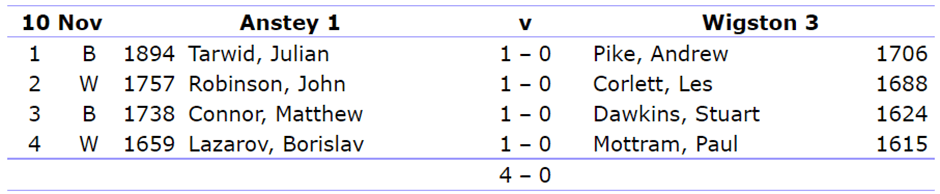
Thursday 10/11/2022. Anstey 1 welcomed Wigston 3 to the Methodist Church Centre in this in LRCA Division 2 clash and scored an emphatic 4-0 win, the first whitewash in the division this season. With John back from injury Anstey looked to field their regular first team of Julian, John, Matt & Mick until Mick himself withdrew in the pre-match warm up after a reaction to a course of anti-biotics. The last-minute change saw super-sub Boris once again stepping in. No such luck as a night off Boris! With the team lists hurriedly updated Anstey had a decisive on-paper advantage (7,048 vs 6,633) and as the clock ticked past 19:30 battle commenced.

The first game to finish was board 2, John playing as white against Les Corlett. After a steady opening Les left his a-pawn en prise which John gobbled up with his rook infiltrating on the queenside. John’s pieces streamed forward squeezing the life out of black’s position. It looked like John was really enjoying the game as he threw in a nice tactic to win another pawn:

Position after 25. Bxe6

Les carried on courageously but John forced home his advantage and took the win. Anstey 1 – Wigston 0.

Boris was white against Paul Mottram on board 4 and was the next to finish. Boris went for his trademark kingside attack throwing his pawns forward opening the h-file and winning a pawn followed by ganging-up his rook and queen on said h-file. Paul defended by swapping off the major pieces but this left knight and 7 pawns vs knight and 6 pawns and a +3 advantage. Knights are tricky pieces of course but Boris made no fatal errors as he ground out a 60-move win. Anstey 2 – Wigston 0.

Matt fished next playing Stuart Dawkins on board 3 with the black pieces. Against Stuart’s e4 and c4 setup Matt delayed the breaking d5 until he was a bit more developed and castled. Stuart expanded on the queenside but delayed castling giving Matt just enough time to grab the white pawn on b4 with his bishop and defend in the centre. White offered an exchange of queens giving black a solid edge. But white’s light-squared bishop was lurking with menace on g2 and had control of the whole diagonal. Matt went for the plan of swapping it off but lost his edge in the double rook, knight and 5 pawns vs 4 ending. As time ticked down both sides made errors, the rooks came off leaving another tricky knight endgame. Luckily Matt managed to win another pawn and with connected passed pawns (and no further mistakes) Stuart resigned. Anstey 3 – Wigston 0.  

Julian faced off against Andrew Pike with black on board 1. In a departure from his regular setup Julian came out of the opening slightly cramped. Andrew continued to press his space advantage but just when he seemed to be about to break through an inaccuracy allowed black’s dark-squared bishop to get into the game with Bd4+. Julian followed this up with the delicious 26. … Nxd5:

Position after 26. … Nc7xd5

Unfortunately, Andrew then made another mistake, Julian pushed his b-pawn all the way, giving up a rook but queening the pawn. In a hopeless position Andrew’s flag fell. Anstey 4 – Wigston 0.

Anstey 1 remain unbeaten in the league and move up to second place.

* As at 17/11/2022

Anstey captain Matt Connor told East Midlands Railway:
I’m relieved! Mine and Julian’s games could easily have gone either way but I’ll gladly take the win. We’ve made a solid start to the season but so far have only played the bottom 4 teams, the next few games will be make or break!

A brilliant performance from Bob secures a solid match win for Anstey 2

The quickest three draws of the season follow our season debutant’s win to claim second league win for Anstey 2 against a solid Ashby 3 side.

Last Thursday (17/11/2022) our second team travelled to Ashby to play against their third team in a Division 3 contest of the Leicestershire Chess League. Anstey 2, conveniently named “The B-team”, was represented by the regulars Brian ‘The Griller’, Boris ‘The Toaster’, Bob, led by the chairman/captain/reporter/marketing director/podcaster/streamer/content creator ‘El Presidente’ Ben. (If you have not listened to our podcast, jump to this link to discover engaging content, soothing voices, and a great banter) Our players were scheduled to play a solid, slightly lower rated Ashby 3 team who were coming from a heavy defeat and were looking to get back on the winning path.

Nick Wyld (Ashby 3) vs Bob Grindrod (Anstey 2) 0 – 1

Still on the lookout for his first win under the Anstey Chess Club banner, Bob was scheduled to play Black against the home team captain Nick Wyld. The players engaged in the French defence, Advanced variation, with Bob opting to take a more minor route in the opening by taking the d4-pawn on move 4 and create a nice target for his pieces to attack. Both players activated their knights in the contest for the said pawn, with our teammate keeping the initiative. Bob’s opponent did not like much the pressure on his centre and decided to exchange his light-squared bishop for the f5-knight, creating doubled pawns for Black on the f-file, while semi-opening the e-file. The Ashby player castled K-side and unsure of what to do with his dark-squared bishop, our teammate decided to exchange it for its white equivalent, thus stripping the home team player of both white bishops. Seeing his pawn on a semi-open file, combined with the remaining ‘bad’ black bishop, White decided to start doubling up of the rooks on the e-file, while at the same time he activated his queenside knight. Executing two plans at the same time from the Ashby player proved to be beneficial for Bob who managed to stop the e-pawn move at its foundation, while gaining tempo on the said knight, making room for his bishop to develop in the process. The previously sad bishop jumped quickly on a6 to attack the e2-rook and suddenly found itself controlling a bunch of light squares in White’s half. Bob decided to activate his remaining knight, threatening a queen and rook fork on b3, and surprisingly his opponent completely missed the threat and attacked the knight with b4. Our teammate happily exchanged his knight for the a1-rook and followed with an annoying, almost bordering with evil, pin on one of the white knights, which his opponent handled a little poorly, much to the delight of the Anstey B-Team. After doubling up queen and rook on the c-file, only to face a rook battery on the c-file across, the Ashby player blundered his knight and seeing the incoming lethal attack, resigned.

Finally, a well-deserved first win for Bob as Anstey Chess Club player, and we are wishing him many more to come.

‘El Presidente’ Ben Vaughan (Anstey 2) vs John Howlett (Ashby 3) 0.5 – 0.5

Our chairman was scheduled to play a solid player in John Howlett who met our teammate’s 1. e4 with the French defence. Almost an expert in the opening, ‘El Presidente’ decided to engage in the Exchange variation. Our teammate rushed to take the b1-h7 diagonal with his bishop which was met by knight development putting pressure on d4. Both players started the development of their pieces, then castled kingside. Black tried to chase Ben’s dark-squared bishop away with h6 to get rid of the annoying pin, but Anstey Chess Club’s chairman only pulled it a square, maintaining the pin from h4. The Ashby player brought both of his bishops to the party, placing them on g4 and f4, putting pressure on both of White’s knights. ‘El Presidente’ rushed to swing his queen away from the pin onto b3, only to be kicked back to c2 by one of the black knights. Challenged by h3, Black’s light-squared bishop exchanged itself for one of the white knights, and then the Ashby player pushed g5 to finally get rid of our teammate’s annoying bishop, and then rushed to exchange the dark-squared bishops. Ben managed to place a beautiful knight on e5, while Black rushed to exchange one of his knights for the last remaining bishop on the board. The home team player brought back his last minor piece to c6 to challenge its white counterpart and our chairman started fortifying his knight first with one of his rooks, and then with f4. The black knight exchanged itself for the only white minor piece, and just seen that Bob has won on the bottom board, upon recapturing with his rook our second team captain offered a draw and a drink to his opponent. Both were happily accepted by the Ashby player.

A solid draw for ‘El Presidente’ who continues to climb up the performance table, having lost only his opening game.

Steve Emerton (Ashby 3) vs Borislav ‘The Toaster’ Lazarov (Anstey 2) 0.5 – 0.5

Following his surprising win in the previous week for Anstey 1, Boris was scheduled to play Black against another solid player in Steve Emerton. The Ashby player led the game into the Caro-Kann, Two Knights variation where our teammate played as if it is a normal Steinitz/Karpov/Smyslov (whichever is your preference) variation. Luckily for ‘The Toaster’, his opponent did not play the most critical line and soon enough the game was led into a normal Caro-Kann position. Boris missed a good opportunity to play Bf5, seeing ghosts who definitely did not exist on his board, and completely trapped his light-squared bishop which ended being the saddest piece on the board, having moved only once until the end of the game. After a normal d4 push from White, our teammate prioritised development of the dark-squared bishop and castled swiftly, while the Ashby player rushed to take the h2-b8 diagonal with his dark-squared bishop. Boris overextended the queenside with a very dubious b5, forcing his opponent to tuck his light-squared bishop back in, but further preventing c5 without losing material. A Nd5 followed from our teammate, and then he decided to place his light-squared bishop to b7 as an investment for when the game opens up. Ben’s co-host on the Anstey Chess Club Podcast further played a prophylactic h6 to take away any sacrifice ideas from White. The home team player placed a knight on e5, which our teammate exchanged for his dark-squared bishop. Luckily for ‘The Toaster’ out of the three possible pieces for White to retake with, the Ashby player chose the worst one, giving our teammate the opportunity to exchange queens and prevent a crushing attack. Eventually, Boris managed to exchange his knight for White’s dark-squared bishop. Having heard Ben and Bob’s results a few minutes earlier, upon recapturing with his g-pawn our teammate offered a draw which after a short consideration, in spite of entering into a slightly winning endgame, but a little lower on time, the Ashby player accepted.

A good draw for ‘The Toaster’ who has been the busiest player for Anstey so far this year and looking to get his tenth game in less than two months next Thursday.

Brian ‘The Griller’ Foreman (Anstey 2) vs Lawrence Hayden (Ashby 3) 0.5 – 0.5

Playing like a machine this season, Brian was playing White against another solid player from Ashby, Lawrence Hayden. Brian opened up with the Queen’s Gambit which was met by the home team player with the King’s Indian Defence. Black develop normally with the typical fianchetto-ed bishop and castling kingside, while also exchanging his d-pawn for White’s c-pawn. Seeing the centre left out by Black, our teammate swiftly placed two central pawns, supported by the white knights and queen. In the meantime, the Ashby player pushed the queenside pawns and fianchetto-ed his second bishop as well. Our teammate decided to push e5, challenging the black f6-knight which jumped on e5 and got exchanged for one of the white knights. The black light-squared bishop jumped into the game to kick the queen back to c2 and the last minor pieces were developed for both sides. ‘The Griller’ went on to attack the black ‘lady’ with Bg5 which led to a big exchange on f6, whereby a couple of important pawns and the dark-squared bishops head to the rest area outside the board. Black was last to recapture with his rook, at a moment when only the top board players were left playing, sitting all by themselves in the small room. Our teammate castled and offered a draw which meant a win for our team and surprisingly his opponent accepted.

Another solid result for Brian who is so far the best performing player for the second team with 3.5 points of 5 possible.

The evening concluded promptly at around 8.45pm, a rather short event in the context of chess league matches, but nevertheless a successful performance for the Anstey 2 team. The B-team even managed to get back to the venue and do some analysis with youngsters and players from Anstey 1 and Anstey 3. After the win, our team find themselves on fourth position, with several teams below them with one or two games to spare. In the next fixture, the B-team will be playing Latimer at home.

If you want to be part of the excitement called competitive chess, come and join us regardless of your ability. All you need is passion for playing chess and a few spare hours to be spent every Thursday from 7.30pm in the Anstey Methodist Church.

League Match: Ashby 4 vs. Anstey 3 (10th November 2022)

The next challengers of the Anstey third team is none other than the current top standing team in the division: the fourth Ashby team. They are on a current winning streak of three out of three matches, and we are aiming to break that streak! The players for tonight’s match are (in board order, starting on board one): Ben Vaughan, Bob Grindrod, Mike Griffiths, Aarav Sinha, Oskar Rudczenko, Yuvraj Sadhra, and John Graham-Brown. A lot of players for a chess match, which is always welcome, and a lot of players means good games are even more likely.

It was a good evening, even though el captain was slightly late for the match, but we got sorted out quick enough after the captain’s arrival. Ashby brought a strong enough team for us to play against, with most of their roster being 1500-1400, with a few players between 1300 and 1100.

Board 1: Ben “El Presidente” Vaughan plays white; Dominic Lennon plays black

El Presidente’s game starts off with the carro-kann defence exchange variation. Although black seals in his light-squared bishop with e6 after the pawns are exchanged, so it’s a bit of a carro-french hybrid with the so called “french bishop.” A knights and bishops start to get developed with bishops taking d3 and d6 positions, and Ben brings his other bishop to g5 pinning the knight to the black queen. A few moves later, Ben’s rooks are on the f and c files, then black black decides to develop his queen to b6, and Ben mirrors this on b3. However, black then shys away from this move by playing his queen to d8, allowing Ben an extra tempo to improve his position further. Ben talked about maybe developing a big attack with his queen and bishop, threatening mate to tie down black’s f6 knight, then putting more pressure on the d7 knight by playing knight to e5.

However, Ben being human, makes the knight e5 move first before making the battery and then black shoos the queen away with pawn to a4, meaning he can’t have the queen infront of the bishop, so the game continues as normal, but with Ben having a small advantage. Although, Ben gets a big advantage soon enough when his opponent traps his own knight, leaving Ben up a full minor piece! Black retakes with his queen, and Ben then improves his other minor pieces with tempo attacking black’s vulnerable queen. Then, Ben makes good progress on the queen-side of the board with bishop to b5, knight d4, and queen b3. Black then tries to take back the initiative with f6 to break down white’s pawn structure, but Ben plays bishop to c6 x-raying the bishop and rook. Black takes on e5 anyway, and Ben takes back with the rook. The bishops are traded off and Ben brings his knight in.

However, Ben thinks he has blundered his knight as queen to d6 is played, but he can just play pawn to b5 solidifying the position for white. Ben unfortunately doesn’t find it and plays rook c to e1, and gives back the material advantage. Ben takes a few pawns an black makes a threat to check the king with a queen and rook battery. Not seeing a way forward, the players agree to a draw and shake hands, so it’s an even start for Anstey vs. Ashby with half a point each.

Board 2: Tom Gerrard plays white; Bob Grindrod plays black

Bob plays the french and his opponent chooses to follow the advanced french, and we get a normal french set up where the c pawns are traded off, and there’s always these ideas for black to play queen b6 and knight to f5 to put more pressure on the d4 pawn. Both players develop a few more of their pieces, and Bob fianchettoes his dark-squared bishop and white plays knight to a4, which attacks black’s b6 queen and defends b2. Bob then goes queen to c7, but then Tom plays rook to c1 to pin Bob’s c6 knight to his queen, so Bob feels obliged to play queen to d8. Tom centralises his knight, and (soon after this) Bob plays h6 to try and kick away the bishop on g5, so white re-positions the bishop to f6 to challenge black’s dark-squared bishop supported by the advanced e5 pawn.

After this, a couple of minor pieces get traded off, and Bob wins a pawn, which supported white’s bishop. After the scrap, both players reposition their queens, and white begins to attack. Firstly, bringing his rook down to c7, and then pushing his kingside pawns to try and dislodge black’s defences. Fortunately, for Bob, his opponent didn’t see a game winning tactic, where he can sack his rook for a pawn, and if Bob retakes with his queen white can fork the queen and king with a bishop. Bob then realises this is a threat and retreats his king back to the 8th rank of the board.

After this, the g file gets opened up and Tom goes for a few tactical plays, which finishes with Bob’s backwards e pawn getting put under heavy fire. Trying to equalise, Bob tries to encourage a queen trade by checking white’s king, but both players miss another supposedly winning move, which is king to h2, because the e pawn is just under too much pressure and the attack opens up black’s position. However, these two are not computers, so they trade queens and the position equalises, just as Bob wanted. Both players use their two rooks to capture pawns, both rooks are traded off after a few more moves and both players agree to a draw with only one pawn each. A white pawn on g5 and black pawn on a6. Now, both teams have a point each and it’s time to go to board 3 with Mike Griffiths.

Board 3: Mike Griffiths plays white; Jamie Rhodes plays black

Mike started off with his usual english opening, and his opponent responded, “soundly but passively” as Mike himself put it. After some time and trading some pieces, Mike was a pawn up in the middle game, and the game proceeded very evenly. Both players traded off some more pieces, and eventually got into a rook endgame. Mike states he had quite a few chances to force a stalemate and call it a night, but he decided to risk a loss and tried to go for a winning endgame. Mike had 3 pawns and a rook; Jamie had two pawns and a rook, but black had a passed pawn.

Unfortunately, Mike had to sac his rook for the newly made black queen, but he did still have two passed h and g pawns against black’s king and rook, it was still all to play for. Mike managed to herd black’s king away from the pawns, and he managed to slowly but surely advance his pawns towards black’s side of the board. Eventually, Mike managed to queen one of his two pawns and it was a rook vs queen endgame, and some time later Mike forked both black’s king and rook. Black had not much choice but to resign as a queen, pawn and king vs a king is a convincingly lost game. Mike admits he took a risk going for the win with such a tight game in his hands, but it was surely worth the risk as he had won the game and given his teammates a lead in the match! It is now two points for Anstey, and one point for the leading team in division four: Ashby 4.

Board 4: Mick Brown plays white; Aarav Sinha plays black

The game starts off with a d4 d5 opening, with Aarav playing an early bishop to f5, and with white playing a catalan set up with knight f3, e3 and c4. Both queenside knights are developed to the c6 and c3 squares, and white shuts down black’s dark squared bishop with c5. White then starts to attack black by pinning the c6 knight to the king, but Aarav stops the pin by castling kingside. Now there is no reason for the bishop to be on b5, so white takes the knight and Aarav retakes with the b pawn. Then, white castles before launching another attack with queen a4, this time attacking the c6 pawn. Aarav defends the pawn with his own queen, but white jumps the knight into e5, which wins the pawn as Aarav cannot defend the pawn with anymore pieces.

Knowing this, Aarav offers a knight trade with Ng4, but white takes on c6, which attacks Aarav’s e7 bishop and the bishop repositions on g5. Although, something went completely wrong with white’s calculation, because Mick moves his knight to e7, checking the black king but also blundering his knight as Aarav has bishop takes e7. What was white thinking? White then scares off the g4 knight and the black knight repositions on h6. White retreats his queen to play b4, and Aarav attacks in the centre with e4, supported by the bishop on f6.

However, this weakens black’s structure too much, and white plays e4. Aarav has to take with the d pawn, but white doesn’t take back yet and plays bishop takes h6, which means both bishops are piled on top of each other and both without protection. This allows for the fatal f takes e4 as the f1 rook skewers the bishops. Aarav takes on d4 with his e pawn, and protects the dark-squared bishop over the light-squared bishop. White continues the attack, but keeps holding on.

White trades the bishop and knight off, which allows his queen to join the attack. However, Aarav still defends well and with a few more shuffles of rooks and queens there’s not much white can do to gain a solid advantage. Aarav was on the cusp of losing, but pulled through against a player who is 300 rating points above Aarav. Both players agree to a draw, making it two and a half for Anstey.

Board 5: Oskar Rudczenko plays white; David Holmes plays black

Oskar starts with d4, preparing to play the jobava london. However, his opponent plays b6 most likely preparing to play the owen’s defence, so Oskar follows the theory for the next move, but black then prepares to fianchetto his other bishop too. Confused, Oskar just plays basic chess and develops his pieces to decent squares and gains centre control. Oskar castles queen side to line up a rook battery down the board with the queen on d2. With the occasional waiting move, Oskar gradually makes space and gains an advantage quickly because of this, as well as tempo from his opponent’s confusing play.

Starting to get impatient and thinking about attacking, Oskar plays e5, attacking black’s d6 pawn, blocking the dark-squared bishop, and stopping black’s knight from developing at all. Black doesn’t take and instead castles queenside, leaving the pawn on e5 and hang over the black position as black later plays d5, completely closing the centre. Oskar carries on forward, beginning an attack on the kingside and using pawns to break through black’s position, but black starts to panic and starts pushing his queenside pawns. Oskar tries to take advantage of this as he sees a very nice outpost square for his knight on c5, so as black pushes his pawns Oskar repositions his knight.

Black’s pieces are stumbling over each other and Oskar’s pieces have as much space as they’ll want. With a failed attack on the queenside, Oskar switches right back to the kingside and breaks black’s structure with a quick g4 and this opens up a very nice open file, the only open file. Oskar takes control immediately and doubles rooks, whilst black trades off the powerful night, but Oskar replaces the knight with a pawn, still freezing the position and black’s hopes of drawing. Black tries to defend from Oskar taking black’s pawns but Oskar still keeps going.

After a rook trade and a captured pawn, black goes all into the white position and abandoning the king. Black then secures winning a pawn, but Oskar need not worry as their is an imminent mate on the black king. However, Oskar misses it and pins the rook to the queen, but white checks the white king which wins the queen. Oskar still has some hope as he has a knight and rook working together, but white has a forced mate in 3 that Oskar needs to take care of, but he misses it and black wins with seconds to spare on his time. Damn… it is now two and a half for both teams.

Board 6: Graham Bird plays white; Yuvraj Sadhra plays black

Yuvraj faces a b3 opponent and plays e5, and Graham plays e3 so Yuvraj plays the principled night to f6. White develops his knights and so does Yuvraj, which makes one question why mov b3 in the first place. Yuvraj continues to develop his minor pieces, and white does so too. Yuvraj moves d5, but as soon as he does his opponent pins the black knight to the black king. Yuvraj castles kingside, which is when he loses a pawn to the short sequence of bishop takes c6 and knight takes e5. Yuvraj’s knight gets replaced with a bishop, but this makes the e5 pawn weak and so the white knight can take on e5. Yuvraj scares the horse away with queen to d6, and white simply puts his knight back to f3.

Now, Yuvraj offers a trade of knights, and white accepts but Yuvraj replaces the knight with a pawn, which is where white mis calculates and moves his knight to g5. Yuvraj’s dark-squared bishop covers g5, so white loses a piece. White tries to make something from the loss of a piece by playing queen g4, x-raying the bishop and the g7 pawn, but with a simple bishop to f6 the g7 pawn is defended well enough. The bishop move also attack white’s rook, so white has to move the rook to b1, and Yuvraj tries to trade queens but white doesn’t want any trading going on, so Graham moves his queen closer to the centre. Yuvraj won’t give up on a queen trade though, and still offers a queen trade. Yuvraj chases the white queen around for a few more moves until he forces the white queen in a corner and uses his bishops to herd the white queen into the path of the black queen.

Yuvraj takes the kind queen trade offer from white, and castles queenside leaving the board with a very early end game and with most pawns still on the board. Yuvraj mobilises his pieces and attacks the white position firstly with his pawns, then he starts to work his rooks into the position. Soon later he chops up the kingside and bullies the white king a little bit. A rook trade is forced by Yuvraj, and because of his extra pieces Yuvraj keeps taking white’s pawns and eventually he starts to push his pawns against white’s zero pawns. It was a long game, but eventually Yuvraj came through with a win and checkmated his opponent with a rook and king. Anstey are winning with a one point lead!

Board 7: John Graham-Brown plays white; Stephen Holmes plays black

John starts off with e4 and black starts off with the owen’s defence with b6. John develops appropriately and black goes for a small tactic by pinning the c3 knight to the king, so then black can freely take the e4 pawn. However, John seems to know what to do and defends the e4 pawn before black pins the knight, and when the bishop does arrive John simply unpins with bishop to d2. Black seems to have not acknowledged the e4 pawn is well defended and still captures the knight even though there is no reason to, so the game continues where John has a very small advantage with the bishop pair.

Both players develop their pieces, both sides castle and black tries to attack in the centre with c5. John takes the pawn and the d file opens up. Black places a knight on d5 and John takes advantage of this by pinning the knight to his opponent’s undefended light-squared bishop with his own bishop. Both players position their rooks on the d file, and after the position opens up a bit, the rooks are traded off along with quite a few other pieces, and not many pieces remain on the board for both players.

Black does eventually get an advantage though when white’s king becomes slightly more vulnerable, and black uses his queen to herd white’s king around the kingside of the board. John also attacks the oppositions king and he picks up a few pawns along the way, however, black might get a bit more than what John had intended as black moves his pawns up along with his king and John’s king. White’s king becomes locked into a position, by the black queen and the finishing blow by black with a pawn knocks John’s king out cold. This leaves the score with both teams having an equal amount of points (three and a half).

Finishing Lines

This match ended in a draw on the night of the match, but there was a bit of bad planning by the Anstey team as we used an illegal amount of players from the second Anstey team, meaning that we have to forfeit the top board, which means we actually lose this match. This incredibly disappointing result, means we are now in seventh place on the leader board in division four, but we have still did very well considering Ashby 4 are the top team in our division, and it was a night to remember as there were a lot of happenings. Such as, low time and moves being blitzed out. An illegal move was thought to have been played, but on closer inspection this was not the case, and a good night of social analysis from both sides. We may not have beaten Ashby this time, but this gives us an idea of the team’s potential.

The next match is against a new club of the league: Leicester University. We don’t know much about them, but we’ll find out soon enough what they’re made of. Until next time, bye bye for now readers.

Anstey 1 Extend Good Start to the League Campaign with Victory at Market Harborough

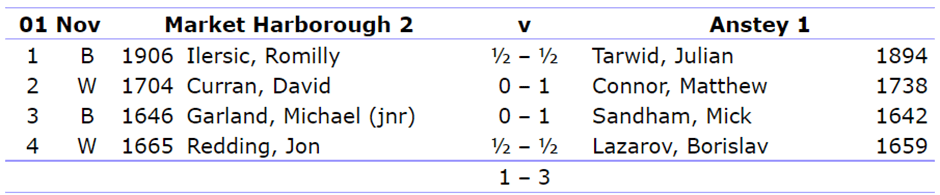
Tuesday 01/11/2022. Anstey 1 travelled to the deep south for the away match vs Market Harborough 2 in LRCA Division 2. Conditions were very different to their last visit with darkness, wind and rain vs a balmy summer’s evening. But the result was the same, another win for the soon to be hopefully unstoppable Anstey 1 LOL. MH are a friendly bunch and there was a jovial atmosphere between the players as they settled down, discussing the strength difference between divisions 2 and 3 (both teams having been promoted last year). The captains exchanged team lists, Anstey 1 again calling on super-sub Boris to stand-in for injury-hit John. With the teams evenly matched on paper (6,921 vs 6,933) battle commenced.

Boris played black against Jon Redding on board 4 and was the first to finish. In a sharp back and forth game where both players had chances, Boris accepted Jon’s gambit pawn on move 3 and after Jon played a few inaccurate moves coming out of the opening Boris consolidated his position and had a nice edge – a pawn up and a better pawn structure. Jon fought back and managed to infiltrate on the 7th rank with his queen leading to winning a pawn. The major pieces were swapped off and it came down to a bishop and knight vs two bishops endgame. Unfortunately, Boris couldn’t take advantage of the two bishops as one of them was pretty much relegated to defensive duty. Plenty of probing followed on both sides, the light-squared bishops were exchanged and the position came out dead even. A draw by repletion followed shortly after. MH ½ – Anstey ½.

Mick played with the white pieces (for the first time this season) against MH’s captain Michael Garland on board 3 and was the next to finish. Michael gambited a pawn on just move 3 but Mick ignored it and carried on with normal development leading to a small but noticeable advantage out of the opening. Mick provoked g6 and f6 to weaken black’s kingside pawn structure before all the bishops were swapped off and the knight manoeuvres began. Unfortunately for Michael, one of his knights was stuck on the edge of the board and with pressure growing on the weak e6 pawn he missed the threat to trap it:

Position after 24. … Nxc7 allowing 25. g4!

Michael rustled up a little counterplay on the open g file doubling rooks but ultimately it came to nothing. White’s queen roamed around the board with aplomb picking up a couple of free pawns on the kingside before swapping to the queenside and winning the other knight. Michael tried a cheap trick to give up his queen but Mick saw the back-rank mate threat and defended easily. Two knights and a pawn down Michael resigned. MH ½ – Anstey 1½.

Boards 1 and 2 both ended in time scrambles. Matt fished just before Julian playing David Curran on board 2 with the black pieces. No early gambits here, after a quiet opening Matt had equalised fairly easily. After an exchange of knights on e4 he made a space grab with f5 then e4, David responding with f4 taking the juicy looking e5 square away from black’s knight. Play transferred to the queenside and Matt infiltrated the 7th rank with 21. … Rd2:

After 22. Qf1 Matt though long and hard over 22. … Rxc2 and lost a lot of time before not going for it (another missed tactic) instead retreating the knight followed by the rook. After a few poor moves on both sides the following wild position was reached:

All hell then broke loose. David went for more complications with 28. Bxe4 then recapturing with his knight eyeing f6. Pawns were exchanged and pushed with check before black’s knight swooped in to d5 both attacking and defending. After more rushed moves (including an illegal one, oops), Matt transferred a rook to the half open h-file and after a final blunder Matt skewered white’s King and Queen with Rh3. MH ½ – Anstey 2½.

Julian faced off against Romilly Ilersic with white on board 1. After getting an edge in the opening he went on to dominate proceedings, at no point did black generate any real threats. The only fly in the ointment, unusual for Julian, was that he used up too much time in the early middlegame and ended up chronically short of time just when he was in a position to play a rook sacrifice for a mating attack with 27 Rd7!:

But with just 10 seconds left on the clock he had to blitz out the moves and Romilly wriggled out and transitioned to an equalish position. With the match already won, Julian offered a draw that Romilly accepted (with relief). MH 1 – Anstey 3.

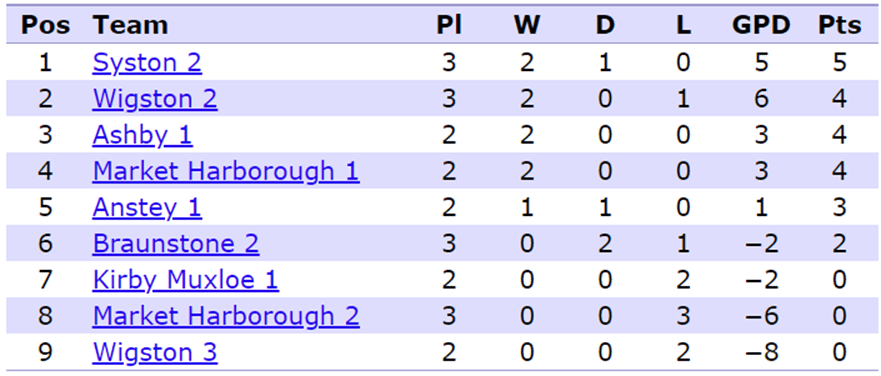
So a draw and two wins in the first three games and a promising league position:

Anstey’s next game is against bottom of the table Wigston 3, a must-win match in what already looks to be shaping up as a five-way scrap for top honours!

Anstey captain Matt Connor told East Midland News:
An excellent result on the road. I’m particularly pleased that we suffered no individual loss as “goal difference” could once again be an important factor at the end of the season.

Anstey’s 2nd team snatch defeat from jaws of a draw

Anstey’s 2nd team made the journey over to Loughborough’s Fennel Street Club in the driving wind and rain that makes one glad that chess is an indoor hobby/sport. As seems to be the way with the venue, we all arrived on time to be left waiting in the wind and rain by the venue. Peter Hickman was spotted in superb camouflage in a doorway as well as young Lindsay Pyun, which gave the travelling team (us!) an idea of what the Loughborough team might look like. We were let in (eventually – when the Fennel St club felt like it) and after the initial setting up of the boards, battle commenced with Anstey’s team comprising of the 4 B’s, Brian, Boris, Ben and Bob.

First to finish (for a change) was El Presidente, playing white against the door master Peter Hickman, who said he had forgotten his glasses before the game. After 1.e4, the game meandered down the Ruy Lopez Steinitz variation where after 4. d4 Bd7 is played – the ‘old Steinitz’. After dxe5 black replies Nxe5, Bxd7+ Nxd7 and already some minor pieces, including the light squared Bishop are off the board. The whole game meandered to a critical point where El Presidente told himself that a Knight vs Bishop endgame is won and pursued that very line, only to find that his Knight was dominated by the Bishop and the game reached the below point:

El Presidente played f4 on move 27 and evaluated this as equal, (despite what Smallfish says on my phone!) and thus offered a draw, fully expecting Peter to reply with f6 and accepting the draw.

Instead, Peter played exf4 whilst declining the draw and saying ‘I’ll take that pawn’. After Kxd4 he realised his mistake and played on valiantly for a few moves before resigning.

He referred to the fact he was missing his glasses and we shook hands – it was literally that one mistake.

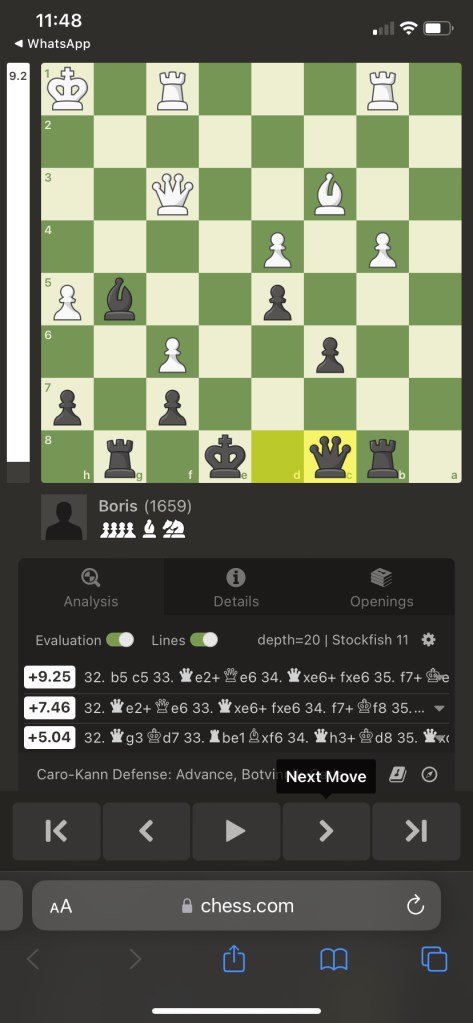
Second to finish was Boris The Toaster on board 2, he was facing the extremely talented youngster Kajus Mikalajunas who has been a nemesis for one or two Anstey players by mixing up games by playing tactically. Boris had black and against 1.e4 employed his favoured Caro-Kann defence with Kajus choosing the advanced variation and Boris this time tried 3. .. c5 in response to the advance of white’s e pawn. Both players developed their pieces with Kajus finding annoying retorts to the Toaster’s development; a nicely placed Knight on f5 was immediately kicked back to e7 with the move g4 and Kajus’s h and g pawns were advanced. As Kajus developed and castled Kingside, The Toaster didn’t seem to have an ideal placing for his dark squared Bishop so it remained at home on f8 until move 24. Unfortunately by this time, Kajus had a Kingside attack with his pawns and pushed ’em baby. This gave the Toaster no time to castle and despite the engine saying it was level, The Toaster’s position looks precarious with white playing 29. f6 to get a pawn in black’s King’s face almost.

Boris had played 31. ..Qc8 here which allowed the continuation:

32. Qd2+ Qe6 (forced) 33. Qxe6+ fxe6 34. f7+!, forking the King and Rook.

Kudos to The Toaster, he valiantly played on, hoping for a swindle of epic proportions – it happens when people fall into mate in ones against Kajus (hey, El Presidente!?). El Presidente employed the crisp crunching gambit as a last gasp hope of putting off Kajus but it had the reverse effect, with the Toaster looking at him as if to say ‘Dude, WTF?!’

Eventually the end came when Kajus Queened a pawn a full Rook up and Boris threw in the towel.

Boris is now taking a couple of weeks to refresh his mind after 4 games in two weeks, demonstrating his commitment to the club.

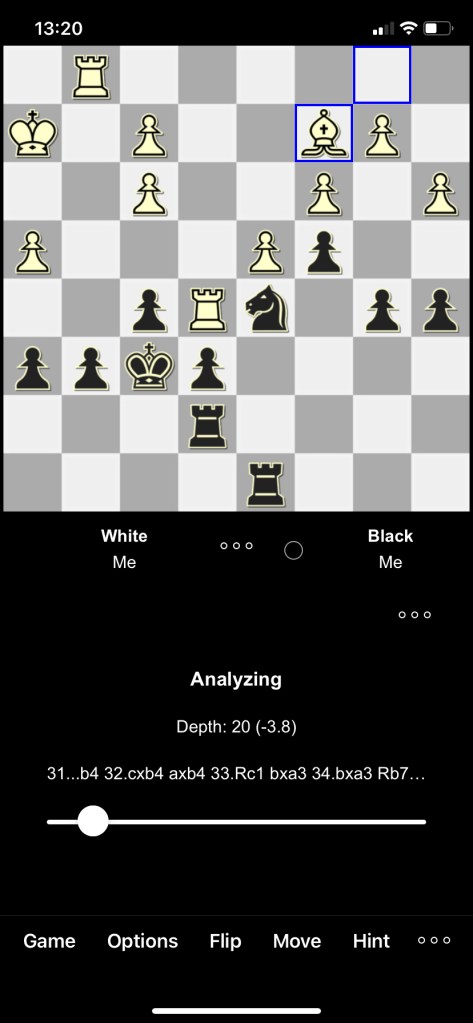
Next to finish was Bob playing black against Loughborough’s captain for the evening, Ric Dawson. Was this to be Bob’s first win for the club? We are all desperate for him to get it. The game started as a Queens pawn game with White employing the London system, after Nf3 and Nf6, Bf4 is played. Bob managed to trade off the dark squared Bishop after a cheeky Bb4+ refuted by the c pawn push to c3. The opening was completely level after both sides had castled and Bob managed to get c5 in on move 9. White looks to play e4 and got the chance on move 12, which simplified things in the centre a little bit. After b6, securing the c5 square, Bob finally realised that he has a light squared Bishop and found a nice home for it on b7. It subsequently found itself on d5 by move 16, holding on to c4 pawn which was under threat – a bishop acting like a pawn. More pieces were traded and Bob declined a Queen trade but things were still dead level. Bob did later trade Queens and the benefit of doing so was doubling pawns on white’s f file. White seemingly had some good play with doubled Rooks on the e file and a passive couple of Rooks for black then switched plan and uncoordinated his pieces a little:

White’s previous and subsequent moves were Bb1-c2-b1-c2 again and white was persistent in this. In the position to the right, Smallfish likes b4 here as I had said to Bob after the game, b4 was a must-play move.

Bob is perhaps a bit short of confidence by his own admission and played a4, locking up the position and after the game said he was more fixated on blocking the Bishop in rather than trying to break through on the Queenside. The win is coming Bob, this game showcased it.

Had Bob gotten up and seen what was going on in Brian The Griller’s game, he may well have played on…….

Last to finish was Brian ‘The Griller’ on board 1, playing white against Lindsay Pyun – another promising young talent for the County.The game started as 1. d4 and Lindsay adopted the Slav Defence after Nf3 and Nf6, c4 and c6. After steady development, and both players connecting their Rooks, black was looking to get c5 in, which she did on move 14. The trade offs provided some fireworks in the centre with more pieces being traded off and a slightly offside light squared Bishop on h3, out of harms way.

Editors note: We do like light squared Bishops as a club, we have nothing against them.

A few more trade offs occurred and throughout the game, the eval bar never strayed above a difference of 1 throughout – the trade offs were all plausible and I think any loser out of the game would be unjust. After 24. .. Rxc4 by black, the eval bar is at -0.1 barely an advantage to either player. After the last pair of Rooks come off and leave a Knight and 6 pawns for each player, literally anything could happen:

As you can see, after Brian was forced to stop notating in the position on the left due to having a similar amount of time to what ‘The Dark Destroyer’ is used to, things are still even.

What subsequently happened is that I think that Lindsay tried to beat Brian on time and couple of pawns fell.

All of the other players were watching the game and Lindsay – sportingly but quietly – offered a draw. El Presidente stated that he didn’t think The Griller had heard her so Brian turned around and asked what the match score was. El Presidente told Brian the match score and he had just been offered a draw. Looking forward to the match point, keeping in mind that Brian had about 15 seconds left on his clock, El Presidente was ready to shake Loughborough’s captain’s hand and get off home. The Griller said’ I think I’d like to play on’, made a move and subsequently did not press his clock.

The gaggle of people present watched for the entire 15 seconds whilst Brian’s clock ticked down and a few seconds after the flag had dropped, El Presidente informed The Griller that his time had ran out.

El Presidente Spoke to the press after the match:

What a match! It could have gone either way but it really does feel like we have snatched defeat from the jaws of a draw tonight. On to the next one!

Anstey’s second team snatch draw from jaws of defeat at Wigston 4

Anstey’s second team made the journey down to South Leicestershire to El Presidente’s old club Wigston. Wigston find themselves in the same predicament as Anstey with too many players and not enough teams, with both Anstey and Wigston pushing to try and add another smaller division. With both teams keen to give players games, they agreed to a 7 board match and after negotiating traffic on all roads leading to Wigston, battle commenced just after 7:30pm.

Prior to the game starting, El Presidente was presented with the Chapman Cup, which Anstey had deservedly won in the Summer.

Andy Morley handed El Presidente the trophy which was met with a ripple of applause in the cosy playing room upstairs at the Wigston Liberal Club.

So to the match and battle commenced. First to finish was Aarav with the white pieces against another young player – Madhav Eradi. Aarav opened with the Evans Gambit – Aarav, if you’re reading this please speak to Just Mick who is a massive fan of this line and would be happy to give you some pointers about playing it. Unfortunately, it seemed that the desire to notate was neglected and once notation stopped on move 15, Aarav was already in trouble having slid out of the book lines on move 8. Aarav and Madhav blitzed out the moves and when I looked over, neither player was notating and Aarav was a piece down with most of the pieces off the board. Not much longer after that, Aarav had resigned being heavily down on material and he looked very disappointed. El Presidente tried to reassure Aarav that there is plenty of time and I think he got caught out by his opponent playing quickly and fell into the trap of doing the same. Wins will come Aarav, take your time! Anstey were 1-0 down.

Second to finish was Boris The Toaster. Boris had the black pieces against Joseph Horspool, somebody that The Toaster had already played in the reverse fixture last month – it is a little unusual to face the same team so closely together. Against 1.e4, Boris employed his favourite Caro-Kann defence and his opponent employed the advance variation where we are straight down the book line where black shuffles his light squared Bishop several times to f5, e4 and having met h4 with h6, the light squared Bishop moved from e4 back to g6 and after h5 moved again back to h7. Not content with this merry dance, The Toaster’s opponent played Bd3, offering another move for the Bishop, which was taken. The Toaster’s light squared Bishop had enough for the day and was knackered! White had a slight advantage at this point, the engine giving it +1.2. Both players then sought to develop and castle – the Toaster won the race to castle but had a severely undeveloped Kingside with all of the Kingside pieces still on home squares and white ready to castle either way after black’s 12th move. After a few more moves back and forth, white played c4, seeking to mix it up a bit with The Toaster met with dc. The Toaster played Nb6-d5 which I thought looked correct but turns out to be an inaccuracy, the trade on c4 is better.

To the left is the position after 18. Rc1 – things are dead level.

Here, the Toaster played the logical looking Bg5 which is slightly inaccurate and the eval bar swings to +2.7. Better was Nxe3.

After Nxd5 exd5 the Knight comes into d6 and is a constant thorn in white’s side.

What followed is a slow progression from white, building around the advanced Knight with The Toaster spending several moves routing his Knight from g8-e7-c8 to try and dislodge the d6 Knight but the Rooks at this point were developed enough to give the Toaster too many problems around his castle King which forced his resignation. 2- 0 to the home side.

Sporting as ever, The Toaster and his opponent looked at the game afterwards and he and his opponent enjoyed the details of what had happened in their game.

Keep that chin up Boris, more results are just around the corner.

Next to finish was board 4 and new man Bob Grindrod who has joined the club this year, after a while out of the game having moved to the area. Bob was another player who was facing somebody that he had played before – the very slippery youngster Sathsara Dissanayake – hereafter to be known as SD! Bob had the black pieces and employed e6 in reply to SD’s 1.e4. Instead of the traditional reply d4, SD played Nf3 and Bob played Bc5. These 4 moves do not have an opening name but SD played 3. d4 which would be logical to force the retreat of the Bishop. Both sides developed their pieces, with Bob managing to get d5 in to stake a claim on the centre. By this time, SD had developed most of his pieces and castled, so Bob was behind in development and was fairly cramped for space with Knights on e7 and d7 and a light squared Bishop which at this stage was jealous of The Toaster’s compatriot on board 2! With the position seemingly level, Bob castled Kingside which allowed SD to trade a Bishop for Knight and finally allow Bob’s light squared Bishop a home on d7 at the cost of a pawn. Both players manoeuvred their pieces into better positions and although a pawn down, Bob had a very comfortable position against SD’s split pawns on e5 and c5, the c5 pawn being the extra pawn. SD played a dubious Na4 move, attacking a Bishop on b6 but this allowed Bob to attempt to deflect the Queen, which was on g4 and protecting the a4 Knight.

To the right – position after 19. Na4, given as -1.4.

More accurate than Bob’s attempt of f5 was h5, according to the engine although f5 looks incredibly tempting and appears to be the flip of a coin kind of a decision!

After 19. … f5 20. Qf4, Bob tried d4 which swings the game in SD’s favour, allowing the Knight to deliver it’s plan of Nxb6 and the two Rooks to gang up on the undefendable d pawn which was soon made mincemeat of by SD.

To be fair to SD, what followed was a procession of very accurate moves, not allowing Bob and inch in which to breathe and let’s just say that Bob’s game crumbled a little bit after the youngster’s accuracy and after an attack on Bob’s King, winning a Queen for Rook, Bob threw in the towel not many moves later. 3-0 to the home side with 4 to play!

We’re all behind you and backing you Bob, that first win is coming and we’ll all enjoy it with you.

3-0 down and with things looking bleak, Mike was next to finish with the white pieces on board 5, facing El Presidente’s conqueror in the return fixture, Luke Muir. Employing his favourite 1.c4 English opening, the game started very evenly, with both players cautiously developing their pieces. Mike fianchettoed his Kingside Bishop and Luke spent a couple of moves initiating Bh3 and the trade off of the light squared Bishop. Mike traded the f6 Knight which was recaptured with a Bishop and got his Knight to e4, hitting the Bishop on f6. Mike felt this was crucial as Luke captured Mike’s g2 Bishop, Mike took on f6 with check and using the intermezzo to ruin black’s pawn structure before re-capturing on g2. The players shuffled their pieces about, denying one another crucial squares that the pieces were looking to occupy. With all of the pawns on the board, there were no open files and things looked pretty even.

Position after 20. b5

Unfortunately, the move Ng6 has been notated here by Mike, which was already played on move 17 and it is difficult to work out the mistake.

The next moves are Kh1 Ree8, fxe5 Rxe5, d4 Rxe3, Qxe3 Rxe3

What followed when I saw the game was Mike having some strong Queenside pawns which you can see was initiated early on with b5. With all of the pieces traded off – bar a Knight per player, Mike transferred the play to the Queenside by using his Knight and pawns in unison to force Luke’s Knight off the board. Mike had the simple task of manoeuvring his Knight over to the Kingside to mop up black’s remaining pawn whilst Queening his own and eventually forcing a resignation. 3-1 to the home side.

Your author is a little unsure whether it was actually Mike or our board 1 that finished before the other but Brian The Griller was on board 1, facing off against somebody that he had beaten in the reverse fixture – Phil Watkinson with Brian having the white pieces. The game opened with Brian’s usual 1.d4 which was met with a Slav setup from Phil and transpired into an Alapin variation with 4. … dxc4 followed by 5. a4. Development of pieces was quick from both players with Brian trading off his Kingside Knight for black’s dark squared Bishop, opening the h file for Phil’s uncastled Rook, forcing 11. h3. Brian had to negotiate g5 a timely g5 from his opponent and found the only defence 13. g4 as mate was being threatened from a Queen on c7 and the open h file. Tension had remained earlier in the game via a Bishop on b4 and a Knight on c3. After Na2 and a questionable Ba5 from Phil, The Griller had the opportunity to trap the dark squared Bishop. Oozing class, Brian delayed the opportunity – it was trapped anyway, no need to rush. A sequence of moves allowed the Bishop to be released but the attacking potential and co-ordination of The Griller’s pieces is scary against black’s castled King. A monster a pawn ran up the board and The Griller’s Kingside attack really took shape.

What transpired is beautiful, as you can see. axb7+ had ripped open the King’s defences and Phil wasn’t able to find an answer to The Griller’s continual threats, moving pieces containing hidden dangers as well as not so subtle threats.

Phil rightly resigned in this position with mate inevitable. 3-2 to the home side with two boards to finish.

The Griller has certainly hit form for us this year and is continuing to do a great job for the team.

I think that it was Noor who finished next but only just finishing ahead of El Presidente. Noor had the black pieces on board 6, facing off against Chris Brown who had beaten Mike after Mike blundered a piece in the return fixture. The players went down the lines of the Giuco Pianissimo – the quiet Italian which gets both players some play with their pieces. Noor’s slightly unusual approach to retreat the dark squared Bishop and the f6 knight costed him a pawn which was greedily accepted by his opponent. Noor’s pieces got in to a tangle early on as a promising looking Bishop on f4 had to retreat back to c8 after Qf3, threatening both Bishop and the b pawn and white enjoyed a couple of tempi developing pieces. After white’s move 13, the eval bar is at +4.9. After castling, Noor gave up a further two pawns by walking in to a couple of minor tactics deflecting the pawn’s defenders. Indeed, after Qxb7, the eval bar is now at +7.3. Instead of accepting a 4th pawn, Chris (logically) decided to try to trade Queens which the computer doesn’t like, dropping the bar down to +3.3. Some inaccurate play followed from Noor’s opponent and whilst Chris shuffled his pieces, Noor grabbed a pawn back and after a Queen trade, got another pawn back.

This position is after black’s move 32 … Rxb2. As you can see, gone are the days of +5 and +7, Noor has almost equalised!

The two connected passed pawns look scary but Noor has a passed a pawn so all sorts of things could happen and happen they did! I think Chris tried to promote one of his pawns too soon and Noor was able to snare it and in the end the position was equal and a battling draw was agreed.

Noor is one hell of a fighter and to his credit managed to draw the game and there was even a point where I think he was winning. At this point Wigston were 3.5-2.5 up with 1 to play.

On board 3, El Presidente faced off against a new face and name Peter Collings with the white pieces. Peter met El Presidente’s 1. e4 with the Scandi and instead of the traditional 3. Nc3 hitting the Queen, played 3. Nf3 – a free developing move. One can play Nc3 at any time – why rush? Quick development ensued and the game remained fairly even after a couple of trade-offs of minor pieces. The critical position appeared below, where El Presidente offered a draw.

Only El Presidente could offer a draw at a -1.5 eval but it was declined.

I had seen that if he goes Qb2:

21. .. Qb2, 22. Qc1 Qxc1 23. Rxc1 Bb2 24. Rb1 Bxa3? 25. Rb3 where the Bishop is trapped and might as well take the b4 pawn as two pawns for a minor piece. Sure enough, this line happened and Peter admitted after the game he had missed Rb3 trapping the Bishop.

The game was far from over and El Presidente tried successfully to trade off more pieces, conceding a bit of the advantage along the way. A chaotic endgame ensued, which El Presidente tried to avoid after the poor showing in the endgame last time but a bit of calculation working out that although a white and black pawn Queened at the same time, El Presidente had a skewer tactic giving black’s King check and winning the newly formed Queen and Peter resigned.

A drawn match from 3-0 down was an excellent result.

After the match, El Presidente spoke to Sky Sports News:

SS: You must be delighted with the result?

Damn right I am, I haven’t won a game since January in Classical chess, I’m absolutely buzz-‘

SS: I meant the team result

Oh – Is this being recorded? (Clears throat) Yes, delighted by the draw, it really feels like a win. Thank you to everyone who played, it’s a long way to come and I am really pleased for those that won. Noor looks like he’s going to be a little superstar for us this year getting a draw from 3 pawns down. Someone also said that Wigston’s first division 1st team were playing and them patzers were all finished before me and Noor! Great to see some old and new friendly faces though, on a serious note. I know for sure that the guys that lost put up a massive fight and I am proud of them all. Wins be a coming for them just around the corner – we win, lose and draw as a team. Can you edit that first part out please?

The second team occupy a respectable 6th place out of 9 and face off against Loughborough 2 on Wednesday which is sure to be a big game.

League Match: Melton Mowbray 3 vs. Anstey 3 (26th October 2022)

The first away match of the new season for the third Anstey team, and it was a very interesting one! All sorts of things happened, and you’ll get to read all about it in this week’s recap of the Leicestershire Chess League.

Anstey 3 played Melton Mowbray 3, and the Anstey team this time was Borislav “The Toaster” Lazarov on board one followed by Noor Datoo on board two, with their team captain Oskar Rudczenko playing on the third board. You maybe asking yourself why I’m only mentioning three out of four of the team’s players, and I’ll get to that when we talk about board four in this report. Melton Mowbray brought quite a solid team to challenge us, and their was good sportsmanship from both captains as we agreed to only play one player, who was rated 1600. Every other player would be our normal team players in division 4.

With the context explained, and suspense exuded, lets jump right into the games!

Board 1: Borislav “The Toaster” Lazarov plays white; Quentin Jacquemard plays black

Normal d4 opening with black adopting a semi-slav set up, and with Boris being very aggressive on the kingside as he pushes f3 and g4 to attack black’s light-squared bishop. The bishop retreats and black is forced to push h6 to protect the bishop, and Boris encourages a bishop trade which black accepts. Black then offers a trade of dark-squared bishops and Boris takes the time to develop his last piece (aside from the rooks) and black trades bishops leaving only brave knights on the board of 64 squares. Black has a slight space disadvantage with his knights slightly further back than white’s knights, which are firmly in the centre or attacking the centre. There is no tension on the board, for now…

On the very next move, black creates tension by playing e5, which attacks white’s d4 pawn. The tension is left there as both sides develop their knights to better squares and both sides push pawns and trade a pawn each. Boris makes some tension on the kingside with g5 attacking black’s h6. Black calmly castles queenside, and the standoff in the centre and kingside is still on-going. Black moves his knight to attack Boris’ queen, x-raying the d4 pawn with the rook to white’s queen. Boris says no and moves his queen to attack the f7 pawn with rook and queen, also attacking an undefended knight. Black offers a knight trade with exd4 attacking the c3 knight. Boris moves his knight and black has hxg5 defending his knight with the h8 rook.

Boris puts more pressure on the f7 pawn with his knight, and black plays rook d-f8 defending the f7 pawn. Boris then thinks he should take back the centre by playing rook takes d4, and a few improving moves later black solidifies his f7 pawn and Boris has two rooks on the d file. Black makes some counter play to attack the e4 pawn, but Boris defends and all the four knights get traded off leaving equal material for both sides with two rooks and a queen each. Boris makes black’s queen retreat and moves his queen forward. Black intercepts the white queen with his and Boris retreats his queen all the way back to g1 to allow black a fork of white’s king and e4 pawn. Boris, being a pawn down, nabs one of black’s pawns, but this unfortunately leaves his rook hanging even though he has doubled rooks, as he can’t retake because a black rook would checkmate on the back rank on e1. Boris resigns leaving a taste of disappointment in his mouth. Melton 1 – Anstey 0.

Board 2: Peter Smith plays white; Noor Datoo plays black

This game starts of with the usual e4 e5 with Nf3 and Nc6, Bc4 and Bc5. The last two knights come out to play and both players solidify their pawns with d3 and d6, an identical position for white and black. Although, when white plays h3, Noor breaks the mirror with Be3, offering an exchange of the light-squared bishops and white takes as Noor has to take with the f pawn. Noor’s pawn structure is slightly damaged, but it’s nicely placed behind two protected pawns, so it might be an asset in the future. White castles kingside and pins the f6 knight to the queen, and Noor says, “no you can’t do that.” Noor plays h6 to say, “go away bishop.” White then retreats the bishop back to d2, and the game continues at Noor’s disposal as he now has the initiative.

Noor finishes his king’s development by castling queenside. White manoeuvres his knights to try and set up a more defensive position, or to re-route the knights and Noor plays g5 with rook d-g8 to start a kingside attack. White mostly ignores this thinking everything is well enough defended and plays c3, trying to make some counter play in the centre and Noor continues his attack on the kingside. A couple of trades are made, and both sides have one less knight and pawn in their armies, which leaves Noor’s rook on g4 looking directly at white’s king, and the computer marks this position at about -4.2, which is a significant advantage for black!

Although, the position is only -4.2 if white plays g3, but white instead plays d4 and basically says, “where’s your attack? Come get me!” Something you really shouldn’t be saying partly because it’s rude, but now the position is -5. Noor can play exd4, which again leads to more exchanges and Noor would have a big advantage. Although, Noor has other ideas and doubles his rooks with rook h-g8, and white plays knight g3, which guards the king for now. Noor plays exd4, white plays c4, Noor plays d3, and white plays queen to e1, which blunders a knight as the only thing guarding the knight was the f2 pawn. However, the pawn can’t take because the bishop on c5 is pinning it to the king. White plays king to h1, and now it’s mate in 2 moves, because the h file is completely open. The black queen can go to h4 with check, then the white king has to go back to g1 and rook takes g2 is mate because the black rooks are doubled.

A terrific game from Noor as he beat an opponent, who was just under 200 points above Noor! Melton 1 – Anstey 1.

Board 3: Oskar Rudczenko plays white; Peter North plays black

The first moves of the game are e4 and e6, so we get a french defence with d4, d5 and then e5 from Oskar. Black immediately goes for c5 to try and disrupt Oskar’s pawn structure, but Oskar says, “no mate, I’m playing c3. I want to keep my pawn structure intact.” Black responds with, “okay, I’ll attack your d pawn with Nc6, Qb6, and Ne7, Nf5.” Oskar is in a bit of trouble unless he plays Be3, keeping everything together, but he plays Na3 and black gets scared and doesn’t take on d4. Black instead plays a6, which gives Oskar a chance to play Nc2 and everything is solid in the white position. Black develops his last piece to allow him to castle, and Oskar develops his rook to e1. Black castles and white goes wild with the move g4, trying to displace the f5 knight, but black goes Nh4 and is fine. Oskar does take the knight and plays g5, and black’s knight goes back to f5.

Oskar slides his king over to make way for rook to g1 in the future (possibly). Black takes on d4 with the c pawn and Oskar takes back with his c pawn. Then, black gallops his knight in the middle of no where to b4 trying to trade the c2 knight, but Oskar simply plays knight to e3 trying to displace the f5 knight. Black takes with the f5 knight and takes back with the dark-squared bishop, completing his development of his minor pieces, and black’s light-squared bishop (or the french bishop) is still on it’s home square. Although, black finally develops his light-squared bishop on the next move.

Now, a fight starts to materialise for the queenside, with some rerouting of black’s knight and then a trade of light-squared bishops is offered by black and accepted by white. Another trade of knights occurs leaving black with quite a nice looking connected pawn on the c file. Then, white tries to set up an attack on the kingside with Rg3, looking to double rooks, but black defends well and there’s not much happening for white’s attack. However, Oskar still does for the attack, even sacking a pawn and the game for it, as the computer says it’s -3 when black takes on b2 with his queen. A few moves later though, black forces a queen trade and both players consolidate and defend their position. Black tries to attack and get a past pawn moving, but Oskar comes in with some counter play that blunders his bishop, but black doesn’t see it so black defends from a fake back-rank mate.

The endgame becomes filled with blunders by both players as different tactics swamp the board, but Oskar is low on time and black thinks he’s won so the game continues as if nothing is happening. However, black makes one blunder that Oskar doesn’t miss, and that is f5 which can be taken with en-passent by the e pawn and the e pawn is protected on f6 and is now a past-pawn. There is of course a mate in two on the board, but neither player sees this. Low time; black assuming he’s won.

Oskar does win a few moves later though, separating the black king from the h pawn, taking the h pawn and making a queen with it to ladder mate his opponent, with seconds to spare on his time. Melton 1 – Anstey 2.

Board 4: Steve Martin plays white; Anstey player 4 plays black

Now, I (as the captain) had thought that Yuvraj Sadhra was playing, but I had forgotten that he is still in India at this time with his family. We did play with a player down, which means that the score was Melton 2 – Anstey 2, so we drew with a player down which is a pretty good result. It also means we could’ve won with an equal amount of players, but let’s not get into the nitty-gritty of these things, as I don’t want to make myself look too bad.

Final Words

With this match said and done, this puts Anstey in 7th place out of nine with two draws and one loss, which is a lot better than last year as we lost most of the games at the start of the last league season. Drawing for us is decent enough, but we always and will still try to go for some wins whenever we have a chance. Our next match is away in Ashby against the very friendly and welcoming Ashby Chess Club. Win or lose, it will be a good night!

See you all in two weeks.

Anstey 1 Register First Win of the Season

Thursday 20/10/2022. Anstey 1 registered their first win of the season in LRCA Division 2, putting up a good performance against a strong Kirby Muxloe side who out-rated Anstey by 7,288 to 6,933. Anstey remain unbeaten in the league having drawn against Braunstone in the first game whilst Kirby have now lost their first two matches.

With John on international duties (playing in the Guernsey Chess Festival), Matt and Mick shuffled up a board and super-sub Boris slotted in on board 4. At 19:30 the teams shook hands and battle commenced. Well, mostly, Julian had messaged in saying he was running and late and to start without him LOL.

The first game to finish was Mick with black against Kirby’s captain Ray Townsend on board 3. After another cagey start, some knight manoeuvring on both sides and the swap off of a couple of minor pieces Mick looked to start his trademark kingside attack with f5, g5, g4 and h5. At this point Ray blundered his queen to a discovered attack:

Position after 21. … Nf3+

Ray played on a queen for a bishop down for another 30 moves but it was a complete rear-guard action. Mick took his time before eventually breaking through and forcing Ray to resign. Anstey 1 – Kirby 0.

Boris finished next on board 4 with white against David Walton. After an interesting game with white’s king stuck in the corner and black attacking on the kingside but with his own king stranded in the centre Boris blundered:

Position after 24. Nxf4??

At this point Boris offered a draw… and David accepted! The very definition of a lucky draw because after 25. … Rh4+ black comes out with queen and king vs two rooks and a horribly exposed white king. And a -10 evaluation. In his defence David was short on time but even so a lucky ½ point for Anstey. Anstey 1½ – Kirby ½.

Julian faced off against Simon Lazarus on board 1. He was about 15 minutes down on the clock by the time he got to the board but blitzed out the first dozen or so moves and had comfortably equalised in a Caro-Kann Panov. White had a small space / activity advantage in return for a crippled pawn structure. Julian calmly manoeuvred and exchanged off pieces and it came down to a same-coloured bishop ending. Simon had a passed c pawn and exchanging off the bishops looked sensible but he had underestimated the mobility of Julian’s kingside pawns. He pushed them forward mercilessly and threatened to create his own passed pawn with white’s king too far away to catch it:

Position after 34. … g4

Simon resigned the completely lost pawn ending a couple of moves later. A 93.6% accurate game from Julian, he’ll want to improve on that! Anstey 2½ – Kirby ½.

Captain Matt was last to finish on board 2 with white against Kevin Dalley. In a terrible game by him he missed a chance to trap black’s queen followed by missing what would have been a beautiful tactic to create weaknesses around the black king:

White to play and win (no, it didn’t happen)

He then mis-played the attack, retreated and lost a piece. Kevin gave him another chance by blundering a bishop back but then (admittedly in time trouble) Matt inexplicably gave away a knight when he had a slight advantage in an unbalanced position. A game best forgotten. But it didn’t matter as Anstey had already secured the win. Anstey 2½ – Kirby 1½.

So a draw and a win in the first two games and a mid-table league position:

Anstey’s next game is against Market Harborough 2, one they are definitely targeting for a win.

Anstey captain Matt Connor told BBC Sport:
I’m really pleased with this one, another engine-like performance from Julian and a great confidence-inspiring win for Mick. Yes, Boris got out of jail with that draw but that’s the way it is in this division, anything can happen!