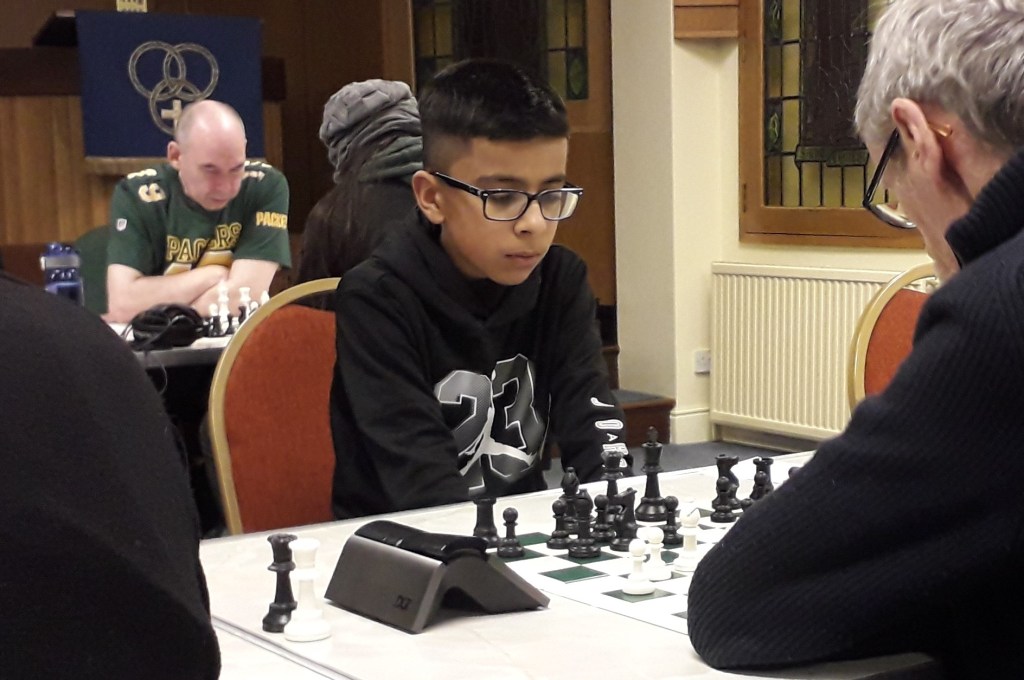
League Match: Anstey 3 vs Ashby 4 (16th March 2023)

Another rematch against Ashby 4. Anstey had lost to Ashby 4 due to an error on El Capitan’s part, but we made sure this time would be a good match and no room for error. Unfortunately, El Capitan had gotten sick for this match, so it was up to El President to take the role of captain for this match.

Board 1: Tom Gerrard plays white; Bob Grindrod plays black

This game starts off as an advanced french defence, with Bob going for the normal c5, and Ne7-Nf5 moves, along with Qb6 (all in that order). So it’s turning out to be a little off beat, but Bob is making it work. Both players castle kingside on the 13th move and Bob plays the f pawn break, which white takes. Both players manoeuvre their pieces to slightly better positions, and white starts to advance his pawns on the queenside. Bob trades the light squared bishops and ends up with a dark squared bishop and a knight, whereas white ends with two knights, so Bob could be slightly better, positionally.

Both players fight for rook control on the c file, and both players keep manoeuvring their pieces to improve their position gradually. White seals the c file to not allow trades, and a few moves later both players trade d pawns, but white puts more pressure on Bob’s position and before taking a pawn Bob has to defend his position first. Bob does defend and he finally manages to take the free pawn. This allows white’s queen into his position, but not for very long as Bob kicks the queen out. At this point, both players have traded their rooks and they both have a knight and queen left.

Bob has a past e pawn, and white tries to make the game difficult by checking Bob’s king and constantly threatening knight forks and taking pawns. However, Bob makes a slight inaccuracy and this means the game may end in a perpetual check as white checks Bob’s king, but Bob blocks this check with his queen and white forks his king and queen with the white knight. Bob resigns, and the score starts with Anstey 0 – Ashby 1.

Board 2: Leo Abraham plays white; Nick Wyld plays black

This game starts off with a giuoco piano game with both knights out for Leo. Black jumps his knight into d4 and Leo trades the knight off for his own. Leo develops his queen to f3 to threaten mate in one, and black defends by offering and queen trade, which Leo refuses and retreats his queen to e2. Black starts a king side attack as Leo has castled kingside. Initially, Leo adjusts his piece placements, and then starts to defend against the f and h pawn advances. Leo attempts to trade off the dark squared bishop, but black trades on his own terms and forces Leo to offer a queen trade which black accepts and then he trade bishops, which gives Leo a couple of doubled e pawns.

Leo then trades rooks and forces black to take with the king, giving up his rights to castle, and Leo develops his rook to the open f file. Black has to move his king. Leo now starts to advance his queen side pawns, although white has pinned Leo’s light squared bishop to the c4 pawn. Leo doesn’t want to create more doubled pawns for himself so he tries to unpin his bishop, which does give white time to take advantage of the pin. Although, Leo still defend quite well, defending his loose pawns and trading off the light squared bishops. Black does eventually manage to claim a pawn, but the game is still a little unclear as black struggles to find a way to break through and create a past pawn.

Although, Leo is on the back foot and is at the mercy of black’s pawn majority on the queen side as Leo has two pawns against three. Again Leo does his best to try and defend the position, but black has the advantage and does find a way to trade rooks and create a past d pawn, as well as a way to shoulder Leo’s king away from the h pawns. A well fought game. Anstey 0 – Ashby 2.

Board 3: Mick Brown plays white; Noor Datoo plays black

Noor’s game starts off with the van geet opening, and Noor sets a sneaky trap to win a pawn as white has played f3. This involves checking the king with his queen and taking the d4 pawn as only the queen is defending it and Noor’s knight is attacking it. Noor manages to complete the trap and white declines a queen trade and blocks the queen trade with his dark squared bishop. Noor threatens a checkmate in one with his dark squared bishop on c5. White blocks with a pawn and Noor is forced to move his queen to f6. White pins Noor’s c6 knight, but Noor quickly attack the bishop and white trades bishop for knight.

White solidifies his kingside pawns, Noor takes the semi-open b file, white defends his b pawn by moving to b4, and Noor sacrifices his dark squared bishop to win a pawn, because if white takes the bishop Noor will play Qxc3 with check and white will be in a lot of trouble. White instead develops his kingside knight, and Noor pins the c3 knight to a rook. White trades the bishop off and Noor’s queen hangs over the white position. White tries to shoo the queen, but Noor repositions his queen, so white castles. Noor advances his e pawn to open the kingside, and white tries to repeat moves with the knight, but Noor retreats his queen to decline the repetition.

Again, white keeps attacking Noor’s queen, but Noor simply moves his queen and continues developing his pieces. White advances his kingside pawns, which Noor prepares to attack, but white keeps advancing them and Noor sacrifices another bishop to open up white’s king. Noor now castles and white desperately tries to counter attack and defend, but Noor keeps on going. And as Noor keeps putting more pressure on white’s position, white resigns. A very well played game by Noor. Anstey 1 – Ashby 2.

Here is Noor’s game: https://www.chess.com/a/2fsPfggoQJdyp?tab=analysis

Board 4: Aarav Sinha plays white; Jamie Rhodes plays black

Aarav’s game starts off as a sicilian, but Aarav goes for the smith-mora gambit, which black accepts, and Aarav manages to develop his kingside in the next two moves and castles. Black tries to fienchetto his dark-squared bishop, but Aarav shuts this plan down by pushing his e pawn to e5 and Aarav defends said pawn well. Black continues to develop, and Aarav starts poking around black’s position. Black keeps attacking Aarav’s advanced pawn, but Aarav blocks the attack by the black queen and manages to trade the pawn into d6, which forces black to move his queen again.

Now Aarav challenges the fianchettoed bishop and black advances his f pawn supposedly to trap Aarav’s bishop and force a bishop trade. Black now advances his queen side pawns to attack Aarav’s light squared bishop, but similar to Noor’s game Aarav sacrifices his bishop to win a pawn and trade bishop for knight. Aarav repositions his dark squared bishop to attack an ill placed black rook, but black attacks Aarav’s queen but Aarav offers a queen trade by attacking black’s queen. Black accepts the offer, and now Aarav tries to protect his advanced e pawn and facilitate his promotion. Aarav defends his pawn well, offers a rook trade, which black refuses but Aarav insists in a rook trade which now accepting would help Aarav’s pawn be one step closer to promoting.

Instead of playing on, black resigns. Another very well executed game. Anstey 2 – Ashby 2.

Here is Aarav’s game: https://www.chess.com/a/2ZrD29XwtJdyp?tab=analysis

Board 5: Graham Bird plays white; Yuvraj Sadhra plays black

Unfortunately, this report is being typed more than a month after the match took place, and Yuvraj’s notes had been lost. However, Yuvraj did win his game against a decent opponent and I’m sure it was well deserved, so this puts the score at Anstey 3 – Ashby 2.

Board 6: John Graham-Brown plays white; Joshua Cherrington plays black

John’s game starts with a four knights italian game, and both players get a mirror symmetrical position on move 5, which John relinquishes by playing Ng5, and black responds by castling. John now offers a knight trade which black accepts and John retakes with a pawn to dislodge black’s c6 knight, but black counterattacks by threatening mate in one. John responds well by castling to defend the mate threat. Black retreats the knight and John brings his queen to h5 to threaten mate in one, which black responds by bringing his bishop to f5. John tries to dislodge the bishop by playing g4, but black brings his bishop to g6, which attacks John’s queen and John retreats his queen to h3.

Black now tries to shoo away John’s g5 knight, but John tries to set up a trap where if black takes the free knight John can almost trap black’s queen. Black sees this and plays Nc8, and John plays a waiting move (Kh1), and black takes the knight and John takes back with the bishop, but black plays Qf3 check and John has to move his king back to g1. Black tries to move his knight back into the game, John counter attacks black’s f rook and black moves the rook to attack the bishop. John now moves the other bishop to attack the rook and black plays c6, which John takes with on of his doubled d pawns and black retakes with the b pawn.

John retakes with a bishop to try and fork black’s rooks, but the black queen defends the pawn, so black takes the bishop and John is now down two minor pieces. John now moves his queen to g5, but this traps his dark squared bishop on e7 and black plays Nd5 to guarantee the bishop capture. John realises this and he takes a pawn knowing it will be taken on the next move. John advances his kingside pawns to attack the black king, but black offers a queen trade and John has to take otherwise he loses a pawn and gets his king exposed. John tries to create counter play for himself, but his opponent keeps coming into John’s position and John loses more material. John now resigns. Anstey 3 – Ashby 3.

Final Words

Another draw by Anstey, which is better than a loss and it does help to keep our position in the middle of the leader board. This puts our total number of draws to seven, which is almost half of our games (eight would be half) and we are still doing quite well. Our next match will be against Kirby Muxloe, which we will hopefully win as they are in the bottom half of the leader board, but it should be a good match still. Bye for now.

League Match: Ashby 5 vs Anstey 3 (27th April 2023)

The last match of the league season. It’s been quite the league for Anstey 3, a lot of new players and exciting games. A lot of the Anstey 3 players have gone up in rating, which is a great sign for the team and the club as we are attracting new players, and they are either getting better or already strong players. Anstey 3 have solidified their position in 5th place out of 9 on the division 4 leader board and, considering a lot of our players are new to league chess, I’d say it’s a good result.

Now, before this match, El Capitan had to show the ropes to a brand new player (Curtis) right before the match, as well as making sure everyone was playing at the right board. It was quite the busy evening with 8 boards and 16 players for one match, a lot of energy and chatter in the room ready for a good showdown between Ashby 5 and Anstey 3.

Board 1: Borislav “The Toaster” Lazarov plays white; Mick Brown plays black

The Toaster starts off loyal to the jobava london opening. Black adopts a more passive set up so Boris goes for a three pawn attack. Black tries to be aggressive by pinning both of Boris’ knights to his queen and king, and black trades a bishop for a knight. Black also plays d5 to continue his campaign against the white position, but Boris defends and castles. Both players improve their position with castling, moving rooks to more active squares and improving piece position. Boris counter attacks the centre with c5, and this starts a capture chain when black takes on d4, then Boris takes on d6 and both players trade dark squared bishops.

However, after black recaptures the pawn, Boris has to defend his position before retaking the black pawn. Black captures another one of Boris’ pawns but Boris makes a battery with rook and queen which pins the black knight to the black rook and queen battery. Black defends, but black loses a knight in the process. Black tries to start another offensive, but Boris jumps into c5 checking the black king with his queen. Black blocks with a knight and both players make a couple of improving moves. Boris moves his light squared bishop to a2 and launches a knight forward to put more pressure on f7. Black defends by placing his knight on d7, which is a little loose as the white queen is pinning black’s c6 pawn to the undefended black queen.

Boris spots this and reacts by forcing a trade of rooks off the board, and if black retakes Boris takes the d5 knight with his a2 bishop; black can’t retake otherwise he’ll loose his queen. As Boris goes for the rook trade, black resigns as he is down two pieces. Boris wins with a tactical advantage. Anstey 1 – Ashby 0.

Board 2: Jamie Rhodes plays white; Mike Griffiths plays black

White launches into the accelerated london system and Mike plays solid by linking up his knights and preparing c5. Mike plays c5 and takes the d4 pawn. White retakes and Mike takes the c4 pawn, which white recaptures, and Mike advances on the queen side with b5. White has to retreat his light squared bishop, which gives Mike an extra tempo to castle. White also castles and advances his own b pawn to b4, so Mike has to retreat his dark squared bishop to b6. Both of Mike’s bishops are on the b file aiming towards the white king.

Both players make improving moves and Mike repositions his knights to the centre of the board, whilst making sure they are still linked up. White advances one of his own knights in the centre and Mike trades off that knight with his dark squared bishop. Afterwards, Mike spots a tactic in which he can trade a knight for a bishop, so he goes for it. White’s pawn structure is slightly damaged on the kingside, but the f file has now opened up on white’s side. Mike takes the open diagonal pinning a white pawn aiming directly at white’s king. White offers a light squared bishop trade and Mike takes it to get closer and closer to an endgame.

Both players start to play around white’s pinned d pawn. Mike doubles his rooks in front of the pawn, and white sees not point in trying to defend it as Mike has enough resources to take it. Instead, white gives his king some loft, and both players trade a rook and a queen each. Mike tries to get the remaining rooks traded off, as he has a pasted e pawn and trading would give him a past c pawn too. White refuses the offer to threaten mate in 1, which Mike appropriating responds by playing g6 to give his king loft.

Mike plays a5 to break up white’s queen side pawns, which white allows and both plays now have one past pawn on the queenside. Although, this doesn’t last too long, as after a few advances and manoeuvres Mike offers a trade of pawns and both players trade past pawns on the queenside. Mike is now the only one with a past pawn on the e file, and he tries to trade rooks still and eventually he manages to force a trade of rooks. Mike also manages to get his opponent into zugzwang and has opposition against white’s king, which means he’s able to force the white king away from the e file. White resigns; Anstey 2 – Ashby 0.

Board 3: Noor “The Prodigy” Datoo plays white; Eden Watts plays black

Noor starts with e4 and black starts with c5, which and the opening position turns into a closed sicilian with black controlling a lot of the dark squares, and Noor controlling the white squares and having a vienna gambit position with e and f pawns on the 4th rank and knight on c3 and bishop on c4. The position quickly opens up as black plays d5 and when the e file opens black plays queen to e7 and Noor blocks with queen to e2. An interesting choice by both players. Noor pins the c6 knight to the black king and both players develop their queenside bishops. Noor centralises his c3 knight and a knight trade occurs, which helps Noor gain an advanced e and f pawns.

Black brings his queen back to d8 and Noor castles queenside and black castles kingside. Noor finishes his development by bringing his kingside rook and knight into the fight. Black chases away Noor’s light squared bishop from b5 and offers a light squared bishop trade. Noor doesn’t take, but firstly advances his e pawn a little further into black’s position and attacking black’s dark squared bishop. Black now trades light squared bishops and retreats his dark squared bishop to c7. Noor now pokes and prods at black’s kingside threatening attacks or mate in 1 multiple times.

Noor continues the assault on the black position with g4 after black plays g6 and h5. Black brings a rook over to h8 to defend as Noor takes on h5, and Noor brings a rook into the attack, which allows black to take on h5 with rook and attack Noor’s queen. Noor ignores this and threatens a queen and king pawn fork, but black does a desperado and sacrifices his queen for a knight before taking Noor’s queen, meaning black is up a piece.

Noor keeps attacking the black position and shreds open black’s pawns. Black’s king is vulnerable and Noor keeps giving checks forcing the black king out of comfort and into Noor’s territory. However, Noor gets a little greedy and doesn’t see a trap. Black sees the trap and checks Noor’s king a couple of times and wins one of Noor’s rooks. Noor keeps checking the black king trying to find a mate somewhere, and he has some progress doing this, but black wins more material with a knight forking Noor’s king and last rook. Noor resigns; Anstey 2 – Ashby 1.

Board 4: Ric Dawson plays white; Aarav Sinha plays black

White comes out with d4 and Aarav plays e5 trying to play the englund gambit, but white declines and advances his d pawn to the 5th rank. White carries on building around his advanced d pawn and Aavav plays around the advanced white pawns. Aarav tries to break up white’s pawns, but white fortifies the d pawn with the e and c pawns. Aarav develops a bishop and queen battery on f2, which white defends with queen to e2. Aarav develops his last knight and centralises his dark squared bishop to d4. White attacks the bishop and Aarav counter attacks the light squared bishop. Both players take each other’s bishops and knights, which results in Aarav having a disconnected d pawn behind white’s centre pawns.

Both players castle and Aarav repositions his knight a few times to get it into a good position and attacking white’s queen a couple of times. White advances his b pawn to break up Aarav’s pawn structure, but later advances the b pawn to the 5th rank and hangs his c pawn, which Aarav picks up with his knight. Both players advance their pawns (Aarav concentrating on the queen side, where as white concentrates on the king side). Aarav continues to advance his pawns but hangs his own a pawn, but after that white blunders his knight with check and Aarav now a couple of white’s centre pawns.

White tries to make counter play by trying to force mate in one, but Aarav has enough resources to make sure there is no mate in one. White tries to deflect Aarav’s queen from the defences, but Aarav defends well and creates a good attack, which opens up white’s king. Aarav still has to be a little careful as white still tries to threaten mate in 1 and infiltrates the black position, but Aarav makes just the right moves to defend.

However, Aarav’s resources run out when he moves his knight ready to checkmate his opponent and Aarav gets force checkmated in two moves. A very unfortunate end to a good hustle by Aarav. Anstey 2 – Ashby 2.

Board 5: Curtis Blunt plays white; Joshua Cherrington plays black

For his first league match, Curtis comes out with e4 knight f3 and his opponent goes into the petrov, which Curtis knows a little bit about. Both players develop their dark squared bishops and move their d pawns to the 4th and 5th ranks. Black is a little faster to castle, but Curtis’ pieces are a little more developed. Curtis develops his light squared bishop and black pins the f3 knight to Curtis’ queen. Curtis now castles and has quite a pleasant position, but Curtis gets into a position where he admitted he didn’t know what to do, so he blocked the bishop pin with his own bishop and moved his pieces and pawns a little bit to improve his position. Both players improve their positions a little more and Curtis offers a trade of light squared bishops, which black ignores and moves his queen, but Curtis now forks black’s queen and light squared bishop to capture the bishop with his knight. Curtis can’t retake with this bishop, but he has the bishop pair.

Curtis now manoeuvres his light squared bishop to attack black’s queen and cause some complications in the position, as his bishop can be taken, but if black goes into a capture sequence then he will lose a piece. Curtis now moves his bishop to check the black king and advances his own queen, but Curtis too falls into a knight fork, but he guards well and doesn’t lose anything from the fork. Black now allows for a dark squared bishop trade and Curtis has to take otherwise he loses a bishop, and Curtis counter attacks black’s advanced knight, but black attack’s Curtis’ light squared bishop with a double rook battery. Curtis can’t move the bishop, so he takes the knight and black takes the bishop. Curtis is forced to trade a rook for rook, but he wins a pawn after the exchanges.

Black forks the loose white knight and d pawn, but Curtis creatively offers a trade of knights and after the trade he threatens a mate in 1 with a back rank mate. Black makes loft and Curtis pins the black rooks to the black queen, but black offers a rook trade and Curtis refuses. Both players guards their rooks and Curtis offers a queen trade a few times with black refusing and trying to create mating threats. Curtis does grab a pawn, but so does black. Curtis’ queen and pawn get rook forked, and Curtis offers a queen trade once again, but now black takes and it up a pawn on the a file.

Both players now bring their kings out and Curtis tries to win the a pawn, whilst black tries to win the white pawn on the kingside. Curtis defends well and manages to create problems for black. Black offering rook trades when he can, but Curtis does defend well still. Eventually though, black forces a rook trade and black still has an a pawn. Curtis has to capture the a pawn with his king whilst the black king eats up the white pawns. Curtis resigns, but considering this was his first league game it was of very good quality! Ashby 3 – Anstey 2.

This is the link to Curtis’ game, as I deem it to be outstanding and a very good first game for Curtis. Well played good sir! https://www.chess.com/a/WbjM5mVGJdyp?tab=analysis

Board 6: Graham Bird plays white; Yuvraj “The Silent Destroyer” Sadhra plays black

This game starts with d4 and d5 with the game turning into a london type set up for white, and Yuvraj developing his minor pieces. Both players continue to develop their positions and improve piece placement without anything being captured. On move 11, the first trade occurs with Yuvraj trying to trade off white’s dark squared bishop for a knight and white opts for the bishop trade instead. Although, white spots a tactic where he moves his f3 knight and causes a few different threats for Yuvraj to deal with. Yuvraj is forced to trade light squared bishops, then he has to deal with one of his hanging pieces and a knight ready to fork his rooks. Yuvraj opts to loose the hanging piece to avoid the knight fork. White takes the free piece with the queen and now Yuvraj starts advancing his pawns with tempo attacking the white queen to try and displace it so Yuvraj can win back the free piece.

This doesn’t work, but Yuvraj still keeps advancing and attacking. Since Yuvraj castled queenside and white castled kingside, this can help Yuvraj to spring board a pawn storm against the white king. White develops his rook to a more active square, but Yuvraj keeps advancing his pawns. White doesn’t seem to understand what to do, so he repeats knight moves a couple of times. Eventually Yuvraj has a triple battery of two rooks and a queen all lined up against the white king, but unfortunately white manages to take a rook for free as Yuvraj can’t move his queen due to white threatening mate in one. Both players advance their pawns though, and white closes the diagonal of his queen to deliver mate, so Yuvraj can take the knight that took his rook and continue his attack.

Although, the white king still remains safe and white again threatens mate in 1, but Yuvraj stops this threat and his pieces can move freely. Yuvraj takes some of white’s centre pawns and manages to win back a piece with a tactic. White’s knight was defending a rook, which Yuvraj’s queen was attacking, but the knight can be taken by his rook which also defends his queen. White now trades queens and it’s an endgame with Yuvraj’s knight and rook against two rooks. Yuvraj takes the remaining white centre pawns and white decides to trade a rook for a knight. Yuvraj manages to win another pawn, which means he’s got two centre past pawns, but white has two kingside past pawns.

Both players advance their pawns and Yuvraj manages to get both of his pawns a few moves away from promoting. However, white manages to get both pawns with Yuvraj pushing one of the pawns too soon. Yuvraj tries to make counter play and blockade white’s past pawns with his king. Yuvraj then goes for a rook trade and starts to advance his queen side pawns, which are two vs one of white’s pawns. Yuvraj almost manages to promote one of his queenside pawns, but white’s kingside past pawns are too strong and Yuvraj resigns. Ashby 4 – Anstey 2.

Board 7: Oskar “El Capitan” Rudczenko plays white; Brian Wood plays black

El Capitan starts off with e4 and black goes into a Scandinavian defence, which Oskar accepts, but it turns into a weird gambit with e6 after exd5. Oskar takes this pawn as well and starts to develop a couple of pawns in the centre (c and d pawns) and develops his knights while black develops a couple of pieces and starts moving his pawns one square on the queenside. Goofy looking but if he wants to play this Oskar doesn’t mind. Oskar castles kingside and black still playing odd moves, and Oskar tries to advance his d pawn with the support of his other pieces. Black does defend some threats, but Oskar manages to jump his knight onto e5 to attack the d7 rook and black moves the rook out of the way. Oskar now sacrifices his knight to fork black’s bishop and knight, but Oskar doesn’t see that black can counter attack his queen, so black remains a piece up.

Black now rushes to castle, but Oskar keeps on building a path for his c and d pawns so when black castles Oskar can play c5. This attacks black’s dark squared bishop, which black sacrifices to check Oskar’s king. Oskar takes this bishop, and then pawn forks black’s light squared bishop and rook. However, black goes in for a knight check on g4 and goes for an attack with his queen, so Oskar takes the knight, which black retakes with the bishop, but Oskar attacks this with his rook. Black doesn’t go for anymore attacks and acknowledges that he’ll lose another piece.

Black keeps trading though by doubling rooks on the e file and trading a rook for a bishop and a pawn. Oskar attacks the rook with his queen and x raying the h3 pawn to maybe start a checkmating attack on black’s pinned g7 pawn. Black defends his rook with his queen though, which double attacks Oskar’s knight, which Oskar defends. Still though, black takes the knight with his last rook and Oskar retakes. This means Oskar has an extra piece (two rooks and a queen) vs black’s queen and trapped knight. Black tries to counter attack Oskar’s undefended rook, but Oskar simply doubles up the rooks lined up against the black king. Black tries to check Oskar’s king, but there is only one check. Oskar now starts a checkmate by taking on g7 with his rook, and at this point black resigns. Ashby 4 – Anstey 3.

Board 8: Peter Anderton plays white; John Graham-Brown plays black

The game starts off as a spanish, and John plays queen to f6 on the 3rd move moving into the Gunderam variation of the spanish. White takes John’s c6 knight to take his e5 pawn, but John takes white’s e4 pawn with check after retaking on c6. White blocks with the queen and John develops a knight and white trades queens. After white castles, John attacks white’s knight, but white counterattacks John’s knight and a knight trade happens, but John’s bishop becomes pinned and John has to defend it. White attacks John’s bishop with his f pawn and John counterattacks the white rook with his light squared bishop. After white retreats his rook to e2 John defend his bishop again with his f pawn and white keeps the pressure on with d4. John attack’s the rook again with his light bishop and white moves the rook to e3.

Now, John plays g5 and white now takes John’s pinned bishop with his f pawn and after John retakes white takes with his d pawn and John castles queenside instead of retaking immediately. After castling John retakes and develops his h rook to the g file. During this time white takes another pawn whilst attacking John’s rook and John offers a rook trade, which white ignores and attacks the other rook. John moves his rook and retreats his other rook back to the 8th rank to guard his king. At this point, John felt the need to resign as his opponent had too much of a material advantage against him.

Final Words

At the end, Ashby win against Anstey 5-3, so Anstey will still remain at the 5th place on the leader board, which is good considering we’ve gotten a lot of new players for this league season. It is always nice to play against Ashby as there is the likely possibility that we can play more than four boards per match, and Ashby seem to always be up for a big match.

This season we’ve seen a lot of new players, and those new players have grown significantly compared to the start of the season. Whether their ratings show this significant change or not, we can see that their play style and consistency has improved a lot and a lot of these new players will keep improving as long as they keep their chess skills regularly exercised.

For now, we’ve got the summer cups ahead of us, and for some it’s a chance to rest and gather up our strength ready for another season of chess. Thanks all for reading and thank you to those who have played, it’s a privilege to be your captain. See you all for the summer cups!

League Match: Heathcote Arms 2 vs. Anstey 3 (28th March 2023)

This match is quite memorable for a number of reasons. One of which being that El Capitan (Oskar) had forgotten about this match and was accidentally reminded by Mike, and two of which being that El Capitan had given the wrong house number to Mike for him to pick Leo up. Not a great start to this match, but it was quite a fun night in my humble opinion.

Heathcote is quite a small and very friendly club, and it’s always a pleasure to play against pleasant people. As the league table stands, Heathcote Arms are 8th on the board and Anstey were 5th placed, so we are hoping to win against Heathcote as this would help to solidify our place in the middle of the league board.

Board 1: Borislav “The Toaster” Lazarov plays white; Ray Beach plays black

So, Boris plays his usual Jobava London, and both players develop normally without tension between pieces until Boris castles and black attacks white’s dark squared bishop. Boris ignores the attack and retreats his c3 knight to play c3 and black trades his knight for the dark squared bishop, which Boris takes back with a pawn. Black castles and Boris simply develops his pieces, whilst also putting pressure on black’s king and bringing his rooks to the d and e files. Boris also plants a Pillsbury knight on e5, which black puts more pressure on.

At this point, black starts to make some pawn advances on the queenside and Boris does start to do the same, but instead he reinforces the e5 knight by planting his other knight on f3 and makes other improving moves, such as king to h1. Black now has his b, c and d pawns advanced to the 5th rank, and Boris makes some more improving moves by moving his queen and one rook to assist with the pawn advances. Black plays b4 and at this point Boris starts to trade a lot of pieces off the board. First, Boris trades his e5 knight, then his d pawn for black’s b pawn. Boris also takes a free pawn on a6 with his light squared bishop and black trades the bishops and Boris lands his queen on a6.

Now, black slides his rook onto c2, which Boris challenges with his own rook and black doubles rooks on the c file, and Boris trades a rook for a rook. The resulting position is Boris has 3 past pawns on the a and b files and white has two past doubled pawns on the d file. Both players have a rook and a queen, but black has a dark squared bishop for Boris’ knight. Boris starts pushing one of his doubled b pawns, which black does win but Boris trades queens. Boris also lands his knight on e5, which black promptly takes with his bishop and Boris retakes with one of his doubled f pawns.

Black now starts to push his d pawns, but Boris simply blocks them with his rook and moves his king out to take the pawns. Then Boris initiates another series of trades, which results in both players having 3 pawns each and they have a past pawn each. However, black trades rooks after Boris takes his past d pawn, which doesn’t end well as Boris can move his king to take the remaining black pawns, whilst black has to use his king to take white’s past b pawn. Black resigns.

Board 2: Richard Maconnachie plays white; Mike Griffiths plays black

The game starts with e4 and c5, which transitions into the Staunton-Cochrane version of the Sicilian. Both players develop normally with little tension, Mike fianchettoes his dark squared bishop and castles king side. White challenges Mike’s f6 knight and a few moves later trades the bishop for the knight. Both players make small improving moves, and Mike prepares to advance his b pawn to tackle white’s c4 pawn. Mike moves his knight to d4 which white trades off with his own knight. Mike reinforces his attack on the queenside by doubling his rooks. White offers a light squared bishop trade, which Mike takes, and after white retakes with a knight Mike attacks the knight with h5 and pins the knight to white’s king.

Mike now trades bishop for knight and white has to retake with a pawn, which doubles his pawns on the e file. As a side note, Mike also is the only one with two sets of triple connected pawns. One set is on the light squares and the other is on the dark squares, and together they form a bowl shape. Now, Mike finishes his cereal and opens up the queenside by trading b and c pawns, which allows Mike to win a pawn and white trades one rook for one of Mike’s rooks. After the dust settles, Mike doesn’t have the bowl shape anymore, but it doesn’t matter because Mike is the only one with a past pawn and this past pawn is quite strong as it’s on the a file.

White’s king attacks Mike’s rook and Mike drops it back. White now centralises his king and starts to chip away at Mike’s centre pawns. Mike allows white to do this, but Mike starts to push his a pawn and white allows Mike to push it all the way to a7 with very little resistance. White also pushed his c pawn all the way to the 7th rank, which Mike has to counter by offering a draw via repetition of moves. However, Mike tries to advance his king which is a blunder according to the computer. White queens the pawn and Mike has to check the king and trade the rook for the new queen. Mike resigns a few moves later, as he can’t win without a rook to counteract white’s rook.

Board 3: Leo Abraham plays white; Bill Roberts plays black

This game started off as an Italian four knights opening with black pinning Leo’s c3 knight and playing d4, which Leo responds with bishop to b5 to pin the c6 knight. Black plays d3 trying to win the knight but Leo finds the clutch move a3 to trade the knight for the bishop and only lose a pawn, for now. Leo takes the undefended e5 pawn, which puts more pressure on black’s pinned knight. Black moves the bishop to block the pin, and Leo trades the knight for knight and bishop for bishop. The resulting position means that black has doubled c pawns and an isolated a pawn.

Leo pins the f6 knight to black’s queen. Black moves the queen out of the way to stop the pin and both players castle. Leo moves his dark squared bishop to attack black’s queen. Black moves his queen and Leo takes more space with f4 and lifts his rook to f3 and attacks black’s over extended pawn on c3. Black moves his knight to attack Leo’s bishop and Leo moves his bishop out the way to attack the c3 pawn and takes the c3 pawn with the queen. Leo now has a queen and bishop battery against black’s king, which makes black play f6, which does trap his own knight on g4, Leo doesn’t see this but he does spot a skewer of the black queen and rook.

After the skewer, Leo offers a queen trade which black accepts and Leo takes one of the only two open files in the position on the b file. In this position, Leo has the b file, doubled c pawns and a rook for a knight, as well as an isolated a pawn. Black defends Leo’s rook infiltration with his only rook, and Leo digs for gold and goes after black’s a pawn. Black takes the open d file and Leo attacks black’s trapped knight on g4, which black counters with rook to d1 check and Leo has to block the check otherwise it’s checkmate for black. Black trades rooks and manages to nab one of Leo’s c pawns. Leo takes black’s a pawn and starts pushing his own a pawn with little resistance. The black knight manages to catch up to the pawn and forks Leo’s rook and the promotion square, but Leo doesn’t care and promotes anyway forcing black to take the newly promoted queen, and Leo has a rook and some more pawns whilst black only has pawns. Black resigns.

Board 4: Gordon Milner plays white; Oskar “El Capitan” Rudczenko plays black

The game starts with the modern variation of the Scandinavian defence. Oskar takes the pawn on d5 with his f3 knight and white trades knights, which Oskar retakes with the queen. Both players develop their remaining knights and white attacks Oskar’s queen with c4 and Oskar drops his queen back to d8. Oskar establishes a small pawn centre with e5 and reinforcing it with bishop to d3. White castles and plays d4, which Oskar ignores and castles as well. Black pushes his c and d pawns to try and force Oskar to retreat his pieces, but Oskar counters with knight to b4 attacking the now over extended d pawn. White takes Oskar’s e5 pawn and Oskar takes white’s d pawn.

White now continues developing, but Oskar wants to keep trading so he takes white’s dark squared bishop and white trades queens. White can retake the knight on e3, but he doesn’t and instead places his f1 rook on e1, which allows Oskar to fork whites rooks. White tries to attack, but Oskar wants to continue trading and blocks the attack with one of his bishops whilst offering a bishop trade. White refuses and Oskar takes the hanging c5 pawn. Oskar also infiltrates on d2 with his rook and doubles rooks on the d file. White tries to attack Oskar’s dark squared bishop with b4, but this allows Oskar to fork white’s rook and knight and Oskar takes white’s knight freely.

Now, the current position is that Oskar as the d file, and he has two bishops and two rooks whilst white has a light squared bishop and a rook. It is very difficult for white to move, because if white moves either his bishop or rook away from the d1 square it will be checkmate as Oskar has doubled rooks and white’s king has no luft on the 7th rank. White tries to make some luft with g3, but Oskar seals it up with his light squared bishop placing it on h3. At this point, white has to shuffle his pieces a little bit to try and move, but white takes Oskar’s c7 pawn with his rook, which allows Oskar to start a forced mate in 2. White resigns.

Final Words

So, Anstey 3 wins! A marvellous victory for the team as this now solidifies our 5th place position on the board. Ashby 5 might be able to catch up to us, but it’s likely that we’ll have the same points as they do. We’ll hopefully end the season with 17 points at least, which will certainly mean we are 5th in the league, and if we win our last match then we’ll end in 4th place for the season.

For now though, we’ll concentrate on the next match we’ve got, which will be against Heathcote again in about 2 weeks time on the 13th of April. Thanks for reading again everyone, and I hope to see all of you on the 13th :), peace.

League Match: Kirby Castlers 2 vs. Anstey 3 (23rd March)

The quiet before the storm. Not a lot happened before the matches started. Oskar helped to set up the boards with the Kirby players, and some people were slightly late getting to the venue as it can be quite hard to find and traffic can be a nightmare. Nonetheless, everyone made it to the match and everyone was able to play a solid game of chess.

It isn’t necessary for Anstey 3 to win this, but it would be great as we have drawn most of our matches and have stayed in the middle of the leader board for the whole season. The Kirby Castlers were not doing very well throughout the whole season staying at near the bottom of the board, so it would be ideal for Anstey to win as this would help to maintain our position in 5th place.

Board 1: Mike Griffiths plays white; John Walker plays black

Mike started off with the english and the game proceeds as a king’s english variation where white fianchetto’s the king’s bishop. Mike launches b4 onto the board along with a4 and then b5. White’s knight and black’s light bishop get traded off. Black takes the b5 pawn and Mike retakes, which now allows the c file to be fully open. Both players make small positional improvements and they trade knight for knight. Mike keeps his fianchettoed bishop, which now slices through the board. Black offers a queen trade, which is considered a blunder by the computer, and Mike takes the queen trade. I suppose this is a blunder because of how powerful Mike’s bishop is and he has control of the only open file for rooks to use, which Mike takes full advantage of and wins a pawn. Black decides to trade a pair of rooks and Mike keeps control of the open file and keeps his very strong bishop.

Both players fidget around with their pawns a little bit, again making small positional improvements to control certain squares. Mike then attacks black’s centralised dark bishop and a centre pawn, black trades pawns and Mike offers a dark squared bishop trade, which black accepts. Black then places his rook on the c file in front of Mike’s light squared bishop, which blockades the c file. Although, this allows Mike to gain a very advanced past pawn on the a file, and black stops this briefly but Mike finds the best moves and black can’t stop the pawn from queening. Black resigns.

Board 2: Nigel Wollen plays white; Bob Grindrod plays black

Bob starts with a french defence and it turns into the exchange variation. Bob fianchetto’s his dark squared bishop and castles king side. Both players make improving moves and white offers a trade of dark bishops, which Bob doesn’t act on and white chooses to trade bishops. Both players continue to make small improving moves. White trades off a knight for a knight, and again both players continue to make small improving moves before Bob offers another trade of pieces, this time offering a light squared bishop for a light squared bishop. White immediately takes it. Bob then blockades the only open file (the e file) with a knight. White dances his knight around the board, and while the white knight dances Bob makes more improving moves.

White trades off knights and Bob retakes with a rook, and white doesn’t want to trade rook for rook so he makes Bob trade rooks. The e file remains open and Bob makes sure that white can’t take advantage of it by placing his king close to the file in case white forces a queen trade. A couple more improving moves later, Bob tries to gain some control of the e file with his rook contesting the white rook on e1. White threatens a pawn capture, but Bob defends. Both players agree to a draw. Upon analysis, both players had played over 90% accuracy according to the chess.com game review feature.

Board 3: Noor “The Prodigy” Datoo plays white; Charlie Clynick plays black

Noor starts off the game as an Italian and the game proceeds as a two knights italian. Noor makes a small inaccuracy and allows d5, which Noor has to take otherwise he loses a pawn. Black retakes with the f3 knight and Noor trades light squared bishop for the knight. Noor tries to get rid of black’s centralised queen with c4, but this allows black to check Noor’s king with the dark squared bishop. Noor has to block with his queenside knight and Noor castles getting rid of the pin. Black trades bishop for knight and black applies more pressure to Noor’s position by attacking Noor’s vulnerable d3 pawn. Noor pushes the pawn to d4 but black castles queenside and once again threatens to win a pawn. Noor again pushes his pawn to d5, but black continues with knight to a5 attacking the c4 pawn. Noor defends and attacks the knight with queen to a4, black defends the knight with his b pawn.

Noor tries to protect one of the doubled c pawns with his rook, but black again attacks Noor’s pawns this time with a skewer of pawn and rook. Noor is forced to give up a pawn, but he pushes the c pawn to attack black’s queen an black takes the pawn on d5. Noor tries to pin black’s bishop to the black queen with one of his rooks, black offers a queen trade but Noor refuses and moves his queen. Black advances his e pawn to attack Noor’s knight. Noor moves his knight and defends with his dark squared bishop which also blockades the open d file. At this point Noor is in quite an unpleasant position and the odds are against him, but black blunders and allows either Noor’s knight to take the light squared bishop or for Noor’s c pawn to take on b6. Either of these moves would bring the game back to also equal, unfortunately Noor doesn’t see these moves and the advantage remains in black’s favour.

However, black makes a couple of positional blunders in a row and the advantage changes greatly in Noor’s favour! Noor manages to force black’s queen away from an undefended knight and Noor wins a piece! An amazing turn around for Noor and an amazing spot. Noor continues to attack and make some small positional changes to make it easier for him to attack black’s vulnerable king. Noor does make a couple more inaccuracies, but nothing too significant to allow black back in the game. Although, Noor keeps making inaccuracies and eventually he makes a positional blunder by allowing black to push a pawn to e2. Noor continues to try to rip apart black’s king with pawns, but Noor sacs a rook in the process and now has a bishop for a rook.

A few moves later Noor realises the trouble he’s in and he resigns when a checkmate in inevitable. An unfortunate loss for Noor, but it was against a very strong and underrated opponent. Both players looking like they will be 1700 in the future or even higher, and it was a spectacle of a game where both players had chances and it wasn’t such a straight forward game.

I shall put a link to the game here (https://www.chess.com/a/JmiFkdDxJdyp?tab=analysis) in case any readers wish to analyse it.

Board 4: Dan Watson plays white; Yuvraj “The Silent Detroyer” Sadhra plays black

The game starts as an italian and develops into a giuoco piano game. White chooses to pin Yuvraj’s knight to the queen and white trades the bishop for the knight as Yuvraj plays h6. Yuvraj centralises a knight on d4 and white counter attacks with knight to b5, and Yuvraj retreats his queen to d8 to deal with the threat of losing a rook. White gets rid of Yuvraj’s central knight by playing c3 and Yuvraj chooses to take white’s knight on f3. White recaptures with his queen, which means his queen and bishop are threatening mate in 1. Now Yuvraj of course sees this and defends it by playing c6, which attacks the b5 knight. Black gets scarred of losing the knight so he plays knight to a3, which misses mate in 1. Yuvraj now defends against mate once again by playing queen b6, which does defend against mate but it allows white to force Yuvraj to move his king without castling.

White then traps Yuvraj’s bishop and Yuvraj fires back by hitting white’s bishop. White take Yuvraj’s bishop but Yuvraj has to move his queen and Yuvraj is unable to retake, so he is down a piece. White increases the pressure on Yuvraj by lining up a rook to black’s king and Yuvraj pawn grabs with check. Black does the same later on, and white castles 22 moves into the game. Yuvraj lines up his rooks to white’s king and attacks once more with his light squared bishop, meaning white has to move his pawn forward, but white plays g4 which allows Yuvraj to sac his bishop for a devastating attack. White doesn’t retake and runs his king back to the centre of the board. Yuvraj keeps on attacking and checking, and a few moves later black blunders his queen with check, and white resigns.

Board 5: Oskar Rudczenko plays white; Nigel Smith plays black

Oskar starts with the scotch game, and black centralises his knight but Oskar attacks with his f pawn and black puts his knight back to c6. This gives Oskar more tempo and a bigger space advantage, but black does fire back by putting pressure on Oskar’s centre pawns. Oskar retreats to defend the pawns and castles queenside. Black’s knight lunges forwards to g4 attacking Oskar’s dark squared bishop, but Oskar finds a nice tactic to avoid giving up the bishop for a knight, and forces black’s knight to move to h6 where is it trapped. Black castles queenside too, and Oskar encourages a knight for bishop trade leaving Oskar with two bishops and black has a dark squared bishop with a still trapped knight.

Black pushes his pawn forward to d5 and Oskar takes with his e pawn, but this allows for a very good move from black where Oskar is almost forced to accept a queen trade and lose a piece. However, Oskar has an intermezzo where he forks black’s rooks with his bishop. Black trades queens and takes a free bishop, but Oskar takes a free rook. After the exchanges, Oskar keeps black’s h6 knight out of the game with g4, which makes f7 and g8 the only squares for the knight. Oskar checks the black king and forks two pawns with his rook on the 7th rank. Black defends the c pawn but not the h pawn, which means Oskar can take the h pawn and a free knight. Black tries to make some counter play with checks and tries to go for a few tactics to win a piece, but Oskar avoids blunders and still is up a significant amount of material. Oskar then delivers a forced mate in 3.

Board 6: Edda Walker plays white; John Graham-Brown plays black

This game starts off as a petrovs three knights defence, but in a very strange move order with knight to c3 and e4 being played first. Both players trade off a couple of centre pawns and John blockages the e pawn from pushing with his knight on e5. Both players make small improving moves and white hangs a pawn, but then pins John’s knight to his queen and threatens to win the knight with a rook and bishop. White threatens a knight fork on the queenside, but John stops this and white blunders a piece. John does take a piece and white retakes, but white’s knight hangs out on d4 and John is the one to blunder a piece.

Both players make improving moves and they trade pawns in the centre and queenside, which leaves the d and c files open. White grabs some pawns with her queen and John attacks with a queen and bishop battery on white’s king. John keeps checking and white blocks the checks but John just takes the blocking pieces. John takes another free piece which means he is now a piece up on white. White threatens a queen infiltration and John proudly castles kingside 31 moves into the game with both his g and h pawns on the 5th rank!

White tries to attack John’s queen, but John checks white’s king with one of his bishops and white blocks with a rook, but John takes anyway and keeps checking the white king. Soon after, white resigns.

Final Words

What a spectacle of an evening. So many eventful and exciting games by so many of Anstey’s players, and we finished the evening with 4.5 points to Anstey and 1.5 to Kirby, which keeps Anstey in 5th place in the division 4 league! Anstey 3 are now only one point behind Leicester University and only two points behind the 3rd team in the division: Braunstone 3. Anstey have now got two games against Heathcote arms one after the other, and Heathcote aren’t doing too well being 8th place out of 9 in the division. This means if Anstey can win either one or two against Heathcote then we have a strong chance of being 4th place. Anyway, that’s all from us today. I hope you all enjoyed the read, and see you next time.

League Match: Anstey 3 vs. Melton Mowbray 3 (23rd Feb)

Photography is credited to Oskar Rudczenko

Another night; another match. This time Anstey 3 play a home match against Melton Mowbray 3, but this time we’re hoping to get a win. Last time these two teams clashed it was a draw, but hopefully that doesn’t happen tonight as Melton have to default a board which means the score is already Anstey 1 – Melton 0 before the match even starts. Already a promising start for Anstey, and morale was boosted by the presence of the Anstey team 1 players as they play at home too.

For this match, Anstey 3 have Mike Griffiths, Noor “The Prodigy” Datoo and Yuvraj “The Silent Destroyer” Sadhra. All three are good players, but all three players are significantly outmatched by at least 80 elo points and with the most being 180 points. Who will win tonight? There’s only one way to find out, it’s time for the match to start!

Board 1: Ian Farquharson plays white; Mike Griffiths plays black

The game starts with an open sicilian, as Mike’s c pawn gets traded off for Ian’s d pawn. White develops his pieces on the queenside first, where as Mike tries to get his knights out and then prepare to castle. Just before white castles black trades knights with white and then both sides castle. Ian throws his kingside pawns at Mike’s king, which Mike doesn’t take very kindly to and sacs his light bishop to try and skewer Ian’s queen and king. Unfortunately there is no skewer as white can trade dark squared bishops. White manages to push his h pawn all the way to black’s kingside, and leaves it wedged between the h7 and g6 pawns making it an annoying thorn in Mike’s side.

White threatens mate in 1, which Mike spots and blocks it with his knight also serving to recentralise the off side knight. White threatens a fork and attacks Mike’s queen which Mike swiftly avoids and offers a queen trade. White repeats moves with his knight a couple of times and black trades queens and white retakes with a rook. Quickly after this, Mike moves his rook to c8 to take the semi-open c file, but white’s light bishop is monitoring the c8 square, which white promptly takes. Mike still has the c file, but is down a rook. Mike tries to win a pawn with his knight, but white offers a rook trade forcing to make Mike take or risk losing pawns. Mike resigns, which puts the score on equal terms.

Anstey 1 – Melton 1.

Board 2: Noor “The Prodigy” Datoo plays white; Peter Smith plays black

The game starts as an exchange philidor defence, where Noor retakes with the queen instead of the knight. Black of course develops his knight to c6, but Noor pins the knight with his light squared bishop. After black defends the pin Noor trades his bishop for the knight. Noor finishes his development and castles queenside. Peter shoves his c pawn into Noor’s face to attack the white queen, but Noor simply wipes it off by retreating his queen. Noor then presses the attack with e5, which forces black to take and offer a queen trade as Noor as a dangerous queen and rook battery all the way down the open d file.

Instead of trading queens, Noor moves his queen to the e file in front of his other rook, and black moves his to a5, which allows Noor to release a devastating and disgusting tactic of playing knight takes f7. Black cannot retake with his king otherwise he’ll lose both bishops, but he can’t retake with his light bishop otherwise it’s mate, so the only other move he can play is castles kingside. This minimises the damage a little as this is only a trade of a knight and bishop, but white is winning by a landslide. The computer thinks Noor’s current position is +13 in Noor’s favour. Although, there was a way Noor could try to win the bishop, which was to play knight to h6 check, which does still hang the knight, but if Peter takes it with his g pawn he opens up his king leading to a very dangerous attack against the black king.

The game continues with black pressing his pawns forward on the queenside, and Noor gathering his minor pieces around black’s king. Noor begins by trading his knights and then trading dark squared bishops, whilst black continues his pawn storm on the queenside. At this point, black doesn’t seem to care and is just allowing Noor to smash black off the board. Noor now uses his rooks to check the black king, and tries to create a mating net which Noor successfully does. After a rook trade, black continues his attack on the queenside, and at this point it’s now mate in 7, which Noor does find! Noor bring his other rook to the fifth rank, and one final blunder from black where he plays f5 and bring the position from mate it 7 to mate in 2. Noor finds it again, and black resigns. A very impressive performance from an already impressive player! Well done Noor!

Anstey 2 – Melton 1

Board 3: Steve Martin plays white; Yuvraj “The Silent Destroyer” Sadhra plays black

The game starts as a giuoco piano game, with Yuvraj’s dark squared bishop getting attacked by a couple of pawns before landing on b6. A move later white’s kingside knight goes back to it’s home square, which allows Yuvraj to threaten mate in one with queen to h4. Steve plays e2 and Yuvraj attacks the white queen with bishop to g4 and white responds by blocking the attack and attacking the black queen with knight back to f3. Yuvraj retreats his queen and trades his bishop for the knight and then trading queens to damage white’s kingside pawns structure. Although, white uses the double pawns to double pawn break through black’s centre on e5.

White continues to apply small amounts of pressure to black’s position, but finally Yuvraj manages to castle. Yuvraj centralises his queenside knight onto d5 with a check, so white moves his king to d2, which blunders a knight fork on b3. Yuvraj is now up an exchange which is a good improvement to his position. Yuvraj then goes after the lonely h pawn, but when white centralises his knight, Yuvraj tries to force a trade by checking the white king and attacking the central white knight. White’s king side steps the check and Yuvraj takes the white knight, allowing white to gain a protected past pawn.

Yuvraj then offers a bishop trade, but then white checks the black king and attacks a black rook. However, Yuvraj makes a fancy move by moving the other rook to c8 which offers a rook trade no matter how white takes. White refuses the trade and moves his rook, but this allows for Yuvraj to advance his rook with tempo on the white king. Yuvraj now moves his rook, but white makes another attack by threatening to win a pawn. Yuvraj doesn’t have to move his king to defend, but he does and he moves the wrong way, it’s now mate in 2 for white!

White takes the pawn with the rook, Yuvraj only has one move, but white doesn’t find the mating move! Instead of playing bishop to e7 check he plays rook to d7 check trying to find a discovered check on the black king to win some material. The discovered attack doesn’t quite work for white, as black can move the king to defend, but only now does white play bishop to e7 check and white loses a rook for free! White resigns and Yuvraj wins by the skin of his teeth! A bit of luck is all a chess player needs sometimes.

Anstey 3 – Melton 1.

Final Words

Finally Anstey 3 get another win! Which means we’re now in 5th place on the leaderboard rather than 6th! Well done to all the players of the third Anstey team for this great result! The next match we’ll be playing is on the 16th of March and we’ll be playing against Ashby 4, which is the top team in the league by 4 points, which is a huge margin. Not sure how we’ll do in that match, but we have been drawing a lot of teams, we have even drawn against the current second and third team (Loughborough 3 and Braunstone 3). We did have a close game the last time we played against Ashby 4 too, so who knows what will happen on the 16th.

Anyway, see you all after the 16th! I’m sure there’ll be some good games had not matter what happens, Ashby are always a good team to play against.

League Match: Loughborough 3 vs. Anstey 3 (8th Feb 2023)

Playing Loughborough yet again with a similar team, as last time we had Noor, Mike and myself playing against Loughborough. This time we’ve got Yuvraj and Bob playing with myself, Mike and Noor. Not much of an eventful start. The venue for the Loughborough club normally opens at about 7:30pm, so there’s a bit of a rush to get all the boards set up. Once everything is set up, it’s time to start playing!

Photo credited to Noor’s dad, which was taken just after the games started.

Board 1: Bob Grindrod plays white; Ben Carpenter-Friend plays black

The game starts with what looks to be a kings indian defence at first, but then black plays d5 on his third move, which turns this into a grunfeld defence. Bob plays this like a queen’s gambit with connected d and e pawns with a c pawn attacking black’s centre. Although, the game starts to get zesty as black plays c5 counter attacking white’s d pawn. A couple of trades occur and black moves his queen to a5 to retake on c5. Bob mis calculates the position and plays e4, which falls into black’s favour as Ben takes on e4 with his knight. Bob’s knight is pinned to his queen by the black queen. To try to counter this Bob attacks Ben’s queen, but Ben goes down a forcing line with exchanges the queens off the board, but leaves black up two pawns.

Bob does manage to castle and develop his bishops, but they are stuck on the edge of the board not really doing a lot. Black starts advancing his pawns on the queen side and Bob tries to create counter play for himself, but black shuts this down and locks the queenside for a few moves before black rotates his knight to force Bob to move his light bishop and forcing a Bob to trade his bishop for a knight. In an open position with no bishops is quite bad for white, as black still has a bishop, which are regarded as snipers of the chess board. A couple of moves later a Bob blunders a bishop skewer of his knight and rook. Bob chooses to keep his knight alive and take two pawns in exchange for the rook, but Bob throws in the towel as black forces a rook trade, which would leave Bob in a rookless end game with a knight against black’s bishop and rook.

Loughborough 1 – Anstey 0. Bob not having a good streak of games over the last month, but with losses comes experience and knowledge. I’m sure there’s a win somewhere down the line for Bob.

Board 2: Peter Hickman plays white; Mike Griffiths plays black

The game starts off with d4 d5 and e3 e6 with some piece development on both sides. White ends up with a stone wall kind of set up with f4 being played and Mike ends up with a queens gambit set up that would normally occur when playing white. A few moves later Peter has castled and Mike trades his c pawn and develops his dark bishop. Mikes also castles and white plants his knight on e5 with the support of his f and d pawns. Whilst Mike reroutes his knights Peter starts throwing his kingside pawns towards Mike’s king, which is quite weakening but it is a fairly closed position so there is a chance that white’s king is fairly safe. Mike trades knights and white ends up with connect 4. Mike then hits the head of the pawn link with f6 and trades the pawns off, then Mike trades the knights off and further improves his position before starting to make trades with white.

Firstly, Mike trades the dark bishops, then he chooses to trade off one of his rooks and then Mike brings his last rook into the fight. Peter decides to trade the last of the rooks off the board and offers a queen trade, which Mike doesn’t mind but he plays g5 first. After this both players agree to a draw.

Loughborough 1 1/2 – Anstey 0 1/2. Mike does seem to like his draws.

Board 3: Noor “The Prodigy” Datoo plays white; Keir Hayden plays black

The game starts as an italian with black developing both his knights, then Noor develops his queenside knight but black executes the centre fork trick, which means black took Noor’s only centre pawn, Noor retook with a knight and black played d5 to fork the c4 bishop and knight on e4. Noor takes the d5 pawn with his bishop and retreats his knight to c3 which attacks the now advanced black queen. Keir retreats his queen and plays bishop g4, which pins Noor’s knight to his queen. Black castles queenside, Noor develops his last minor piece and Noor captures black’s advanced knight on d5, which offers a queen trade. Black doesn’t refuse this offer, but takes one of white’s knights instead and then takes white’s queen.

The game continues with both players dancing black’s light bishop with white’s knight across the queenside. Black develops his last minor piece and Noor castles. Noor starts to march his queenside pawns towards black’s king, but Keir stops this by counter attacking Noor’s pawns and Noor engages in a pawn trade. Noor also offers a dark bishop trade which black does accept, and protects his b pawn with his black rook. Noor attempts to double rooks but black refuses to let this happen and advances his b pawn to attack white’s knight. Noor moves his knight back but Keir keeps advancing his pawn right in front of Noor’s rook. Noor simply places his knight back to c3 and continues to double rooks.

Black tries to counter attack Noor’s protected e pawn, but Noor simply captures black’s over-extended b pawn and captures the other pawn with check. Black advances his other rook into Noor’s position and pins the white knight to the only white rook. Noor tries to advance his kingside pawns, but black pushes in the centre. Although, his opens up a rook trade for Noor as he moves his knight and both rooks stare at each other, but if black takes the white rook Noor can fork the rook and king. Quite the fancy manoeuvre, but this is in black’s favour as the computer says it’s -4 for Keir. However, black takes the wrong way and ends up trading a rook for a knight, so if black traded rooks he would’ve been winning as he would have a past pawn. This version of the game doesn’t allow black a past pawn, and Noor is now winning with +2.6 as the computer evaluation. At this point, Keir cheekily offered Noor a draw, which Noor instantly declined.

In the next few moves, Noor simply advanced his rook to the black side and started cutting down black’s pawns with check, and once he did that he aimed his rook at the black bishop which was defending a pawn that stopped Noor’s c5 pawn from queening. There wasn’t much that black could do, as Noor advanced his passed g pawn and black could not stop both pawns from queening. Noor sacrificed his rook for the bishop and pushed his c pawn, and all black could do was resign.

Loughborough 1 1/2 – Anstey 1 1/2!

Board 4: Michael Bordiak plays white; Yuvraj “The Silent Destroyer” Sadhra plays black

The game starts with white playing the london system, and Yuvraj plays symmetrically and a mirrored position occurs on the board on move 6, but on move 7 white plays h4 and Yuvraj plays queen to a5. Michael develops his queen to the queenside as well, and both players trade a pawn and a piece. Black then puts more pressure on white’s pinned knight, which white deals with by castling. Yuvraj takes the c3 knight and again on c3 as white retakes with his queen. Black castles and white trades pawns and Yuvraj retakes with his knight. Both players continue to develop their pieces and improve upon their positions, but suddenly Yuvraj takes white’s weak c pawn and it’s sufficiently protected. Yuvraj mistakenly took on c3 and is now down a piece!

Black continues to gently improve his position and double rooks on the open c file, which white occupies with one rook. This plays into quite the plot twist as white moves his king to f2, which blunders a rook! What on earth is going on?! Such a crazy start to the game. The computer is taking a rollercoaster ride by evaluating the position as +4 for white only a few moves ago, but now it’s -4 for Yuvraj!

Afterwards, the game continues with Yuvraj’s rook getting behind enemy lines and assisting black pawn marches down the kingside. White tries to harass the black rook with his bishops (white’s only remaining pieces), but Yuvraj simply moves his rook out the way and into a safe spot. White tries to create some play on the kingside too, but it falls flat when black counters the counterplay. White tries to attack with his king, but black uses his king to solidify the position and white struggles to defend against black’s free resigning rook. After a bit of “pawn grabbing” Yuvraj now has two passers on the queenside, and white can try to hold off the avalanching pawns but eventually Michael will have to sacrifice his bishop and black will be completely winning.

The game finishes just as white tries to stop the a pawn from promoting and black pins the white bishop to white’s king. Michael resigns leaving Yuvraj the silent victor of the game.

Loughborough 1 1/2 – Anstey 2 1/2!

Board 5: Oskar Rudczenko plays white; Stuart Gordon plays black

The game starts off as a closed sicilian with both players developing their knights and white pinning black’s knight to his queen. Black then plays queen to a5 which dodges the pin and pins one of white’s knights. A big trade then occurs in the middle of the board where Oskar sacrifices a knight in exchange for another one of black’s knight and as the dust settles white’s queen is on d4 and black has no g pawn and doubled f pawns. Black shoos white’s queen away from the centre and white tries to castle queenside. Luckily, before castling, black plays bishop h6 which would have skewered the white king and queen, so Oskar simply moves his queen out the way and attempts to castle kingside instead. Stuart struggles to know what to do and tries to lift his rook up and fianchetto his light bishop to castle queenside.

At this point, Oskar missed that he could’ve trapped black’s queen with b4, and only sees it after he grabs a pawn, but the computer evaluates that Oskar is winning by +3.5. Stuart sees that his queen can be trapped and moves the queen out into fresher air before castling queenside. However, Oskar mounts up the pressure as he doubles his queen and rook on the d file targeting black’s backward d pawn. Black defends well, but Oskar keeps going forwards with b4 and knight to d5 with check. Stuart tries to poke at the white position, but Oskar defends well himself and black trades off the powerful knight helping Oskar to make connect four on the queenside.

Stuart tries to break up the connect four with b5, but Oskar gladly takes the pawn as this opens the c file for his rooks and queen. The computer evaluation is now +6.5. Oskar brings his rooks and queen to the c file immediately and makes alekhine’s gun, which is where the queen teams up with both rooks on one file of the board. Black tries to make counter play, but Oskar wins black’s bishop, so now black has a queen and a rook vs a rook, bishop and queen. It is +10! Black starts to grab pawns and tries to make counter play. Oskar makes room for his king and sets up a trap to win black’s queen, but Oskar doesn’t realise his rook hangs, and now the evaluation goes from +63 to -5. Oskar tries to stay in the game, but there’s not much he can do as black threatens checkmate, and the only thing Oskar can do is sacrifice his queen to avoid the checkmate. A devastating blunder; one that Oskar will feel for a while.

Loughborough 2 1/2 – Anstey 2 1/2; the final result is a draw.

Final Words

It’s another draw for Anstey 3, which is not what we’re looking for but it is not a loss at least. At the moment the third Anstey team are still in the middle of the div four league table in 6th place out of 9, which is not too bad still as a couple of wins will get us in the upper half of the leaderboard and possibly in the top 3 of the division! All I can say for my team is it’s been a good hustle so far and we can make it into the top half of the division! I believe that we have the potential as players and as a team!

The next match Anstey 3 have will be against Melton Mowbray 3 on the 23rd February and Melton are in last place of division four, so we can beat them! We have 6 matches left and 4 of those are against teams in the bottom half of the division, so the future looks promising for the third Anstey team!

See you all after the 23rd, and thanks very much for reading!

League Match: Braunstone 3 vs. Anstey 3 (25th Jan 2023)

Credit to Oskar “OskarRud” Rudczenko and Borislav “Bobideco” Lazarov for writing this report.

Our second match against the third Braunstone team. Braunstone do have quite high rated players, but some of our players are quite under-rated so it might just be an equal match. Anstey had Bob Grindrod, Leo Abraham, Noor Datoo, Yuvraj Sadhra and Oskar Rudczenko for this away match. Anstey got to the venue and mostly were ready to play by the time the Braunstone team got to the venue, which had happened last season we played against them. At least the venue was quite warm, and the games played were certainly of good quality.

With everyone ready and set to go, we’ve got Bob on the first board.

(Photo credited to Noor Datoo’s dad. Taken just after the games start.)

Board 1: Bob Grindrod plays white; Martin Steel plays black

Bob was scheduled to play with the white pieces 20 points higher rated Martin Steel from the home team. Our teammate’s Queen’s Gambit (yes, like in the series, go and check them out on Netflix, if you haven’t) was met by a Dutch defence from the Braunstone player. Both players developed rapidly and in the spirit of their opening choice until Black decided to double his pawns on the d-file while dubiously exchanging his dark-squared bishop for its white counterpart. Bob happily exchanged the bishops, getting a significant advantage (based on Stockfish 11 +1.73 evaluation, depth=20, powered by chess.com) by move 7. Unfortunately, our teammate missed the opportunity to fix his opponent’s pawn weakness with d5 straight away and naturally castled in anticipation of opening of the centre, thus giving a crucial tempo for Black to play d5 and either take the centre or fix his pawn structure while opening the long h1-a8 diagonal for his light-squared bishop. After a couple of pawns were exchanged and Black slightly over extended himself on the queenside (Q-side), the Braunstone player finally castled his king, giving Bob the opportunity to play d5 and try to rupture his opponent’s central pawn structure in spite of losing a pawn. Our teammate instead opted for the natural development of his rooks in an attempt to prepare the d5 push, only to give Black the opportunity to develop his last piece and equalise comfortably by move 16. The knight squeeze from the Braunstone player continued and after a pair of “horses” were exchanged, the remaining black knight found a lovely home on e4, harassing White’s back three ranks. Although the home team player missed the opportunity to put more pressure on Bob’s position, the Anstey player made a couple of inaccurate decisions, first giving up the c-file to Black and then trying to chase the black knight which found a beautiful square on c3, protected by his own rook and putting pressure on the white rook. In the resulting position, Black managed to trap the white knight, emerging a full piece up albeit with slightly exposed king by move 26. Our teammate was initially squeezed by his opponent on the back rank, with Black greedily munching on the white pawns but our teammate tried to create some counterplay on the dreaded c-file by exchanging rooks and then activating his queen on the c1-h6 diagonal. Unfortunately for our teammate, the Braunstone player managed to get his queen into a ‘must exchange’ situation of attacking both white king and queen, and met with the perspective of facing two passed pawns supported by their light-squared bishop, only armed with his lone king, Bob resigned. A hard day in the office for Bob again, as he was unfortunate to miss some engine moves, for which no one could blame him.

This was Braunstone 1 – Anstey 0, on the second board was Leo “The Lion”.

Board 2: Vijay Gulab plays white; Leo “The Lion” Abraham plays black

Leo was scheduled to play the tough nut and very solid player Vijay Gulab, who was Braunstone’s top board versus “Big Daddy” Valdas in the home fixture. Unfortunately, the authors only received a brief description of Leo’s game by the player himself and cannot lead you through the depths of his game on the night. Nevertheless, the players opened the game with their king’s pawns and continued in a common drawish development. White managed to get doubled rooks, attacking a file, but our teammate was defending it well. Moreover, “The Lion” used his excellent board vision to gain a pawn, but oversaw a simple tactic losing one of his rooks for free. Unfortunately, our teammate never managed to recover and came out on the wrong side in this occasion. A tough lesson for Leo, who is currently pressurised by GCSE preparation, but we are sure that after he gets his excellent grades he will be back in form bringing fire on the board with a cool expression.

With Braunstone 2 – Anstey 0, the situation is looking bleak, but our top-performing player is on board 3.

Board 3: Noor “The Prodigy” Datoo plays white; Shaun Wilkinson plays black

In-form Noor was scheduled to play more than 300 points Shaun Wilkinson. Our teammate’s e4 was met by a Pirc type setup from Black, and after “The Prodigy” had occupied the centre, he decided to harass the f6-knight with an early e5-push. The players exchanged the queens and our teammate found himself with a +1.6 advantage by move 8 with equal material on the board. The young Anstey player continued to squeeze his opponent and completely paralysed Black’s pieces with an early g4-push but Black started manoeuvring his pieces in an attempt to get them into play. Our teammate was having none of it and quickly exchanged his dark-squared bishop for the h6-knight and then blocked the fianchettoed g7-bishop with a solid, albeit slightly extended pawn chain on e5, f4 and g5. Black tried to get some counterplay on the Q-side but his very first pawn push was met by an excellent reply from “The Prodigy” forcing the Braunstone player to undevelop all of his Q-side pieces on move 17 in order to protect the c6-pawn. While Black spent the next four moves trying to untangle his pieces, he completely ignored the white h-pawn who kept marching unopposed, only to get to h6 and trap the already paralysed g7-bishop, like a spider paralysing his prey before tangling it in its web only to eventually have a nourishing meal. In one last attempt to trick Noor, the Braunstone player exchanged his knight for the remaining white bishop trying to line up an attack with his own light-squared bishop against the two white knights. At this stage of his chess life, though, “The Prodigy” would not fall for simple tricks and simplified the position to emerge by move 24 with a two point material lead resulting in a +4.6 advantage for himself. At this point his opponent realised that there is little point in continuing the torture and resigned. No surprise this season, another amazing win for “The Prodigy”, who finds himself fighting toe-to-toe with 1500+ players and really looking to challenge for the spots in the second team.

Some hope for a decent result for our team as Noor’s win makes it Braunstone 2 – Anstey 1, let’s see what “The Silent Destroyer” is doing on board 4.

Board 4: Guy Closs plays white; Yuvraj “The Silent Destroyer” Sadhra plays black

The game starts off with a roy lopez, and Yuvraj plays the unconventional knight to d4. Guy takes the knight and Yuvraj has an advanced d pawn. Guy stops Yuvraj’s pawn from advancing any further forwards and Yuvraj defends his pawn with his dark bishop on c5. White castles and black swats white’s bishop away with c6. Yuvraj develops his kingside knight which white immediately pins with bishop to g5, possibly looking to win it by playing e5, as the knight is pinned to the queen.

Yuvraj doesn’t fall for this and plays the correct h6 to swat another bishop away and Yuvraj goes even further by playing g5, which completely vanquishes the pin on the knight, but this makes Yuvraj’s position very weak. Yuvraj then strikes in the centre with d5, but his king has still not castled which weakens his position even more than he already has done. White opens the centre and immediately takes advantage by taking control of the e file with his rook.

Black has to retreat his dark bishop to cover the check on his king. White puts more pressure on the bishop with his own bishop and attacks the undefended f6 knight with his queen. Yuvraj again retreats another one of his bishops to protect the knight, but finally manages to castle on the queenside. However, his king is still quite exposed to threatening attacks.

A big trade occurs in the centre of the board with bishops and queens being traded. What is left is that white has a dominant bishop on g3, which cuts right through the board and white has control of the only open file. White certainly has the upper hand, but can Yuvraj pull this back in his favour?

The game continues with white winning black’s d5 pawn, and slowly making more space for himself by trading more pieces and cracking black’s queenside open just enough to try and squeeze a pawn through. Yuvraj of course tries his best to defend, unfortunately though Guy manages to queen his a pawn. Yuvraj keeps playing down a queen, but eventually he feels obliged to resign.

Braunstone 3 – Anstey 1. Unfortunately this is a loss for the team, no matter what sort of magic Oskar can pull out, but we can still see how his match went against Steve Barlow.

Board 5: Oskar Rudczenko plays white; Steve Barlow plays black

The game starts with a three nights petrov defence, which leads to both e pawns being traded off as well as the c3 knight and black’s dark bishop. The game continues with Oskar developing his light bishop with tempo by attacking the knight on e4, but Steve plays f5, which weakens black’s kingside slightly as the black king starts to become more exposed. Oskar pins the knight with queen to e2, and black responds with queen to e7. Oskar then plays knight to g5, which again puts more pressure on Steve’s knight, and black takes on g5. This leads to both queens being traded and both knights, but black can’t castle and white develops his dark bishop by taking the knight on g5 with check.

Now Oskar castles queen side, and both players put their rooks on the e file. Steve initiates a rook trade giving Oskar control on the e file. Oskar pushes his kingside pawns to attack Steve’s king, and putting more pressure on pawn that is pinned by Oskar’s light bishop. This leads to a very devastating loss for Steve if he isn’t careful, as white can win a piece if Steve plays this wrong. However, Steve doesn’t see the threat, so after a pawn trade Oskar checks the king with his rook to force black’s king away from the bishop and loses said bishop. The evaluation for this position is +6 according to a computer.

Steve tries to carry on a make a draw, but he keeps offering piece trades which is in Oskar’s favour. White has now got two bishops against black’s knight. Oskar has to win by getting his bishops behind black’s pawns, but he doesn’t realise this. Instead, white tries to break through black’s kingside pawns with pawn attacks, which does help to trade more pieces off, but it’s not a winning strategy. Black had got his knight trapped in the corner, but finally moves it and white takes immediately. With black being down a piece, it is very difficult to defend against white’s king and bishop attacks all at once. Both players make a few more moves, and as soon as white’s king gets behind black’s pawns black resigns. A very good victory for Oskar, as Steve was rated 1375 and Oskar was 1138.

Braunstone 3 – Anstey 2. A less than decisive victory for Braunstone with the Anstey players putting up a good fight, especially from Noor!

Final Words

An unfortunate loss against Braunstone, which will drop us down a place on the leader board, so now we’re on the lower side of the middle of the board. This is still okay though, considering how many new players we have, who are maybe not familiar with league chess or notating with a clock. We’re still in a good fighting chance though of moving up a place or two again. So far we’ve played against most of the top teams in the season, and the last few matches we’ve got are mostly against teams on the lower end of the scoreboard this season.

Also, I personally think we’ve done pretty well, because draws are not wins but they’re also not defeats either. We are still gaining points when we draw too, so we are still making progress.

Anyway, we’re got our next away match two weeks from now (8th Feb 2023) against Loughborough, which we may win as Loughborough have not performed well in past seasons. Although, they are third this season, so this could go either way! We’ll see when we play against them. Until next time, see you later folks.

League Match: Anstey 3 vs. Ashby 5 (19th Jan 2023)

Credit goes to OskarRud and Bobideco for this report.

Quite a nice evening of chess this was, and a little celebration as Yuvraj had won the minor section of the Atkins Congress rapidplay in Mountsorrel on the 15th January. Everyone clapped as he entered the club, even the Ashby 5 players clapped for him; no hints for future away teams visiting Anstey ;).

Anyway, the games started just before 7:30pm, and each team had six players this time. Those fighting for Anstey (in board order starting at board one) were Bob Grindrod, Noor Datoo, Aarav Sinha, Yuvraj Sadhra, Oskar Rudczenko, and John Graham-Brown. It was a fairly evenly match night, with Bob outgrading his opponent by 130 rating points. Like in a lot of the Anstey 3 matches, a lot of our boards were outgraded by their opponents but still a strong team as we have drawn 5 of our 8 matches so far. Hopefully we’ll win one or two, which should help us to finish in the top half of the scoreboard.

So let the games begin! I wonder how Bob on board one will do.

Board 1: Mick Brown plays white; Bob Grindrod plays black.

With Ashby requesting six boards, Bob from the B-team stepped up to the occasion and played against Mick Brown from Ashby. Our teammate met his opponent’s d4 in the Trompowsky lines with his usual d5-based reply, only for the players to see a transposition of the Bg5 Classical variation of the French (“El Presidente” will be proud of you, Bob). Bob’s opponent decided to exchange his bishop for the f6-knight and expanded on the dark squares, thus squeezing the range of the Bob’s own dark-squared bishop. Our teammate replied by chasing away the white e4-knight with a pawn push after a few developing moves, and before long, the players had castled opposite sides in anticipation of a hectic attacking game. Our teammate tried to prepare his pawn storm, but after some manoeuvring from White, our teammate found himself in a piece shuffling battle instead. Both players tried to gain some sort of positional advantage through the latter shuffling with White attacking Black’s c-pawn while Bob was trying to get his pieces on active attacking squares while not blundering anything. Eventually, the bishops and a pair of rooks were exchanged and found himself controlling the open file, our teammate rushed with his knight to start the attack, falling victim to the Steinitz rule and freeing the remaining white minor piece, which laded on d6, supported by the long chain of pawns starting from h2. Due to the restricted area of influence of the black pieces, our teammate could not start a successful pawn storm and after evaluating the draw-ish nature of the position (in spite of the engine liking White more with +1.0 evaluation) the players decided to avoid blunders in time trouble and shook hands agreeing to a draw. A solid draw for Bob.

Anstey 0.5 – Ashby 0.5, next was Noor with an almost certain win (because he basically always wins this season)

Board 2: Noor “The Prodigy” Datoo plays white; Eden Watts plays black.

Flying high, in form Noor was scheduled to play 150 points (on paper) higher rated Eden Watts. Always the tactical player, “The Prodigy” opened with e4 and leads the game into the Italian opening. His opponent immediately gave up the advantage with slightly dubious pawn pushes and having the superior development, Noor offered a bishop exchange early in the game which Black covered with his knight. Our teammate missed the opportunity to engage in a long forcing sequence, emerging a full rook our of it, and instead exchanged his bishop for the opposing knight and immediately put pressure on Black’s advanced e4-pawn which he subsequently won with one of his knights. Black tried to pressure our teammate’s knight, creating a battery on the g1-a7 diagonal, only to find his bishop trapped and only able to exchange itself for the white knight. A beautiful tactic followed by Noor who temporarily sacrificed his light-squared bishop for a the remaining black e-pawn, only to take it back after a check which both disrupted Black’s king safety and restored the material advantage for our teammate. The Ashby player activated his rook and started harassing the white lady, but after some outstanding manoeuvring, “The Prodigy” tucked his queen into a safe position, preserving his g-pawn and material gains in the process. Given plenty of tempi by his opponent, Noor seized the opportunity to consolidate his position and activate his pieces and before long the white queen activated itself and picked up the black b5-pawn. Flustered by the power of the white lady, the Ashby player tried to create a counterattack against the white king, only to fall victim to a beautiful checkmate in one, delivered swiftly by “The Prodigy”. Another win for Noor who is flying high in the Leicestershire league this season.

Anstey 1.5 – Ashby 0.5. Aarav was on the next board looking to come back on the winning path.

Board 3: Neil Roberts plays white; Aarav Sinha plays black.

Aarav was scheduled to play 180 points higher rated Neil Roberts from the opposing team. The players opened with their King’s pawns and before long our teammate found himself facing the Ponziani Opening – an opening previously regarded as dubious but regaining popularity nowadays, with IM Eric Rosen being one of its famous proponents. Aarav replied with (I am fairly certain he is perfectly aware of this) the Jaenisch Counterattack (as per chess.com evaluation), and the players started mobilising their forces. While White was busy trying to support his weak(ish) e4-pawn with his queen and d-pawn, our teammate decided to castle quickly and strike in the centre with d4. The Ashby player pinned Aarav’s knight with his dark-squared bishop, only to be chased away to an unwelcoming diagonal and after the black lady unpinned herself, White found nothing better to do than to push h3 and wait for the Anstey player to lead the game. Found himself with a slight advantage based on the Stockfish 11 (depth = 20, powered by chess.com) evaluation, Aarav chose to advance his d-pawn, giving his opponent the opportunity to close the centre. White ignored this opportunity and instead decided to go after Black’s e-pawn, currently weakened by the positioning of the f6-knight, but this plan ended up being too slow, as our teammate started an expansion in the centre, trading his dark-squared bishop in the process and placing an amazing knight on d4, attacking both the white queen and light-squared bishop. Moreover, the remaining white knight was completely stuck on the first two ranks, resulting in an evaluation of -3.67 in Aarav’s favour. Unfortunately, Aarav missed the opportunity to force open the centre and pick up White’s d-pawn and continued his Q-side expansion instead. The Ashby player finally managed to equalise at move 17 after tucking his king away on the K-side, but our teammate continue to be active, bringing his a8-rook into the game and continue with pushing his Q-side pawns. However, White manged to activate his knight, supporting his a-pawn and stopping the backward black c-pawn in the process while also putting pressure on e5. The Ashby player decided to give up the good positioning of his knight in order to pick up the latter, and after some solid defence from Aarav he managed to activate his position himself and attacked the white king position with his queen. After White defended, our teammate offered a queen exchange which the Ashby took, having the extra pawn. Unfortunately, Aarav missed the opportunity to take a huge advantage by picking up the white bishop with a check and instead took back the queen with his h-pawn. In a few moves, White accumulated a significant advantage, only to fall victim to his greed and lose the exchange due to a beautiful knight fork from Black. The players entered a tricky endgame where material was equal, but immediately the evaluation bar started playing a tennis game as both players were struggling to navigate the best plans according to the engine. Nevertheless, after a rook exchange Aarav managed to equalise and did a lovely tactic to win one of the bishops. Unfortunately, with the time going, White managed to consolidate his position with a7 and Bb8, leaving Black only the option to try and checkmate the white king with his rook and king with limited help from the remaining black bishop, but under the time pressure, the players agreed to a draw. Nevertheless, an excellent comeback for Aarav in a very hard fought game.

Anstey 2 – Ashby 1, next was “The Silent Destroyer” on board 4.

Board 4: Yuvraj “The Silent Destroyer” Sadhra plays white; Joshua Cherrington plays black.

The game starts with e4, e5 and the opening is a four knights game along with bishop c4 and bishop c5. Both players mirror each other, or black mirrors white for a few moves. However, we get some differences when black decides to castle kingside, and white puts his queen on e2. We get a couple of different pawn moves as well and we get another mirror with both players offering a bishop trade with bishops going to e3 and e6. Yuvraj castles queenside and black takes a trade of light bishops. Both players refuse to trade dark bishops and Yuvraj pushes his c pawn in front of black’s dark bishop forcing Joshua to play bishop a5, which points the bishop towards Yuvraj’s c3 knight. Yuvraj doesn’t move his knight and instead plays queen to b5, which means when black takes white’s knight Yuvraj ends up with a slightly open king, which is more vulnerable to attacks.

Now this is where a lot of trades happen: Yuvraj takes most of black’s queenside pawns, and Joshua takes white’s centre pawns. Afterwards, Yuvraj trades his dark bishop for one of black’s knights, and takes another pawn. Then black offers a queen trade, but Yuvraj refuses and his rook and knight get forked by a pawn. Yuvraj then moves his rook to assist his queen, and Joshua takes on g2 with tempo (attacking white’s rook on h1). Yuvraj pins black’s knight to his queen and there isn’t a way to save the knight, but black plays queen to a6 which attacks the a2 pawn and covers f1 which is also covered by black’s rogue pawn on g2. Yuvraj doesn’t see this and he has to sacrifice a rook for a queen, which black gets back after the g2 pawn promotes.

From this point forward, it is checkmate in 13 moves for black. To Joshua’s credit he does follow the mating line very accurately for 5 moves and being 1200 that is quite impressive. However, Joshua trades queen’s instead of trying to carry on mating Yuvraj, which makes sense because black is up a rook, which means he can still win even without a queen. Black threatens mate in 1 and Yuvraj sacs his rook to make a getaway for his king, which is the best move according to computer but it’s not a great position for white. After some rook shuffling and pawn pushes, Yuvraj resigns. Yuvraj did do quite well throughout the game, but I think it was his greediness to capture black’s pawns that got the better of him.

Anstey 2 – Ashby 2. How is el captain getting on?

Board 5: Graham Bird plays white; Oskar “El Capitan” Rudczenko plays black.

The game starts off with d4 and d5. Graham plays an unusual bishop to e3, and the game transitions into a french defence for black. However, Oskar doesn’t take on d4 with his c5 pawn, he pushes the pawn to c4, which locks down white’s position and makes it quite difficult for him to move his pieces on the queen side. White launches a knight forward to e5, and Oskar castles his king out of harms way. As Oskar retreats his queen to c7, Graham moves his knight forward to fork black’s bishop and queen. However, Oskar can check white’s king, which is still on e1, and unless white wants to lose the knight he has to move the knight back to c3.

Oskar then takes the lonesome knight on e5 and gains a pawn for his troubles. Then, Graham moves his bishop off of e3 and right to d4 to offer a trade of bishops, which Oskar is okay with, but he moves his knight to defend the bishop so he can trade on his terms. The bishops then have a short starring contest, until Graham throws a punch with f4 trying to dislodge Oskar’s bishop and it works. Oskar has to move his bishop or trade, which he admits he should’ve done instead of keeping the bishops on the board as the bishop starts to get quite annoying.

Graham then threatens a check mate in one, then tries to pry open black’s position with f5. However, Oskar moves his knight in to attack the queen, which Graham gladly trades off with his bishop. Although, Graham doesn’t manage to follow up on his attack, so tries to defend but this gives Oskar some time to defend his position and fix his pawn structure. Both players start to shuffle their pieces, but white then sacrifices a rook for a bishop and pawn. However, Oskar wins back the pawn straight away, and pushes a pawn up to f4, fixing his bishop into white’s position.

Oskar takes the open file with a rook, and white moves the knight forward which he must’ve been glad for because Oskar moves the other rook and blunders a fork on his rook and king. Down an exchange, Oskar replaces the locked bishop for the rook, and white moves the queen but this blunders a piece. With one push of his pawn this opens Oskar’s queen on white’s king whilst the pawn attacks another piece. Suddenly, this leads to a mate in 6, but Oskar doesn’t have to take the piece to checkmate. It’s a simple queen move to g3 to start the mate, but Oskar doesn’t see it (being a human not a computer) and takes the piece because why not.

A few moves later, Oskar offers a trade of queens to help his chances of winning, but black declines and moves his king out of the pin to move his queen. This is even worse, as Oskar can now pin the queen to the king with a rook. After some consideration, Graham resigns in a position that could lead to a mate in 8 moves. What a game, and Oskar had the advantage for most of the game according to the computer. White had a good chance in the middle by playing e4. This would make black’s centre pawns would crumble as Oskar had insufficient defending pieces on his d5 pawn. Lucky for Oskar white didn’t see this, as this would have been disastrous for him.

Anstey 3 – Ashby 2. Finally, lets take a look at the enduring John on board 6.

Board 6: John Graham-Brown plays white; Brian Wood plays black.

The game starts off with a sicilian defence style of opening with John putting his pawns in the centre and black opening lines for his bishops to develop quickly. John plays quite principled chess and Brian plays quite defensively, and John immediately being aggressive with e5, kicking the f6 knight away and black places it on e4 with the support of the fianchettoed bishop on b7. They trade knights and John castles whilst trying to create black weaknesses by trading pawns with his opponent and repositioning his knight to double attackers on the lonesome c5 pawn. As he repositions the knight, white’s knight attacks the over extended black bishop, which black has to retreat, allowing John to improve his position more so without much challenge.

Black tries to open the position, even though his king is still on e8. John sets up a bit of a trap to win a pawn, however, black places his queen on f6 allowing John to fork a bishop and queen, which forces black to trade a bishop for a knight. This occurred with John’s rook on d1, black’s bishop on d6, and John’s knight on d2. Although, according to the computer, it may have been better to play knight to b3 as this is winning material (a pawn) rather than trading material… probably. The computer is a lot stronger than most people, so I don’t really know; I’m just guessing. Just like everyone else really.

Anyway, John activates his rook and Brian finally castles. John wins the pawn anyway, and Brian threatens mate in one. John swiftly deals with this by playing g3, and black tries shuffling his bishop a couple of times as John relocates his queen. John hits the queen with his bishop, and goes for a very nice sequence of trades. John’s bishop x-rays a black rook through a white rook, and John’s rook can take a black bishop, so this allows John to trade a rook for a bishop but then trade a bishop for a rook. Quite fancy looking, and I’m quite glad and surprised John spotted this. John really is showing us how he has improved at chess, and John even had the upper hand for most of the game (quite a big upper hand too).

Although, with a couple of moves and pawn pushes later, John hangs a bishop, then a pawn, and then a rook. Not a great turn of events, but John does not resign. Again, John’s endurance shows itself, even in the face of a mate in 8, which Brain doesn’t spot as he’s not a computer; he is only human. On move 34 black had a mate in 6 and he started to follow the mating pattern, but it is quite a difficult mate to spot as the position doesn’t look like there is an imminent mate. However, the game continues and black does not know how to mate John. John stays fighting even when his king is in the centre of the board, and after almost 60 moves John is mated in the centre of the board. One eventful king chase that left the white king literally running for his life.

Anstey 3 – Ashby 3. Lets take a look at how this has effected the Leicestershire league scoreboards.

Final Words

Unfortunately, Anstey could not get a win, however the team’s position in the league doesn’t actually go down and nor does it stay the same. Anstey actually go up a place on the board as Leicester Uni haven’t played their 9th game yet, so briefly this puts Anstey in 5th place out of 9 teams. Considering how Anstey have faired in previous seasons, it’s a lot better of a season than they might’ve imagined.

Once again, Ashby were a good set of players and had great sportsmanship too, not allowing their graceful reputation to budge. It was a great night of games, and an Ashby player stayed later than the rest to, so a couple of us played some games with him. We had a laugh after the match, tasting some polish jaffa cakes with the resident ginger GM.

The next match Anstey has is an away match against Braunstone 3, and this too might be a good match as we have some good players and Braunstone have some good players. For now, it’s a good bye from us, and we hope you enjoyed the read. Take care folks!

League Match: Anstey 3 vs. Leicester University (12th Jan 2023)

The first match of the new year begins fittingly with our last opponent of 2022: Leicester University. They don’t have too many players so it was a 4vs4 again, but Anstey bringing a much younger team than before. With the average age of about 12-13, Anstey brought out Aarav Sinha, Noor Datoo, Yuvraj “Silent Destroyer” Sadhra, and John Graham-Brown. The future of the chess club, and with huge potential lets see if they can bring down some university students.

Board 1: David Reid plays white; Aarav Sinha plays black

This board starts off with an italian game, with Aarav playing a6 and h6. Pieces are being developed as normal, and Aarav builds up a battery of his light-squared bishop and queen to aim at the h3 pawn, possibly opening up a sacrifice to open up white’s king. White offers a trade of dark-squared bishops, and Aarav says, “go on then, take it” so white obliges and Aarav has a couple of split pawns in the centre which clamp down his control on the dark-squares in the centre of the board, as well as the queen-side of the board.

White moves his king to f1 to do something, I’m not quite sure why white moved his king. Possibly to re-route his f3 knight as Aarav’s pawns are covering most of the squares where the knight can move to. Suddenly, Aarav sacs his bishop with the queen supporting the brave bishop, but he loses a lone pawn in the process as Aarav moved his knight away from c6, which leaves the pawn hanging. Fearless of black’s plans, white takes the sacrificed bishop right after taking another pawn from Aarav. Aarav’s f pawn is taken by white’s light-squared bishop, which forces Aarav to move his king. The bishop can’t be taken as white’s knight is protecting the bishop from e5.

As white takes on h3, Aarav retakes with his queen and the white king runs to e2. Aarav presses the attack and gives another check on h5, but his queen can now be taken by the same bishop that took Aarav’s f pawn. Aarav gets a bishop for the queen, but the queen is the most powerful piece on the board, meaning it’s very hard for Aarav to come back in this game. A few moves later, Aarav gets check-mated. Not one of Aarav’s best performances, but being young and still learning chess, Aarav has a lot of time to become a much better player.

Anstey 0 – Leicester Uni 1. Lets go to board 2 with Noor Datoo on the board.

Board 2: Noor Datoo plays white; Jake Howard plays black

The game opens into some sort of vienna game, with Noor bringing his knights to c3 and f3, then developing his light bishop to c4. Black brings out his bishops first, developing his dark bishop similarly to a caro-kann set up with bishop to c5 and d6. Black offers a trade of light bishops, but calmly plays d3 and allows his pawn structure to be slightly damaged. However, having great control on the light squares in the centre of the board.

Noor pushes his pawns on the queen side whilst black tries to develop, but with Noor threatening black’s bishop Jake has to keep retreating his bishop. However, Noor makes one developing move and black switches the tempo in his favour by attacking in the centre and forcing Noor to undevelop his only bishop, otherwise losing material from a pawn fork. Noor has to move his c3 knight away from black’s advanced d pawn moving to the 4th rank. Noor blockades the pawn with his queen, and carries on defending his position against black’s small attacks on the white queen-side.

Noor pushes his queenside pawns, burying them deep into black’s side of the board, but black runs from the pawn advances and swaps to a kingside attack threatening checkmate in one. Noor calmly blockades the attack with a knight and coordinates his pieces to keep a secure grip on the kingside. Noor attacks black’s queen with a knight, but this hangs a pawn and white is up material for one brief moment. However, this is a huge blunder as Noor attacks black’s king with a knight and forking the king and queen. Black is now in deep trouble as he has a pawn and knight for a queen.

Noor carries on his attack on the queenside, whilst poking and prodding black’s queenside. Eventually, Noor breaks through the queenside and gets a rook trade, as well as moving his queen right into the firing line of black’s only remaining rook. However, Noor’s queen on the 7th rank is protected by a pawn, and if black takes the queen there would be no way of stopping the pasted pawn. Black moves his rook away from Noor’s queen, so Noor moves in with a check and starts to quickly create a mating net. A couple of moves later, black resigns. A very smooth and slick victory for Noor, and an absolutely disgusting idea to sac his queen to get a pasted pawn.

Anstey 1 – Leicester Uni 1. What’s Yuvraj getting up to on board 3?

Board 3: Gnanvardh Pentakota plays white; Yuvraj Sadhra plays black

The game starts off with d4, d5 and a colle system appears on the board with white fianchettoing the dark bishop on b2, and Yuvraj playing e6 after bishop moves to f5. Both players keep developing their fortifications and improving their positions until Yuvraj plays knight to e4, supported by his bishop and d pawn. White calmly castles and Yuvraj plays queen to f6. White puts his knight on e5, supported by the bishop and d pawn. Possibly hoping for black to take with the c6 knight, so white can retake with a pawn, which will fork black’s bishop and queen. Yuvraj instead takes with the bishop, and instead of taking the pawn an pinning his knight to his queen, Yuvraj plays queen to g5 and getting pushed back to g6.

White plays rook f3 and Yuvraj immediately pins the rook to white’s queen and taking the rook immediately after white defends the pin. Both players consolidate and they start trading pieces. First, one knight from each side are traded off, then Yuvraj starts to chip at white’s centre pawns creating a mass of 3 centre pawns for himself. White then hangs a pawn and Yuvraj gets in with a check, and Yuvraj slowly brings his pieces out. White can defend his king, but Yuvraj takes a defended rook which white doesn’t retake. Instead, white gets scarred and hides his queen on g1, so Yuvraj forces a queen trade and is up by two pieces and four pawns.

White tries to make counter play, but black just has too many extra pieces and Yuvraj makes a queen by sacing his rook for white’s last remaining piece, which was defending the promotion square for black’s pawn. White now tries to go for a stalemate, but Yuvraj has more than enough time to herd the white king onto h5 and checkmate with the queen on g6. What an unbelievable game from Yuvraj, the silent destroyer.

Anstey 2 – Leicester Uni 1. The final event of the evening is John on board 4.

Board 4: John Graham-Brown plays white; Steven Cheung plays black

The game starts as an advanced french with John sacing two pawns for piece activity, and by the time both sides have castled John has got all of his pieces developed and black has got a bishop and rook on their home squares. Also, black’s queen and bishop are pressuring a knight that was pinned to the king, but now they’re not being all that useful. John starts to create space for himself and starts to poke around at black’s position and forcing black’s queen to it’s home square.

Although, John’s position is quite precarious as this pawn centre is quite weak, which black takes advantage of by attacking the centre with two knights and John struggles to defend. In a few moves John loses three of his minor pieces, losing two to a knight darting across the board, and another from black’s infiltrating queen. John tries his best to defend this position with a knight and king as black keeps on checking John in an effort to checkmate, but John is a slippery fish and very hard to catch.

Eventually, black is forced to use other pieces, as well as a knight and a queen, but John sacrifices a rook to keep himself afloat. Soon after, a knight drives John’s king forward shouting a monstrous battle cry, “you want me? Here, have me then!” Black, not knowing what to do, snatches a pawn from the a file and only now is he able to take the might John down. In a fancy sequence of moves black finally is able to take John down, but not before John gives one last swing of his sword by sacing his queen for a rook. An unfortunate game for John, but a very honourable and brave stand against an impending loss; I salute you John sir.

Anstey 2 – Leicester Uni 2.

Final Words

Another draw to Leicester University, but a draw is much better than a loss. Plus, it was a good night for some good games. After the match, the students stayed at the church a little longer, talking to the third team captain about the games, before heading off to rest for their maths exam the next morning.

This now puts Anstey 3 in 6th place on the Division 4 leader board with one win, four draws and two losses. Not a bad set of results by any means, and if we start winning we should rocket up the leader board.

Anyway, that’s all I’ve got for today folks. Take care, and have a good one!

League Match: Leicester University vs. Anstey 3 (16th November 2022)

The next opponent the third Anstey team face are the young students from Leicester University, and the students currently stand on the third place in the league leader board so they’re no slackers. The live ratings for the students for a couple of them are 1500, one who’s about 1400 and the last who’s about 1260. The first two players for the Anstey side are Mike Griffiths and Leo Abraham, two of the strongest players Anstey has, who regularly play for the third team, so this maybe an equal pairing. Leo is 1360 but he has proven himself a worthy opponent against 1500 and occasionally 1600 opponents before, so a worthy opponent for a 1500.

The next two players for the Anstey side are Noor Datoo playing against the 1300 and (again) no slacker at all; Noor has faced off against 1300 and 1400 rated players, so an equally matched board 3. Finally, on board 4 for Anstey, is Oskar Rudczenko, who is rated 1100 but he’s starting to show some growth as a player, so possibly an equal match, but we shall see.

Board 1: Mike Griffiths plays white; David Reid plays black

Mike opens with the english playing c4 and d3; black responds with Nf3 and d5 attacking straight away. Mike does like to trade pieces as soon as he gets the chance, so a pawn trade it is. Both players continue to fight for centre control and another trade of pieces occurs, this time with knights being exchanged. Mike fianchettos his light-squared bishop and black uses his own light-squared bishop to counter the fianchetto. Mike castles kingside and black castles queenside. Black takes Mike’s fianchettoed bishop. Mike pushes his b pawn up, supported by the a pawn, to attack the c6 knight provoking it to move. Black moves his knight to the d4 square, supported by the e5 pawn, and Mike instantly goes for the trade hoping for a rook endgame.

Mike soon gets what he’s looking for as black trades dark-squared bishops and takes an offered queen trade; we’re now in endgame territory. Black pushes his kingside pawns to rain down onto white’s king, and Mike responds with small pawn moves to wait for the pawn storm and lock up the structure. This shuts down black’s play on the kingside, which forces black to make some play with his pawns on the queenside, where the b and c files are semi-open. Mike’s only pawns on the queenside are the a and d pawns, which means his pawns will be under slightly more pressure than usual especially if it starts to rain pawns.

Mike soon trades his a pawn off for the b pawn, and black has a past a and b pawns. Although, Mike has two past d and e pawns, and as both players occupy the c file with their rooks a trade of rooks occurs, leaving Mike’s d and e pawns disconnected. As black storms the queenside, Mike rushes his king over to c2 as his rook blocks the b pawn from promoting. Another trade occurs, this time with rooks, and black attempts to break through on the kingside, which he succeeds in doing. However, Mike has a past e pawn, so it’s a race against the rain with both pawns and both pawns queen.

However, Mike is barely out of the woods, as black can make a second queen. Mike gives a few checks, but blacks king runs down the board to his pawns and with the queens help black makes another queen. Mike feels forced to resign. The score starts off with Leicester Uni taking the first point, but this match is far from over!

Board 2: Jake Howard plays white: Leo Abraham plays black

Leo opposes the queens gambit, and plays a slav defence type of set up for his defences, and he loses a pawn a few moves into the game. Although, one pawn doesn’t make too much of a difference, especially at the start of a game so Leo pushes on to try his best being a pawn down. The game continues with Leo trying to make some counter play on the queenside, advancing his queen to pin the c3 knight to the white king and putting more pressure on the knight with his dark-squared bishop. However, white prevails and manages to castle without much damage to his position.

White then proceeds to further evolve his position by attacking Leo’s light-squared bishop, and successfully trading it for a knight. Another trade of minor pieces occurs and we are in a rook and queen game. Now, with Leo being down a pawn, and pieces getting traded off the more Leo will feel that one missing pawn. The game was now made up of a queen and two rooks for each side, and white kept pushing his positional advantage to win some pawns. Leo tries his best to defend his clumsy position, but he was still falling short of equalizing the game.

Eventually, it came down to a queen and a rook for both sides, and Leo was about to get overwhelmed as he fell into a few tactical traps and his opponent managed to find a mating pattern and followed through with it quite well. Unfortunate loss for Leo, but you can’t win them all. The score is now two points to Leicester Uni, but it’s not over yet. Lets see how Noor did.

Board 3: Noor Datoo plays white; Gnanvardh Pentakota plays black

Noor starts the game with e4, and his opponent responds with e5. Knights come out on c3 and c6, and Noor pulls his bishop out to c4. After this, black fianchettos his dark-squared bishop on the kingside and castles kingside, whereas Noor continues development of his other knight and bishop. Noor lines his queen and dark-squared bishop together to strike at the fianchettoed bishop on black’s side. Black advances his f6 knight to counter the strike, so Noor moves the bishop to attack black’s queen. Black blocks with the dark-squared bishop, but Noor plays h6 to dislodge the knight on g4. Both players trade dark-squared bishops, leaving Noor’s f6 knight on g5, and black sacs the g4 knight to trade knights and pick up a pawn in the process.

A few pawn moves later a queen trade occurs, and Noor castles queenside. Black then starts raining pawns down the board as Noor calmly rotates his knight from queen to kingside, and centralises his light-squared bishop, which also pins the black knight to a rook. Noor develops his d rook to a more active square, and black fianchettos his light-squared bishop, stopping the pin on the knight, but the bishop is undefended. Noor starts poking around the black king’s position with h4 h5, and moves his knight closer to blacks vulnerable king. The black king then hides on h8, with Noor starting to surround the black king, and black snaps by moving his knight out of the the pin, but blundering his bishop.

Black makes a few strange moves after this blunder, as he sacs his knight and checks Noor’s king on e2, but then moves the same rook a few more times in a thoughtless kind of manner, only really using his pieces to attack rather than improve his position. Black even trades his rook for a bishop for not much reason. This lets Noor improve his own position and grasp around the black king, as he is very close to mating, he just needs to spot a knight move to e6 and his doubled rooks can start checking the king. Noor doesn’t spot this, but does trade his rooks for black’s only rook and queens a pawn to start to check mate his opponent. Black resigns soon after, which leaves the score two points to Leicester Uni and one to Anstey. One more point and it will be a draw, which is a better result than a loss.

Board 4: Steven Cheung plays white; Oskar Rudczenko plays black

The game starts off as a classical Roy Lopez: Berlin defence, with white castling on the fourth move. Oskar then plays for a6 and b5 to get rid of the annoying light-squared bishop, and Oskar then fianchettos his light-squared bishop. Then, black tries to pin the other knight to the queen, which Oskar stops with bishop to e7 and proceeds to castle kingside. White prepares a pawn attack on the queenside, and Oskar asks what white’s dark-squared bishop is going to do as he plays h6. White decides to retreat his bishop to e3, possibly preparing a pawn advance in the centre of the board.

Oskar starts to look for break-throughs in the position, and starts with a pawn advance on the queen side of the board, but that gets shut down. Then, Oskar goes for a centre break through, and after some calculation he thinks it’s the right, which is the best computer move in the position. This causes a series of trades, which leaves a semi-open d file and a very weak d pawn in white’s position. With the help of a rook, a queen trade occurs, and Oskar starts to move his pieces forward to constrict his opponent. Black rooks are now doubled and Oskar opens the position even further with another pawn, but black makes a move that complicate the position: he takes a defended h pawn with a his dark-squared bishop.

Although, Oskar is surprised by the move, he doesn’t phase and finds the best computer move once again: checking the king with his own dark-squared bishop and if the king moves it will be mate in one. Steven is shocked by what Oskar plays, so he moves his bishop back to defend his king, which results in a bishop and rook trade. However, Oskar then finds a deadly knight fork, checking the king and attacking a pinned knight, which is pinned to an undefended rook. Another trades happens, but this one leaves Oskar up a full bishop. White tries to defend his position, but it’s only a matter of time to fall when you’re a piece down, or a blunder from your opponent. Oskar doesn’t blunder a piece, but he does lose a pawn, which luckily doesn’t matter too much. A few moves later white resigns leaving the score two-all for the uni students and the rural outsiders.

Final Say

Another draw for Anstey 3, which is okay again a draw is better than a loss. Also, it does mean we are gaining a point per draw, so we will be climbing above teams that are losing a lot, and when we do win one or two matches we’ll start to really climb on the leader board! For now though, Anstey 3 are in eighth place out of nine, due to an illegal team that was played against Ashby 4, which is disappointing, but if we win one or two, we’ll be in fourth or third place as a win counts for two points on the league table. Our next opponent is Kirby Muxloe 2, who aren’t doing too well so we will hopefully win against them, and it will be a good match as we’ve got seven players lined up for each team! See you all soon.