Jakub plays as black on board 1, and he opted for a sicilian defence against e4, and white opts for an open sicilian. The game seemed to develop quite calmly for the opening phase and both players try to play quite positionally and slowly, which is how most people play a sicilian as it is quite a complex opening. Both players spend quite a lot of time on their moves, particularly Jakub’s opponent, which is good for Jakub as it means he can play to win on time as well as on the board.
The game goes to an endgame, where Jakub is on the back foot and he has to play quite defensively in order to not lose quickly. It is quite a messy endgame as both players create opportunities to win, but both do have weak pawns they need to defend as well, so there is some chaos. Although, Jakub is still playing on the backfoot, but he is up on time by quite a significant margin so he can still try to win on time. However, his opponent manages to find a winning idea and Jakub now struggles to defend himself. Jakub resigns.
Anstey 0 – Syston 1.
Board 2
Oskar plays white on board two and his opponent opts for a caro-kann defence, which Oskar’s opponent admitted that he has been struggling to play with over the league season. Oskar opts for the fantasy variation, which does confuse black a little as he does not know the fantasy very well. Black responds by making a counter attack on the pushed d pawn, which Oskar ignores and develops another piece. After tis Oskar continues to try and develop his pieces as actively as possible and making threats to force black to respond to Oskar’s moves directly.
Black does not play very accurately and ends up being behind on piece development, which can be very bad, and a few moves after the opening and black makes a serious mistake of pushing his pawns a bit too much and creating enough weaknesses for Oskar to exploit. Now black’s position is very weak and Oskar has some very easy ways to create serious threats. Soon, black gives his queen up and resigns right after.
Anstey 1 – Syston 1.
Board 3
Reidan plays as black and white opts for a roy lopez (aka the spanish opening), which Reidan has played himself, so he has some familiarity with this opening. The game develops fairly smoothly for both players, as they are still developing pieces. However, Reidan is not as experienced as his opponent and he does make some small inaccuracies, which don’t matter too much individually, but they do matter when there are multiple of them. Reidan is getting much better as a chess player, but he still has a few things to learn. Although, his opponent was significantly higher rated than him, so we can’t be too hard on him.
Reidan falls under some quite significant attacks from white, which is may have needed to pay a bit more attention to as the attacks start off quite small but then they turn into quite big attacks, and Reidan’s king starts to look weaker and weaker. By the time Reidan realises how much trouble he is in, it’s almost over as his opponent has a very strong mating attack that Reidan will find difficult to stop (if at all). Reidan unfortunately gets checkmated.
Anstey 1 – Syston 2.
Board 4
Hayden plays as white and his opponent plays the sicilian defence. I’m not too sure how familiar with the sicilian Hayden is, so this maybe quite an interesting learning experience for Hayden. Both players develop fairly normally, but Hayden does develop a little too passively as his opponent is able to start attacking quite soon after the opening. Black does end up having a little more space than Hayden, which can make the game a little more difficult, especially if a player does not know how to play with less space.
Although, Hayden does do quite well for some time, but Hayden does unfortunately succumb to the pressure his opponent is putting on him. Hayden does not see that his opponent can win a piece and Hayden does lose a piece. Credit to Hayden as he does play on to try and see how he can play down a piece, but unfortunately his opponent does execute his attack quite successfully and Hayden resigns.
Jakub plays on board one as the black pieces. White plays a queens pawn opening and both c pawns get traded off quite quickly. Both players play quite well throughout the match and appeared to be equal in skill, and this game does go on for some time as you might expect from a classical game. This is a more positional game where both players try to take advantageous squares to put more pressure on the oppositions pieces and position. However, white has a small advantage in the endgame as he has a couple more pawns compared to Jakub, which ends up making the difference as Jakub does not feel able to defend the position. Jakub does resign.
Anstey 0 – Kirby 1
Board 2
Oskar plays on board two as white. Black turns the game into a version of the pirc defense with c6 and d6. Oskar develops quite a nice advantage out of the opening and does end up putting a lot of pressure onto the black position, but Oskar misses some moves that black can play as defensive resources. This means black does eventually come out of the middle game not much worse that white, even has a small advantage according to stockfish16. However, the game soon turns into a drawn game. Both players do play some more chess, but Oskar does try to make sure he gets a draw as he thinks he is losing. Eventually, Oskar does offer a draw and his opponent agrees as both sides have defended pawns on opposite colours to each of their opposite coloured bishops.
Anstey 0.5 – Kirby 1.5
Board 3
Hayden plays black and white plays the italian opening, and Hayden mirrors white’s pieces with his own with some exceptions as white plays a few waiting moves of h3 and a3, which are not good moves to play when you are ahead of your opponent in development. Hayden opts to trade a knight and a dark squared bishop, and as white plays f4 to open up the black centre. Hayden counter attacks white’s centre, which he doesn’t have to do he could retreat his knight to reinforce his own centre, but he opts to play aggressively. White trades off a knight for Hayden’s last bishop, and Hayden takes a free pawn, which is okay and it doesn’t give white much opportunity so free material is always good. Hayden defends well and brings in his other rook. White trades a pair of rooks, and white goes for an attack on Hayden’s king and white does checkmate Hayden.
Hayden did play quite well, but he does need to see not worry when his opponent does attack something and sometimes retreating backwards can be the best defensive resource.
Anstey 0.5 – Kirby 2.5
Board 4
Reidan plays white on board four. The opening develops naturally for both players as they both prioritise piece development, which is great to see. This too was a long and positional game as both players seemed quite equally matched. This game, just like on board 1, takes shape in the endgame where both players have traded off a few pieces each. Both players have two rooks and a minor piece each; Reidan has a bishop where black has a knight, which is thought to be slightly better depending on which piece can move more freely and be placed on strong squares. Both players move their pieces trying to squeeze some sort of advantage out of the position, and eventually Reidan manages to win one of black’s rooks. Reidan’s opponent was quite surprised when he realised he was losing a piece, and he did play a few moves on but he did soon resign as Reidan is up a rook, which is quite devastating in the endgame.
Jakub played on board 1 as the white pieces against a slightly higher rated opponent, but Jakub is improving quite quickly and he may even be underrated. The game starts off as a usual indian game, but on move 2 Jakub’s opponent plays e5, which is the Budapest gambit. From here we get a very slow and positional game as Jakub uses up more time than his opponent. In the end it comes down to a queen and bishop endgame where Jakub’s king is quite weak, but not weak enough to get mated. Jakub’s opponent keeps trying to find a checkmate but non appear. By the end black had three queenside past pawns and Jakub had two past kingside pawns, but Jakub manages to make a perpetual check and they both agree to a draw.
Heathcote 0.5 – Anstey 0.5.
Board 2
Oskar, El capitan, plays on board 2 and plays the scandinavian defence. This is again a very slow game, but a lot happens in this one. Oskar applies some pressure to white’s position and keeps applying pressure. Disallowing his opponent to castle, but white does castle anyway and Oskar takes a knight for free. White tries to create threats of his own, but Oskar defends and keeps applying serious pressure trying to win the white queen. Oskar also plays some very tricky moves and even allows white to take his queen, but it means Oskar went up an exchange whilst also trading queens. The end game is quite one-sided too where Oskar forces white to retreat his bishop to defend the king and Oskar wins yet another piece for free. White resigns.
Heathcote 0.5 – Anstey 1.5
Board 3
Curtis plays on board 3 and he plays as white using the italian, and black opts for a philidor defence set up. Both plays develop their pieces quite normally, black pins Curtis’ knight to his queen, but all of a sudden Curtis plays Nxe5. Black did not see this at the time but Curtis is actually threatening a mate in 3, that is if black takes Curtis’ queen, which black shouldn’t take. Instead, black should take Curtis’ knight and exchange a bishop for knight and go down a pawn. Although, I suppose black thought, “oh free queen” and then fell into a mate in 3 trap, which would be difficult to see as this wasn’t even the first 10 moves of the game. So Curtis wins.
Heathcote 0.5 – Anstey 2.5.
Board 4
Reidan plays as the black pieces and white plays the spanish or the roy lopez and Reidan opts for the morphy defence. This was a very entertaining game to look at as Reidan launches all of his kingside pawns towards white’s king, which could have ended up being a very strong attack but unfortunately Reidan made some inaccuracies, which may have cost him the game because when you launch your kingside pawns quite aggressively then either one of two things will happen: either you will checkmate your opponent or your opponent will checkmate you. Unfortunately, the latter happened with Reidan as his king was vulnerable and white was able to capitalise on this.
Anstey plays against another Wigston team, and there is a rating difference between the Anstey team and Wigston team, which is to be expected at this point. The average rating of the Wigston team was around 1400, whereas the average rating of Anstey was around 1200.
Board 1
Jakub Miler is on board 1 and the game started off quite well with Jakub having a small disadvantage playing as black, which is to be expected. Jakub was doing quite well throughout the match, but he was on the back foot trying to gain back the initiative and maybe start an attack of his own. Things started to look like they were doing to go into an endgame, which they did, but white had a past h pawn and the other pawns (a-e pawns) where all locked in place by each other. This could maybe be a draw, but dealing with an a or h pawn is more tricky because they are on the edge of the board. However, Jakub’s opponent herded Jakub into a zugzwang, which means any move that Jakub makes will be a losing move. Jakub did play one a little longer to try and see if he could make a draw, but Jakub did realise there wasn’t much else he could do as so he resigned.
Board 2
Alex Street was up next on board 2 and his opponent also is named Alex, so it was Alex v Alex. The start of the game was as expected, both Alex’s are good players and do know their chess. This game was very dynamic and interesting to watch as both players were being offensive in their defences. It was a very close game throughout the match, but both players are very good and managed to create significant threats whilst dealing with significant threats. However, Anstey Alex had a small advantage throughout the game, which was may have been small but it made a big difference in the end. Anstey Alex constantly put pressure on his opponent’s position, which his opponent eventually succumbed to as Wigston Alex hung mate in 1. Anstey Alex did not see the mate in 1 but Wigston Alex resigned anyway. Even if Anstey Alex did not see the mate, he still could have taken a free piece, which was hanging for the last 10 moves of the game. Both players did see the hanging piece, but they had better moves to make.
Board 3
Oskar Rudczenko plays on board 3 as black opening with the modern scandinavian. The game did go okay for the opening phase, which was good considering how the scandi is considered a dubious opening by some. However, early in the game Oskar had made a mis calculation and went down an exchange, which was not great, but it was not too bad of a position still. However, the real killer was how Oskar’s queen was cut off from the rest of the board, which Oskar did not understand fully until he had trapped his own queen. White did not win the queen, but the queens were traded off. In the endgame, Oskar had a disadvantage of having a bishop in place of a rook, which was not a disaster but’s it’s not preferred. Oskar tried to make some counter play, which did give his opponent some trouble, but at the end white had a few too many threats for Oskar to count. Oskar missed a forced mate in 3, which his opponent spotted and started playing. Oskar resigned before the mate could happen.
Board 4
Reidan Minhas played on board 4 against an opponent who was over 300 elo points above Reidan, which is quite a significant difference. However, Reidan plays on and is willing to take up the challenge. The game starts off as usual since both of these players do know chess quite well and may not make any big blunders. The game carries on at quite a steady pace, both players make some progress and some trades and Reidan keeps his cool. Both players continue to play, but the game starts to slow down and both players start to make less and less progress in the position. Eventually, it does become clear that this game might be a draw, which Reidan would be very happy with as his opponent is much better than he is. Soon enough both players do agree to make a draw, rather quickly during the evening as Reidan was the first to finish his game. Well done Reidan, he should be very proud of this game as it shows how much potential he has.
Send off
A 1 1/2 – 2 1/2 loss for Anstey, unfortunately, but the Wigston side were quite strong so we did well to score 1 1/2 out of 4. Our next match will be against Heathcote Arms, which maybe a more equally matched evening, as Heathcote are not the strongest club in Leicestershire, but they are certainly a friendly club!
First time playing against the newly made team 2 of Leicester Uni; it’s always good to see a club grow. It’s 4 vs 4, and Curtis did request to be put on stage for the match (picture below), which he was very chuffed about.
Board 1: Curtis Blunt (black) vs. Ben Taylor (white)
E4 & e5 start transposing into a vienna, which quickly transposes into a berlin like game. No tension on the board as both players develop their pieces and escort their king safely to the corner of the battlefield. Both players play one more waiting move each (a3 & a6) until white finally releases some tension by providing piece tension: centralising his knight on d5. Curtis keeps the tension for one more move before deciding to capture the knight on d5.
After a bit of trading there remains no more tension once again, and both players make identical moves (c3 & c6), but Curtis’ move is the more forcing to push white’s bishop to a2, which Curtis challenges with his own bishop. Both players move their c pawns again, but Curtis is the one to try and press for an attack with b5. White counter attacks with a knight, but Curtis takes on c4, which does not win a pawn but it does force white to damage his own pawn structure. White trades the knight for a bishop.
Curtis is doing quite well, his position is good and he has ways of improving his position, such as he can move his knight to c6 to really dominate the queen side on the dark squares. Curtis could also move his queen to the semi-open b file and double rooks, or create a queen and rook battery on the b file. Curtis is doing well up until move 18, on move 19 Curtis moves his knight to g5, which is good in theory as it attacks an undefended dark squared bishop. However, moving his knight to g5 blunders as white can simply take the undefended knight with his queen.
After this Curtis quickly starts to trade most of his pieces off, which is not what someone should do when they are down a clean piece. Curtis does stop trading pieces, but the only piece he has left is a rook against a bishop and a rook. A few moves later Curtis resigns, which is an unfortunate ending to a good looking middle game. There maybe some inaccuracies during the start, but it is still a good looking game. After the match, Curtis did get some coaching from our budget grand master (Julian Tarwid, a polish 1900 player aka The Engine).
Board 2: Jakub Miler (white) vs. Fraser MacDonald(black)
The game starts as a benoni defence with black having a little bit more space than white. Both players develop their pieces with no tension on the board as of yet. Black advances his centre and Jakub counter attacks, which provokes black into playing a very aggressive move, which is Ng4 attacking the f2 pawn twice with the bishop on c5. Jakub does defend this threat quite well, but the way he defends this threat allows black to fork two of Jakub’s minor pieces. Therefore Jakub will unfortunately be playing down a piece.
Jakub is forced to give up the bishop otherwise black will fork Jakub’s rook and king on f2. Then Jakub rotates the knight onto g3 and forces the black g4 knight to move, which may have been a mistake as the black knight moves to a better position on e5, which threatens to trade pieces off the board and because Jakub is already a piece down he really does not want trades. However, in this case Jakub is forced to trade pieces, and Jakub does try to make things difficult for black with Qh5, but black has a simple way of defending.
Jakub does keep trying to dig his foot in some how, but black again has quite simple defences, so instead of trying to attack black’s pieces, Jakub tries to make big threats to try and freeze black’s pieces. Jakub moves his queen away from the black king to make sure the queen cannot get attacked easily, then Jakub doubles rooks and as soon as black makes a misplay, Jakub takes the b7 pawn. A ridiculous move that seems impossible, but black cannot retake otherwise Jakub would be able to deliver a forced mate on e8 with his doubled rooks.
Black deals with this situation well though, and Jakub has to move his queen back. Not a lot happens from here on out as black forces some more trades off the board. Jakub does move his king onto the same diagonal as his queen, which would normally be a blunder, but the f pawn can block this pin so the skewer is not really a threat in this case. Jakub does of course try his best to create counter play and keep the game alive, but before the game ends black manages to take two of Jakub’s very loose pawns and creating two past pawns, which would be very difficult for Jakub to defend with only a rook against a rook and bishop.
Board 3: Hayden Padgett (black) vs. Gnanvardh Pentakota(white)
The game starts with a four knights italian opening, in which there is no tension in the position at all until move 7 where white centralises one of his knights and Hayden immediately trades off knights and centralise one of his own knights, which white does not trade off. White instead puts more pressure on the black knight and Hayden moves his knight out of the centre, which allows black to play d4. Both players trade off pawn for pawn and Hayden moves his queen into an xray, which is not great but it does not come with terrible consequences. Both players simply trade off a few minor pieces. Soon after this Hayden trades queens and they are now in an endgame where both sides have two rooks and a bishop, as well as 7 pawns each.
Hayden immediately takes control of the open e file, where as white solidifies his pawns on the queenside and Hayden tries to break the pawns apart with c6. White expands on the queenside and tries to prevent Hayden from expanding on the king side with h6, g5, but Hayden still expands and both players trade pawns. White stops Hayden from advancing his g pawn further. Hayden tickles one of white’s rooks to try and get some firm control of the e file, which white denies and so Hayden trades off a pair of rooks to try and keep control of the e file. However, Hayden now trades another pair of rooks off the board, which means this position is more likely to be a draw.
Both players now try to get their kings more involved in the game, which you need to do to have a better chance of winning an endgame. White trades off a pawn for pawn and Hayden does his best to freeze the kingside of the board. White carries on to try and make progress, but Hayden does his best to stop white and Hayden does start to repeat moves, but white still tries to find a way to win. White marches his king down to the h file to try and get behind the black pawns and start taking some free material, but Hayden has the same idea and he is quicker than white, so white will at some point have to move back to defend his own pawns.
White moves his bishop to defend what pawns remain, but on move 47 white makes a blunder and allows the chance for Hayden to win. Using a computer to look at the position, white had to start moving back to defend himself, but white kept moving forward behind the black pawns. However, Hayden does not see it as he thinks he will lose if he does not start moving back, so Hayden moves his king back to c3, but if he had moved to a5 it would have been a win. This is quite a hard move to find and I did not see it until now, but it will be a good game to learn from.
Hayden does start to move his king back around to defend himself and (using an engine) the position is still a draw, until Hayden moves his bishop away from the d6 pawn on move 51, which now gives white a past pawn. Hayden does try to defend the position, but it is difficult to defend as black has got an isolated f pawn, which Hayden will need to defend as well. However, Hayden unfortunately is not able to defend and he resigns on the 65th move of the game. A good end game to look at in which Hayden could have won, but again it is a difficult move to see and it is a good lesson for Hayden to learn.
Board 4: Reidan Minhas (white) vs. Yingxin Chen(black)
E5 c5 start to the game with black playing a najdorf type set up for the first few moves and Reidan playing an italian set up. No tension at the moment as both players are developing their pieces. Reidan castles and black prepares to castle whilst Reidan is preparing to play e5, which Reidan does do successfully and this forces black’s f6 knight back to d7. Reidan trades his e pawn off and pushes some pawns forward, I suppose waiting for his opponent to make some moves herself.
Black pushes her e pawn forward and Reidan blocks the pawn’s path with his c3 knight, which black immediately trades off for her own knight. Black manages to grab Reidan’s h pawn, which was loose, but Reidan does create some counter attack with Ng5, which attacks the bishop and attacks black’s pawns in front of her king. After black retreats her bishop back to it’s home square Reidan has some good opportunities to make some attacking moves, such as Qh5 which would put lots of unpleasant pressure on the black position.
However, Reidan instead took on f7 with his bishop, which black retakes with her rook and Reidan takes the rook with his knight, but Reidan has just lost a piece. Even though it is a rook he has obtained, he has traded a bishop and a knight for a rook, which is not a favourable trade. Afterwards, Reidan moves his queen up to d5 with check, which black blocks with her bishop and Reidan has to move his queen out of the way. Black now centralises her knight on d4, which is known as a pillsbury knight when a knight is defended by two pawns. Reidan moves his queen again, which allows black to develop her queen to an active square on f6. This threatens Nf3+, which was a threat to win an exchange but Reidan defends against it well.
Redain again shuffles his queen once more, which allows black to move her bishop into a good position, and this is not good for Reidan as black is arranging her pieces to attack and checkmate white. Reidan does miss this and black does manage to checkmate Reidan. The start of this game is promising for Reidan as he had a significant advantage in the opening and start of the middle game, but unfortunately Reidan chose to exchange two pieces for a rook. Afterwards, Reidan was not able to create an attack and he shuffled his pieces more than is necessary.
Not a great result for Anstey 4, but there were some shining moments for each player. With every loss we learn something, which is all that matters really.
Our next match will be against Melton Mowbray, which maybe hard as they are one of the 3 top teams in the league. Not expecting much, but I’m sure it will be good to play another game of chess!
Here we go, the 4th match of the league season in Leicestershire against the 3rd team of the Syston club (the only club in Leicestershire to have a Grandmaster). Playing for Anstey are Oskar Rudczenko, Curtis Blunt, Jakub Miler and Reidan Minhas. Yet again, Anstey are the underdogs when we look at the rating points of each player, but players can be underrated and others can be over rated, and Anstey are far from a weak club. This may be another tough match, but when you lose you learn, and when you win you realise your real strength.
Board 1: Oskar Rudczenko (1205) vs Oscar Brown (1400)
Oskar plays white and his opponent plays a sicilian defence as black. Oskar opts to develop his pieces before opening the position with d4, which is okay but at some point it does bite Oskar back a little later. By the time Oskar has castled and developed three minor pieces his opponent has only developed two minor pieces, but black does have some play with Bg4 pinning a knight to Oskar’s queen. Oskar can no longer play d4, which makes his position a little more cagey.
Oskar defends the pin with Be2 and afterwards both players develop and improve their position slowly but surely. Until Oskar advances his e pawn to e5, which does work quite well and as Oskar had intended it. Black initiates a trade of bishops, Oskar recaptures with his queen which does fall into Nd4 with the threat of forking Oskar’s white rooks, so Oskar has to move the queen back to d1 to defend. Black offers a trade of knights which Oskar does not mind but he develops his last bishop whilst he can. Black trades the knights off and offers a bishop trade, which Oskar forces as he move his queen out to threaten mate in 1.
Black simply trades the bishops and snaps the c pawn with his knight on d4. Oskar attacks the knight and the knight moves to attack the now isolated queens pawn, which Oskar cannot defend, so he allows for black to take the pawn with a rook fork, but Oskar wins the queen for his two rooks. This can be an okay trade if the opposing rooks cannot coordinate, but this does not matter as Oskar has very little time on the clock at this point. Oskar tries to make his position work, but having only seconds to think of each move he has to move fast. At the end of it Oskar traps his own queen just after running out of time. Syston 1 – Anstey 0.
Board 2: Curtis Blunt (1137) vs David Bedder (1375)
Curtis plays as black and plays the Giuoco Piano game, which is a variation of the italian opening. Both players move some pawns and develop pieces to improve and stabilise their positions. White plays a3 and b4 to make Curtis move his dark squared bishop to b6. White offers a dark squared bishop trade on e3, which Curtis accepts and white has a semi-open f file and a useful pawn structure with doubled e pawns. Both players castle and Curtis plays d5 to break open the centre of the board, which white happily accepts and trades pawn for pawn and bishop for knight. White moves his knight to f5 to make an outpost, which Curtis counters well with his own knight and Curtis trades knights, and white takes back with the rook.
Curtis gives a check with his queen on b6, which white blocks with his rook and Curtis lifts his rook to e6 to start to take advantage of the pinned rook. White tries to deal with this by attacking Curtis’s queen with a knight, which Curtis deals well with by moving the queen to a different spot on the same diagonal, so still pinning the rook. White can deal with the pin quite easily with other moves like Qe2 and Raf1, which I suppose white did not do because he was worried about his pawns getting attacked.
Again white tries to attack Curtis’ queen with a knight and Curtis deals with this well by moving the queen to e3. At this point white I imagine gets quite frustrated and just offers a queen trade, which Curtis accepts. White recaptures with the a1 rook, so Curtis attacks the vulnerable white a pawn, which white defends by moving his rook back to a1. Curtis plays f6 to stabilise his e pawn, but white immediately attacks Curtis’ e pawn with d4 and Curtis trades the e pawn off. White recaptures with his knight, which Curtis immediately attacks and white defends with c3.
Curtis restricts the white knight with a6 and white advances his pawns on the kingside with g4. At this point both players agree to a draw, which maybe rightly played as the computer does say that their position is slightly better for black by about 0.2. Black is to play and the computer says black’s best move is to play b6, 29: Re1, c5 to advance on the queenside, whilst white’s play might be to focus on the kingside and centre. Nevertheless, both players played a good game with both getting 91% accuracy according to stockfish on chess.com. Syston 1 1/2 – Anstey 1/2.
Board 3: Jakub Miler (1130) vs Aron English (1294)
Jakub starts with d4 and the game transitions into a queen’s gambit declined with blacks second move being Nf6 and then e6 rather than e6 being before Nf6. After e6 Jakub strikes with Bg5 and black strikes with Bb4 so both players have pinned each others knights. Jakub plays e3 and black trades off the bishop for the knight, which allows Jakub to have two c pawns, so he can attack black’s centre twice. Black defends the second c pawn push and then plays Qa5+; Jakub blocks the check with his queen and black plays Qa3. Jakub finishes developing his minor pieces, both sides castle, and black trades his d pawn for Jakub’s second c pawn.
Black centralises his knight on e4 attacking Jakub’s queen and reinforcing the e4 knight with Ndf6. Black trades a knight for a bishop, both players make small improving moves and black trades a knight for a knight. However, Jakub moves Rab1 and white responds with Rb8, but because black’s light squared bishop is still on it’s home square this means the rooks aren’t connected. This allows Jakub to play Bxc6, because if black retakes then Jakub can take the rook on b8 with his b1 rook, and the position would result in Jakub being up the exchange and having won a pawn. Therefore, black does not retake on c6 and moves the bishop instead, which makes bxc6 now a threat so Jakub has to move his bishop.
Jakub now attacks black’s light squared bishop twice with pawns. Black attacks Jakub’s queen once and black sacrifices the bishop for a pawn, which does not make a lot of sense as the bishop was not trapped, but I suppose black did not see the squares he could move the bishop to? Either way, Jakub is up a piece and even though black gets two pawns it’s not exactly worth the trade. Now some more manoeuvring from both sides and black builds a queen rook battery on the c file, which Jakub challenges with one of his rooks and black sacs the queen for two rooks, which would be a bad decision, but a couple of moves later black wins Jakub’s bishop as it was pinned to Jakub’s king to stop checkmate. In the final position, Jakub has a queen for two rooks.
Eventually, the queenside pawns get traded down and a couple of pawns from the kingside, so it’s queen vs rooks and both sides have f and g pawns, which the computer does estimate is a draw with perfect play; both players agree to a drawn game. Syston 2 – Anstey 1.
Board 4: Reidan Minhas (725) vs Rohan Joshi (1200)
Reidan plays black against the london system, which Reidan starts to attack immediately with Bg4 threatening to pin white’s knight if white ever moves his e pawn. However, after the second knight moves to defend the potential pin Reidan moves the bishop to f5 instead, possibly thinking the bishop is doing less on g4 compared to f5. White makes the london triangle pawn structure and Reidan starts to advance his kingside pawns and then moves his knight to a5 to make an outpost on c4, which white immediately stops with Qa4+ and Reidan has to move his knight back to c6 in order not to lose it.
White puts more pressure on Reidans now pinned knight with Bb5, which Reidan defends with Bd7. Reidan now tries to force the situation with a6, which forces white to make a decision to trade his bishop for a knight or to move the bishop back. White chooses to move the bishop back, which allows Reidan to advance his queenside pawns more to attack white’s queen. White move his queen and Reidan fires back on the kingside with g5, which white ignores to play Bxh7, which Reidan ignores and takes the bishop he was attacking with his g pawn.
Unfortunately, Reidan had missed a mate in 1 with either the bishop or queen moving to g6, as Reidan had moved his f pawn to the 6th rank earlier in the game. However, it is not as if Reidan was getting out played, he only missed a move, which happens to all of us. As long as Reidan practises his puzzles and tactic recognition he may be able to spot these types of moves more quickly. Syston 3 – Anstey 1.
Final Words
Anstey are not having a great season this year as a start, which is not the end of the world, as I know from experience that you can start rough but have a good ending. Anstey may have better luck a bit later, but the best thing we can do right now is to analyse, practise and prepare for the next match. Speaking of which, we will be playing against Leicester Uni 2 for our 5th match, which could go either way as the Uni team are slightly lower in strength and experience compared to most other clubs in Leicester. However, there’s no harm in preparing for a rough ride. Until that match has been played out, I hope you have a good day and I wish you fare well until next time.
The third match of the season for Anstey 4 and the Anstey team are the underdogs once more. Anstey 4 go up against their first team with 1500 rated players, near to 1600, in the season. Kirby Muxloe appear to be a mighty team, but frequently being the underdogs the Anstey team may be prepared and ready to face these stronger opponents. Will this be a match of David vs Goliath, or will it be goliath stompth on chess players?
Board 1: Oskar Rudczenko plays white; David Walton plays black
Oskar plays e4 and black plays d6, black after the game said he was playing an opening called the black lion, it’s a variation of the philidor defence. Oskar advances his c, d and e pawns to the 4th rank making a big centre and developing his knights. Whereas, black had made a solid pawn structure and developed a knight and his queen. Black attacks in the centre with e5 trying to open the centre and give himself some space. Oskar advances his pawn to keep the centre closed as to not allow any space for black.
Black then starts an attack on the king side by advancing his h and g pawns with the help of a knight, and Oskar simply keeps developing himself into a comfortable position by castling kingside and preparing an attack on black’s backwards d pawn. Black continues to position what pieces he can over to the kingside of the board, but Oskar repositions his pieces to stop the attack. Black continues to advance and Oskar advances his knight to a very strong square, which black trades off and has to retreat a knight backwards after Oskar retakes with a pawn.
Oskar still prepares his attack to open the centre of the board and begin demolishing the black position. After black keeps advancing Oskar simply deals with the attack in simple and few moves. Black tries to double up his rooks on the now open g file but Oskar doubles his rooks and adds a defensive bishop for good measure. Black now tries to reposition his queen in order to threaten a mate in one. By this point Oskar is down to 8 minutes on the clock whereas black has 20 minutes, which may have been a factor in missing the mate in one and losing to checkmate on the very next move. Oskar believes he played a very good game and probably the best he has so far in his chess career, he doesn’t want to toot his own horn, but it does feel good to do a bit of showing off occasionally. Kirby 1 – Anstey 0.
Board 2: John Walker plays white; Anstey plays black
Unfortunately, the player who was intended to play on board two for Anstey was not able to play, which meant that Anstey had to default a point towards Kirby. Kirby 2 – Anstey 0.
Board 3: Jakub Miler plays white; Nigel Wollen plays black
Jakub plays d4 and his opponent plays d6. Jakub takes as much space as possible with e4 and developing his knights, whereas black develops in a very strange way by putting his knight on f6, playing c6 and putting his queen on a5 and moving his queen immediately afterward. Possibly trying to play a black lion similar to Oskar’s opponent. Jakub responds quite well to his opponents strange moves by developing his bishops, and black attacks in the centre, which Jakub responds well by pushing his d pawn to d5 and trying to lock down the centre as black has less of a space advantage.
Black pins Jakub’s knight to his queen and Jakub mirrors his opponents move, which black responds to and both players castle kingside shortly after. Both players move their rooks to the e file in anticipation of the e file opening up. Black positions to put more pressure on Jakub’s d5 pawn and Jakub offers a bishop trade, which black accepts. Black advances his knight into the white position, which is immediately kicked out with a pawn. Both players trade off their last bishops as well as a knight trade. Black stabilises his centre before attacking Jakub’s centre with his kingside pawns, and as soon as the f file both players trade off their rooks leaving only a queen and a knight for both sides.
Jakub places his knight on a nice outpost square, and black manages to infiltrate the white position and force a queen trade, which could have been better executed if he had also won some of white’s pawns as well. With the queens off the board black reactivates his knight and centralises it. Jakub starts to launch a queenside attack with his pawns only, which is a little rushed and it does start to cause him problems when he allows a past c pawn for black. This may have been when Jakub was low on time and still trying to notate, which was not his bad I should have said he can stop notating if he is below 5 minutes on the clock.
Jakub though gets a little lucky and his opponent, after winning another pawn, loses his c pawn. Jakub now desperately trying to stay ahead of the clock blitzes out each move without much thought. At this point, Jakub could have been a bit more active with his king and actually play for a win, but he was very low on time so I don’t want to be too harsh on him. Jakub was in fact playing quite quickly and soon enough his opponent lost on time. Jakub had played quite a good game and I’m quite impressed with how far he has come so far. If he keeps up his practise I’m sure he will be a very strong chess player. Kirby 2 – Anstey 1.
Board 4: Dan Watson plays white; Hayden Padgett plays black
Hayden plays black and plays against the spanish, aka the Roy Lopez opening, and Hayden plays the Morphy defence, which is where you play a6 after Bb5. White moves the bishop and both players develop their pieces in a principled way (knights out before bishops), and Hayden bats the light squared bishop to b3 with b5. White does not like this and so pins Hayden’s knight to his queen, which Hayden ignores and white trades the bishop for the knight. White also trades off the light squared bishop for bishop and infiltrates with his knight and attacking Hayden’s queen in the process. Hayden moves his queen and white forks Hayden’s last remaining bishop and knight with b4.
Hayden chooses to keep the knight alive and white takes the bishop meaning Hayden is a piece down in the middle game. White launches an attack with his queen on the kingside, which Hayden defends well by pushing a pawn one step forward forcing black to move his queen one step back. Hayden now really reinforces his e5 pawn is protected, but now white can take a pawn for free and fork Hayden’s king and rook.
Hayden is forced to give up the exchange and white prepares another attack by moving his queen to the side and moving his knight forward to prepare a mate in 1. Hayden sees the threat, but white plays a forced mate instead. Hayden unfortunately gets checkmated. This game was well played by both players, and I’m sure if Hayden practises more then he can over come the mistakes he made in this game. Kirby 3 – Anstey 1.
Board 5: Reidan Minhas plays white; Edda Walker plays black
Reidan plays the roy lopez opening and Reidan trades off the light squared bishop for a knight, which is not a traditional way of playing the spanish but this is how Reidan has chosen to play. Black retakes with the other knight and plays g6, whereas Reidan plays d4 attacking the centre. Black defends with by placing the queen on e7, which Reidan attacks and black defends by playing f6 and Reidan repositions his bishop to better support the centre. Black reinforces her centre and Reidan trades centre pawns. The board remains relatively closed with the exception of the open d file.
Reidan trades a knight for a bishop and black finishes off her development with O-O-O (notation meaning castled queenside). Reidan offers a queen trade and black accepts, so we have a queenless middle game. As soon as black develops her last remaining bishop Reidan snaps it up and trades his last knight for the bishop. Reidan tries to split the kingside pawns apart by pushing his g pawn, but black refuses this and locks down the kingside. However, Reidan tries to open the centre more with f4 and trades off blacks e pawn. However, black unleashes a tactic where she attacks Reidan’s dark squared bishop whilst attacking the e4 pawn, and Reidan cannot defend both, so he correctly chooses to defend the bishop, which black trades off, and loses the e pawn, which is far from the end of the world.
Both players trade off pawns, which leaves most of black’s kingside pawn to vanish and Reidan’s centre pawns to be eaten up. Reidan tries to advance his new g pawn, which has become a past pawn, so Reidan aims to queen this pawn and black intends to counter attack Reidan’s king. Reidan manages to double his rooks on the 7th rank and loses the past g pawn in exchange for one of black’s queenside pawns. Both players try to make more progress, but they agree to a draw. Kirby 3 1/2 – Anstey 1 1/2.
Final Words
Over all, this was a very interesting night. Some of us had good games, some had not so good games, some had okay games and there was some difficulty with the clocks. I’m proud of my own game as I believe I played quite well, and Jakub had played quite a good game too going up against a much stronger player and winning is a difficult challenge. The next team Anstey are to play is the 3rd Syston team, which may be okay to play against, but the Syston club is known to have the only Grandmaster in Leicestershire, so we will see if the Syston players have been practising with said GM. In the meantime, I hope everyone has a great day and see you when we play Syston!
The second match of the league season and we are up against a club, who have gained a second team for the first time (as far as I’m aware). There are other teams who have gained more players to then have more teams, which is great for the growth of chess! Again Anstey 4 are the underdogs in this match being out-graded on every board. The player, who was the least out-graded, was out-graded by 140 rating points with other players being out-graded by almost 200 points. Not the first time Anstey have had this sort of disadvantage, but it does not mean Anstey have lost either, as we have beaten teams who are stronger.
Board 1: Mick Broadhurst plays white; Aarav Sinha plays black
Aarav plays black against a simple 3 knights opening. Aarav responds with Bc5, which allows the centre fork trick, where white captures the e5 pawn which results in black’s pieces being forked by a pawn protected by the white queen. This is quite common when a bishop is placed close to the centre of the board and the e pawn is only protected by a knight. It’s basically a trade of knight and pawn for bishop and pawn, in Aarav’s case.
Aarav sets up a simple tactic where he would win a queen, which white does defend against. Aarav goes for it anyway, as he is prepared to trade queens and lose a knight in the process. White does capture the sacrificed knight, but does not recapture Aarav’s queen and instead he forks the king and a8 rook. At the end of the capture sequence, Aarav will be down a piece, but Aarav can easily recapture the knight which is trapped on a8.
Aarav repositions his queen a little, as well as developing a knight, and white attempts to win material. However, Aarav simply defends by counter attacking, and at the end of an 18 move game both players have the same amount of minor and major pieces, but Aarav has a queen in place of a rook. White resigns as this is a middle game that will most likely be dominated by Aarav as he has a queen and white does not. Anstey 1 – Heathcote Arms 0.
Board 2:Oskar Rudczenko plays white; Dave Ricketts plays black
Oskar starts with the scotch game opening, and black protects the e5 pawn with d6, which leads Oskar to capture the e5 pawn and trade queens off the board. This means that black has to sacrifice his castling rights, which is not too bad for black but it is not favourable. Oskar then plays quite aggressively with Ng5 trying to fork the black king and h8 rook. Black defends and Oskar reinforces the attack with Bc4, but black responds with f6 forcing Oskar to make a decision. Oskar’s decision is to retreat the knight back to f3.
Black now plays aggressively himself with g5, which Oskar is not afraid of and simply develops the other knight, which black pins with a bishop. Oskar defends the pin, and black makes a knight advance into the white position. Oskar unafraid again by castling (O-O-O), and black blunders a knight on f7, which Oskar captures. Black now initiates a trade of bishop for knight, and advances his knight further into the white position.
Now, black makes an immediate blunder, which Oskar did not see at all until he played this move. Black moves his light squared bishop to e6 protected by the king on e7, but because of the open d file and the criss-cross apple sauce bishops on h5 and Bb4+ black is going to get mated in 1 move. Black can block the check with a pawn, but Oskar can capture the pawn and checkmate the black king. Oskar and his opponent were very surprised of this, and Oskar only thought he was trapping the advanced knight; what a turn of events! Anstey 2 – Heathcote Arms 0.
Board 3:Richard Maconnachie plays white; Jakub Miler plays black
Jakub chooses to play the sicilian defence against e4, and white chooses to play the alapin, which is a common weapon of choice against the sicilian. Jakub takes some centre space controlling a lot of the dark squares with a stone wall pawn structure. White trades a bishop for a knight and to double Jakub’s pawns on the c file. Jakub has the upper tempo so he decides to tickle white’s e4 pawn with his minor pieces and castles.
After Jakub pins a white knight to the queen, things start to liven up on the kingside. Jakub maintains the pin and white deals with the pin by brining his second knight in to try and trade off the bishop using both of the knights. Briefly, Jakub’s knight does a little dance all the way to g6 and finally gets traded on h5. There is quite a bit of tactical tension when Jakub tries to shoo the white knight away, but the knight does a little dance of it’s own ending up on g4.
The dark squared bishops are traded off, and Jakub keeps attacking on the kingside (winning a knight for a pawn in the process. Jakub’s knight is on f4 defended by the e5 pawn and has a rook and queen battery on the h file. Jakub manages to create an open d file, which win’s him two pawns and gets a rook for rook trade. White misses a tactic which gives Jakub an absolutely winning tactic, where Jakub can sacrifice a rook in exchange for a mate in 3. White resigns and Jakub walks away with a good smoothly played game. Anstey 3 – Heathcote 0.
Board 4:Hayden Padgett plays white; Ray Beach plays black
Hayden starts with the italian game and castles as quickly as possible. Hayden keeps developing his pieces and black tries to start an attack by pinning a knight to the white queen, which Hayden ignores and keeps developing his pieces. Black then starts to throw pawns on the queen side with b5, which forces Hayden to move his light squared bishop to b3. Black tries to hunt down the bishop with Na5 and takes on the next move. Afterwards, black locks down the position on the queen side and forces Hayden’s knight back to b1.
Hayden starts retaliating on the kingside with h3 and g4 to sway away the bishop to unpin the white knight. Hayden starts to hunt down the bishop with his now unpinned knight, but the black queen swoops in to take the knight away from the board. Being a knight down, Hayden threatens an attack on the black king with the black queen defends. Hayden retreats his queen and moves his knight forward, and moves his d pawn to try and break up the centre, which he does but he losses a pawn in the attack and black has traded a bishop for knight.
Hayden tries to infiltrate the black position with his queen, but black keeps defending and Hayden has to keep retreating his queen. Black castles kingside on move 27 and advances his knight to attack Hayden’s dark squared bishop, which Hayden retreats. Black keeps developing an attack and Hayden tries to move his pieces to defend. Both players start to trade more pieces and even queens, which is not good for Hayden as he is down material. Hayden gives it all he’s got trying to turn the game around somehow. Unfortunately, this did not happen, and Hayden resigned like the gentleman he is. However, Hayden did last a while against a higher rated and much more experienced player, which is a good sign for the future of his chess play. Presently, he still has a lot to learn. Anstey 3 – Heathcote 1.
Board 5:Bill Roberts plays white; John Graham-Brown plays black
John faces the Roy Lopez opening, and John responds with the Berlin defence. White develops his other knight and John develops his bishop to c5, which does allow the centre fork trick but white does not see it or chooses not to go for it. Instead white castles (O-O), and John makes a bit of a weakening move by playing d5. Normally, the b5 bishop of the Roy does not mean the c6 knight is pinned, but because John pushes the d pawn there is now a pin on the knight, which means John is in some trouble.
White trades pawns and takes the e5 pawn, which puts more pressure on the pinned knight and John defends with the light squared bishop. White plays d4 and John retreats his bishop from c5 to d6. White sets up a discovered attack by playing Re1, which John stops by capturing the knight and because the bishop is protecting the knight white has to take back with the d pawn. John moves his attacked bishop back to c5, and white advances his pawn even further into the black position with e6. John now makes an attempt to counter attack by trying to win a piece, but John loses a queen in exchange for a rook and a pawn.
Both players now have an equal number of minor and major pieces, but white has a queen in place of a rook. John does try his best to counter attack white, but unfortunately white has a queen, which can be very hard to defend against without a queen of your own. The ending position means that John will get checkmated in 1 move and John resigns before this can be played. Anstey 3 – Heathcote Arms 2.
Board 6:Reidan Minhas plays white; Gordon Milner plays black
Reidan plays the italian game with Bc4, Nf3 and d3 along with e4. Both players develop their pieces normally, and white trades a bishop for a knight, which does double Reidan’s pawns on the c file. White tries to advance his kingside pawns after castling, which can be dubious depending on if the opponent can punish this. However, Reidan blocks the advancing g4 pawn by playing g5. White advances his queen side pawns, and Reidan advances in the centre, which results in an explosive trade of pawns and pieces. At the end of the chaos, both players have traded off a pawn and a pair of bishops each.
Reidan manages to castle kingside on the 18th move of the game. Reidan takes the open d file. There are a couple more pawns being traded off as the board opens up even further, which could lead to some good attacking chances for both players. Both players trade queens off the board too, which reduces the attacking chances for both players and often means the game will be decided more slowly.
Both players trade pawns throughout the game, but Reidan has a more active king which can mean a lot in the end game. At this point Gordon had offered Reidan a draw, but Reidan declined and proceeded to play. The position Reidan was in might be considered a draw, if not a difficult win, but Reidan managed to play very well and got himself into a completely winning position. Black had gotten into zugzwang, which means that any move black makes is a bad move. Black resigned and Reidan won his first league match! Anstey 4 – Heathcote 2.
Final Words
A very nice win for the Anstey underdogs considering we were significantly out-graded, but we won with some luck and some great play from our players. Our next match will be against Kirby Muxloe 2, which I’m looking forward to as Kirby are a nice club of players just like so many clubs in Leicestershire. For now, our position in the league is 4th place out of 8 teams with one loss and one win, which is a nice comfortable position to be in. Until next time, I hope you all have a good day or night and we’ll talk when we have played our next match!
This was the debut for the 4th Anstey team and it is exciting to have so many new players who have joined the club over the last few months! In this match, there were 6 players from both sides ready to play some competitive chess. On the Anstey team, we had Amit & Aarav Sinha, Oskar Rudczenko, Jakub Miler, Hayden Padgett and Reidan Minhas. Anstey 4 were up against a team of strong 1300-1400 rated players, which meant Anstey 4 were out-graded significantly on most of the boards. However, this is Anstey and we may be the underdogs, but it does not mean we will roll over looking for a tummy rub.
Board 1: Amit Sinha vs. Sathsara Dissanayake
Amit, being on board 1 for the away team, played white and played a roy lopez opening (AKA the spanish opening). Black responds with an unusual move with d6 after Bb5 is played. Both players shuffle pawns and Amit strikes in the centre with d4! Black continues to develop and both players castle kingside. Both players develop their umoved pieces and black pushes the light squared bishop to b3. Black trades a bishop for a knight and black wins a pawn by capturing the only defender of said pawn.
Amit attacks on the queenside with c4 and black retreats his knight to b6, which attacks the c pawn twice and can win another pawn. However, both players ignore this and choose activity over material. Black strikes at the white d pawn with c5 and Amit pins the black knight to the queen, which black unties from quite quickly. The board is now almost locked up, but black is refusing to take on d4 with the tension between pawns.
Amit tries to manoeuvre his pieces to attack the kingside, but black defends well enough and the pieces Amit has tried to attack with start to get cramped in the corner of the board. Both players trade knight and rook, which helps to calm things down. However, black moves his pawns up in a timely manner to make some very dangerous threats for Amit. Amit resigns, because of the amount of threats for black to win material.
Amit is a good player, as I have played him, but he may not have been prepared for the strength of this young player. Wigston 1 – Anstey 0.
Board 2: Aarav Sinha vs. Madhav Eradi
Aarav played black for Anstey 4 against the Roy Lopez and Aarav plays the Berlin. Both players shuffle pieces and white strikes in the centre with d4, but Aarav sacrifices his light squared bishop to expose the white king! White accepts the sac and defends with Nh2. White also seals the centre shut with d5 and offers and queen trade, which Aarav takes after developing his pieces further. Aarav moves his knight up the board and white trades it off for a bishop.
Aarav tries to defend a misplaced pawn, but he unfortunately struggles to, so he tries to improve his position. However, Aarav still has some tricks up his sleeve being the tactic wizard he is. Aarav pins the rook to the white king, which white tries to deal with by advancing his own knight and forking Aarav’s king and rook. Effectively, both players trade rooks, and Aarav trades once again (a knight for a knight this time).
Unfortunately, white manages to get a past pawn and promotes it to a queen in the end game. Aarav was down a queen in the end game, which is losing, but he does not have to resign. Aarav allowed himself to get checkmated being the good sportsman that he is. Wigston 2 – Anstey 0.
Board 3: Oskar Rudczenko vs. Alex Shen
Oskar played as white and opened with the scotch. Both players took their time to make their moves and think about what they wanted to do. Black tried to play aggressively in the opening, which Oskar fought back. However, Oskar over looked his defences and black managed to gain 2 pawns for free, which is not what Oskar wanted.
In the opening Oskar was not at his best, as he was falling for various simple tricks, which caused him to be down 4 pawns out of the opening. However, his pieces were very active compared to black’s, and he was determined to make that count. Oskar made various threats with his doubled rooks supported by an active light squared bishop and queen. Although, black had quite simple defensive moves, black was only moving his queen and not developing his pieces.
As Oskar ran out of threats, his pieces were much more active still, but black was catching up in development quickly. Oskar did not realise it at the time, but he was being herded into a bad position. Oskar’s bishop was placed quite poorly and was soon to become trapped. Clearly out matched and getting out played, Oskar resigned. Wigston 3- Anstey 0.
Board 4: Jakub Miler vs. Jack Clark
Jakub faces the London system, an very well known opening. Both players develop their minors pieces and quickly both players start to create some tension on the board. Jakub tries to break up white’s centre with the move c5, but white simply defends and Jakub offers a dark squared bishop trade, which white refuses. Both players move their knights more centrally and Jakub decides to trade a bishop for a knight as white was threatening a checkmate.
White manages to win a pawn with a smart tactic, and Jakub nabs a pawn himself. White threatens checkmate again and Jakub simply defends. Not a lot going on; both players are taking it one fight at a time. Until Jakub starts making small threats of his own, and he starts by winning a pawn and then he wins a rook by sacrificing one of his own for white’s knight.
Jakub nabs a couple more pawns and forces a queen trade, leaving white with no pieces and Jakub the only one with a rook. White resigns. Jakub is quite the strong player, and he certainly proved himself in this match. Wigston 3 – Anstey 1.
Board 5: Hayden Padgett vs. Ryan Jones
Hayden played as black and played the caro-kann defence, and white chooses the advanced variation. Both players develop their bishops and knights first: principled players. Hayden trades a bishop for a knight after bringing his queen out, and he castles after the trade. Not much going on so far. Hayden plays c5 to break up the white centre and to give himself more space. White offers a queen trade which Hayden accepts and wins a pawn, then Hayden trades a bishop for a knight. Hayden is doing a good thing by trading when he is up material, but it is only a pawn advantage that he has.
Hayden is doing quite well considering this is his first league match, he is making a few small inaccuracies but otherwise he’s doing well. Both players trade off their last pair of minor pieces and Hayden ends with two extra pawns, with white having an isolated kings pawn on e3 and an isolated c2 pawn. Hayden’s position is looking very nice. Now Hayden starts to move his king closer to the action and so does white. White tries to advance on the kingside, but Hayden shuts that down and white starts shuffling his king back and forth.
White’s king runs to the queenside and Hayden starts to break through on the king side. White defends and Hayden continues to push his f pawn forwards until it’s on the 3rd rank, which white has to blockade with a rook. Hayden expertly manoeuvres his rooks and king to advance his f pawn further into the enemy lines and eventually white has to sacrifice a rook for a pawn. Hayden’s position is looking brilliant, but Hayden does lose this match and I presume on time as the notations finish abruptly. Wiston 4 – Anstey 1.
Board 6: Reidan Minhas vs. Arav Ajaykumar
Reidan plays as white and opens with the queens gambit, which black declines. White opens the centre and trades queens, which makes Reidan lose castling right, but it’s not a losing advantage. Reidan manoeuvres his knights to more central squares and white trades one knight for another, and then castles. Both players develop their pieces to be more active, and Reidan trades a bishop for a bishop.
White manages to win a pawn or two after the opening stage of the game, which in an endgame will be the deciding factor. White tries to attack Reidan’s kingside, which Reidan does defend well, so another trade of minor pieces occurs. Reidan tries to make some progress on the queenside, by advancing his pawns up the board. However, Reidan seems to be on the back foot in this game as white increases the pressure on the black position, and manages to trade off a rook for a rook.
Reidan’s king gets attacked a few times being herded to the edge of the board almost, and white has got a lot of pressure on Reidan’s position. This does result in white promoting a pawn into a queen, and Reidan resigns. A well fought battle by Reidan, and this being his first match he did well to stay in the game for as long as he did against a much higher rated opponent. Wigston 5 – Anstey 1.
Final Words
The debut of the 4th Anstey team, which could have gone better, but Wigston did have a strong team and they do have a lot of strong players at their club. A couple of our players had their debut as well, as they had not played league chess before, and they did the best they could and that’s all that matters. You can always learn something from a lose and you may be more motivated to not lose the same way twice, rather than if you are to learn from a win. We’ve got a match against Heathcote Arms 2 next week, so hopefully we will win that match.
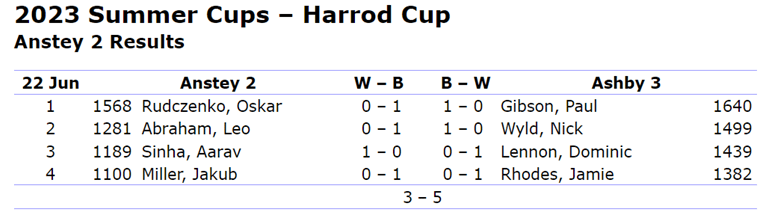
The second round of the Harrod Cup was an interesting match for Anstey 2, as every player on Anstey side was out graded. On the top board (Oskar Rudczenko from Anstey vs Paul Gibson from Ashby) Oskar was outgraded only by 70 points, which isn’t that much in over the board chess (or face to face chess). However, the rest of the Anstey players were severely out graded, as the rest of the Anstey team were rated under 1300, whereas the whole of the Ashby team were rated well over 1350. Boards 2, 3 and 4 from Anstey were all out graded by at least 200 rating points.
Even though Anstey was out matched, it doesn’t mean we were going to buckle under the strength of the Ashby players. The first to win was the second board Anstey player Leo Abraham, (playing against Nick Wyld) who had to take a long break from chess to do his GCSE exams, and Leo still plays well even after only playing a couple of other matches throughout the past year. The next to win was an Ashby player named Dominic Lennon (playing against Anstey player Aarav Sinha), who is a strong player but is also a regular at the Anstey chess club, as he said he had played at Anstey for the last few weeks before this match.
The next match to finalise was board 4 with Jakub Miller playing for Anstey (against Ashby player Jamie Rhodes). Jakub is a new member of the Anstey club, and he is quite tricky. I have played against him a few times and he can cause some chaos on the board, which can make it hard to keep track of what’s going on. Unfortunately, Jakub could not cause enough chaos for this match, but Jakub did last for a long time against a very strong Ashby player.
Board 1 was the last to win (Oskar Rudczenko from Anstey vs. Paul Gibson from Ashby), and both games played that evening were close and of good quality. Oskar is a player who has worked hard since playing for the club (when he was a chess beginner), he is not improving quickly but he is improving, and he is sure to keep working on his chess. Oskar had won the first game against a strong Ashby player, unfortunately, he could not keep up his performance in the second game as Paul won the second game between the two top board players.
Leo had lost as well on the second board, Jakub on the last, but Aarav on the third winning his second game against Dominic Lennon. This results in the match between Anstey 2 and Ashby 3 to be 3 points to Anstey and 5 points to Ashby (result table below).
As I’ve said before, we were out graded but it doesn’t mean we should give in. We had won some games, but with every loss we get the more we can learn, that’s how it works in chess and in all sorts of other things too. Anstey 2 play against Latimer in the next round of the Harrod Cup, and Latimer are a strong team but Anstey are quite a strong club filled with players who are full of potential. We’ll see what happens on the night, but until then it’s a bye for now.


 Anstey Chess Club