Episode 5 of the Anstey Chess Club podcast – The Dark Destroyer and the rise of The Prodigy

It has been an interesting period for our club as Anstey Chess Club and its members grow both over and off the board. Following the growth of the club, we have decided to take the next step in our development through the release of a monthly podcast. Throughout the next year, we will use this new platform to give you updates on the season and Leicestershire chess in general. Our team is also committed to do their absolute best to interview each episode a member of the club or the community.

In the fifth episode of our podcast, the hosts Boris “The Toaster” and “El Presidente” Ben were joined by Matt “The Dark Destroyer”. Our first team captain spoke about his journey in Anstey Chess Club and OTB chess. After the interview, the three discussed eight games of the very busy 2022/23 season for Anstey Chess Club.

To listen to the episode, follow this link. It is also available on AnchorSpotify and Amazon Music. Subscribe, comment, like and share!

Anstey 3 claim their first win of the season in a seven-board thriller

One of the youngest teams to play in the Leicestershire League this season claims a narrow 4-3 win against a solid Kirby 2 side.

It has been more than a month since our third team’s last game of 2022 and your author has finally found the time to write the report of this thrilling seven-board match, full of exciting games. One of the youngest teams from any club to play in the league this season was just a member short when the board number was agreed, and chairman Ben stepped up to the occasion, his confidence backed up by great performances this season for all Anstey teams. Unfortunately, in the last hours before the match, the captain Oskar found himself unfit to play and “the usual suspect” Boris filled in on board 1. Kirby Muxloe 2 arrived with a solid, albeit slightly lower rated team and naturally managed to cause all sorts of problems to our players. It was a turmoil of an event, with players winning and losing all over the place, but eventually the Anstey youngsters prevailed to claim the first win for our third team this season and start climbing up the table.

Paul Gray (Kirby 2) vs Borislav “Boris The Toaster” Lazarov (Anstey 3) 1 – 0

Boris “The Toaster” filled in for the team in a very short notice and was playing as Black against a solid player in Paul Gray. On the table with (on paper) the biggest rating difference, “The Toaster” was (again, on paper) the favourite to win this game. The players engaged in the Caro-Kann Exchange variation, and as soon as move 13, our teammate found himself faced with a choice of whether to have some fun or be solid. Surprisingly, Boris decided to go the former route and immediately put pressure on White’s dark-squared bishop with an early g4, followed by an attack on the king with g5. A series of exchanges took place, with the Kirby player throwing away a +2.9 advantage (Stockfish depth=20, powered by chess.com). “The Toaster” tried to build up some pressure on the open g-file, but White managed to exchange queens. The players picked up some pawns, with our teammate having the more active knight and having a -0.9 by move 26, which grew to -2.2 for a move, only to be brought back to equal game in a couple of moves. Boris put pressure on his opponent on the kingside (K-side), only to win a pawn – a move which the engine disliked, giving a +0.1 with material down for White. Although up a pawn, “The Toaster” was not able to do anything with his pawn, and quickly realised that his pieces cannot be improved easily. Our teammate tried to shuffle his rook, only to blunder his knight twice and offered a draw on the second time. His opponent did not miss the somewhat simple tactic on the second occasion and cashed on his material advantage to win the game for Kirby 2 on board 1.

A bitter lesson for Boris who is long due to slow down and start calculating deeper.

“El Presidente” Ben Vaughan (Anstey 3) vs John Walker (1529) 1 – 0

It has been great season so far for our chairman who was scheduled to play with the white pieces against another solid player from Kirby in John Walker. “El Presidente” opened with his old favourite, Ruy Lopez (for any fans of him out there, he switched now to the Catalan) to which his opponent answered with (based on chess.com) the Cozio defence. Ben occupied the centre immediately, and both players developed their pieces as soon as possible. Our second team captain castled K-side, while his opponent’s king was still in the centre in the beginning of the middle game. “El Presidente” decided to exploit the latter fact by striking first on the queenside (Q-side) and immediately after in the centre, winning a pawn in the process. With a strong pawn on d5, Ben put good pressure on Black’s position, making the Kirby player spending tempi on rerouting his pieces. Nevertheless, Ben’s opponent decided to put pressure on the K-side, but a solid defence from our chairman kept the advantage for White. Under significant pressure, Black rushed to exchange queens, only to fall victim to a sophisticated tactic by “El Presidente”, winning him a full piece for a pawn. In a slow and steady manner, Ben started exchanging pieces, first a pair of knights, followed by a pair of rooks, whereby our chairman sacrificed a couple of pawns as well. Our second team captain managed to pick up Black’s c7-pawn, creating a passed pawn of his own which unfortunately did not last long but gave him the opportunity to sweep clean the Q-side on his march to exchange pieces and capitalise on his material advantage. Eventually, “El Presidente” exchanged his remaining bishop for the enemy knight and equalised the pawn count. A full piece down, his opponent decided that enough is enough and resigned.

Another great win for Ben who is deservedly in the competition for best performing player for the club.

Nigel Wollen (Kirby 2) vs Leo “The Lion” Abraham (Anstey 3) 1 – 0

The top regular Anstey 3 player for this match was Leo “The Lion”, scheduled to play as Black against another experienced player in Nigel Wollen. The players engaged in the Ruy Lopez whereby Black opted for the Old Steinitz defence (based on chess.com), allowing for White to exchange on c6 and double the pawns on the c-file. Our teammate decided to fianchetto his dark-squared bishop and both players develop quickly and castled K-side. “The Lion” tried to open the centre with f4, recapturing with his light-squared bishop and thus completing his development. The Kirby player stroke in the centre himself with a somewhat premature d4, but our teammate could not resist the slightly losing possibility of placing a bishop on e4 where he had to push his pawn instead. The players exchanged most of their minor pieces, leaving only a pair of knights on the board which worked in White’s favour, as the weakness on the c-file remained. Eager to capitalise on his advantage, Leo’s opponent rushed to exchange knights and doubled his rooks on the e-file. “The Lion” exchanged one set of rooks and in the process managed to exchange one of the c-pawns for its d-equivalent. Having created a protected passed pawn on the d-file, our teammate tried to push both the c- and d-pawns, but a premature c-pawn push saw Leo losing both pawns for the price of the white b-pawn, leaving White a pawn up, with both players having one pawn each on the Q-side. The rooks picked up the pawns, and not long after, the solid Kirby player exchanged the rooks in a 3 vs 2 endgame. Unfortunately, our teammate missed a few opportunities to draw the game and with the last move Kh7 giving a clear advantage for White, “The Lion” resigned.

Another tough day in the office for Leo, who is under some GCSE pressure, but looking to improve his game further regardless.

Noor “The Prodigy” Datoo (Anstey 3) vs Dan Watson (Kirby 2) 1 – 0

Another player in great form, Noor played with the white pieces against a young Dan Watson from Kirby. The players opened with the Italian variation of the Four Knights game, with Noor hurrying to exchange the dark-squared bishops, albeit at the price of doubled e-pawns. Our teammate put pressure in the centre, while his opponent attacked the remaining white bishop and further exchanged it for one of his knights. Finding himself with a slight advantage, the Kirby player decided to tuck his king into safety on the K-side which was welcomed by “The Prodigy” who started a K-side attack with h4 and g4. Both players shuffled their queens, and Noor sacrificed the c-pawn for initiative and attacked with g5. Black did not call the bluff and started shuffling his king, letting White to open the K-side in the process. Our teammate consolidated his Q-side with Nxc3 following Black taking on c3 “en passant”, and started to exert a solid squeeze on the K-side. The Kirby player brought his queen to the K-side party and tried to create a counter attack, sacrificing two pawns in the process, but the mighty white knights kept everything together for “The Prodigy” who capitalised on his accumulated advantage and delivered a beautiful checkmate with his d-pawn.

Another great win for Noor who is looking to steal the “Best Performing Anstey Player” from “El Presidente” this season and is definitely on his road to the second team.

Charlie Clynick (Kirby 2) vs Aarav Sinha (Anstey 3) 1 – 0

Aarav was back in action for the third team and found himself playing against another young Kirby player in Charlie Clynick, Unfortunately, little information was received about the game and the report on this will be shorter, based only on the unreliable memory of the author. Nevertheless, both players opened up normally, with them developing their pieces swiftly and unfortunately, Aarav was down a piece early in the game. Our teammate manged to get back in the game and even had an advantage the next time the author had a glance at the game. Unfortunately, the next time Aarav was seen he admitted that he lost the game.

An unfortunate evening for Aarav, however, he is not far away from capitalising on those games and his advantage.

Yuvraj Sadhra (Anstey 3) vs Nigel Smith (Kirby 2) 1 – 0

Another returning junior was Yuvraj who played as White against Nigel Smith from Kirby. The young Anstey player was a tad late, and found his board with his clock already ticking when he arrived. Our teammate opened with the Ruy Lopez, which was met (probably not to the awareness of either player) by the Lutikov variation of the Exchange Morphy defence (based on chess.com, although the author admits that the name sounds dubious at best). Yuvraj hurried to exchange on c6 and double his opponent’s pawns. Both players started their development and while the Kirby player opted for a double fianchetto and a King’s Indian setup, our teammate opted for a c1-h6 bishop led battery and a Q-side castling, with the c3-knight protecting the king. Black pushed his a-pawn while the young Anstey player attacked with “Harry” and “Garry”, exchanged his dark-squared bishop for the remaining black knight and broke the K-side pawn structure of his opponent. The advantage of our teammate was so prominent by move 17, he could afford to part ways with his knight for free, but he decided to keep it just in case. Black tried to counter attack with his a-pawn, but it was too little too late, as Yuvraj forced an exchange of the black dark-squared bishop for one of his knights and followed with infiltration of the queen on the K-side, delivering checkmate shortly after.

Another great game from Yuvraj who is looking to challenge the top boards’ players for their spots very soon.

Edda Walker (Kirby 2) vs “Young” John Graham-Brown (Anstey 3) 0 – 1

It has not been the best of seasons for John who is regularly outrated by hundreds of points. Which explains his excitement prior to his match with the black pieces against experienced Edda Walker who is in the same rating range as our youngest competitor. The game proved to be an absolute mayhem, worthy of a place in our teammate’s future memoirs. The players used an unusual move order to reach the four knights variation of the Italian game. “Young John” decided to prematurely attack with his knights, only to exchange one of them for the white counterpart and part ways with the other after a decent tactic from his opponent and an unfortunate blunder from John. Our teammate had to further exchange a pair of bishops and tried to activate his remaining minor piece, supported by the mighty queen. However, the youngest Anstey player fell victim to a fork in the process which costed him his queen, and even worse upon recapture of the enemy knight, our teammate lost his bishop as well. Down 12 points of material, the game look bleak for “Young John” who never stopped fighting and activated his rooks, bringing one of them on h5. His opponent missed her opportunity to finish off the game and instead attacked John’s Q-side pawns, only to lose her queen for no compensation. “Only” a minor piece and a pawn down, John started pushing his Q-side pawns and soon created a hole on the b-file. John managed to stop the march of the white e-pawn at the price of a rook exchange and continued his march on the Q-side. With White being careless in the early endgame, our teammate managed to push his b-pawn the whole way and promoted a queen which soon wreaked havoc on White’s position. Seeing that our teammate is in control of the game, the Kirby player decided to call it a day and shook John’s hand.

Congratulations on a great first win for “Young John” and we wish him many more to come.

With this first win of the season, Anstey 3 went up to sixth place at the time and after several games were played in the division, our third team is still holding the position after six games. Entering into the second part of the season, we are sure that the young Anstey players will further rise to the occasion and make their captain Oskar happy by delivering more defeats to their opponents.

During the night, club night took place with our teenage band, led by regular member Sev, back in the house to play some casual games with dad Damien and son Aristotle.

Anstey Chess Club celebrated an amazing club night before a well-deserved holiday

Surprisingly, in spite of the busy season featuring three Anstey Chess Club teams, last Thursday (22/12/22) was fixture-less and a busy club night took place instead. Well in advance, our chairman Ben started the organisation of a blitz tournament to celebrate the last club night of 2022. Hesitant about the number of people to turn up, ‘El Presidente’ left the details open until the very end, only to find himself overwhelmed by the interest in the tournament by our players and members. In total of sixteen players were eager to take participation in the event, with Mick and Ben himself watching from the sidelines and attending to the organisation of the tournament. The club saw a diversity of casual players, competitors in the league, prospective juniors and seasoned experienced chess players. Julian “Mr Engine”, John “The Torturer”, Matt “The Dark Destroyer”, Boris “The Toaster”, Bob, Leo “The Lion”, Aarav and his dad Amit, Oskar “El Capitan”, Young John, Sev, Aristotle and dad Damien, newcomers Tom and Luca, and returning for the holidays Glasgow student Ashton all started their clocks around 8pm and embarked on a five-round Swiss style tournament under the critical eyes of “El Presidente” and “Just Mick”. After a brilliant performance, naturally Julian won the tournament with 4.5/5 points, but the important outcome of the event was the excitement for all of our regular, returning and potential new members. After the tournament had finished, a fair number of our players went to “Passage to India” while the remaining members stayed for some puzzle work and casual games.

An amazing end to an amazing year. We cannot be any happier seeing the variety of ages, abilities and backgrounds of people coming to our club, all united by the love of the great game of chess. We wish them all the best for their future both over and away from the board.

Finally, to all our members, friends and everyone interested in Anstey Chess Club, Merry Christmas and Happy New Year! See you all in 2023!!!

Anstey Chess Club celebrates the end of a successful calendar year with Blitz tournament and curry

As the calendar year is drawing to an end, our members are looking forward to a busy and promising 2023

With Christmas songs being heard more and more often on the radio and the streets, the great Anstey community, including our amazing Anstey Chess Club, are all looking forward to the festivities at the end of the year. Fortunately, in a slightly odd development of the circumstances there are no scheduled competitive league games in the last week prior to Christmas. Surprisingly, our members will be able to enjoy a full club night whereby our great chairman ‘El Presidente’ Ben has prepared a great program for the final club gathering for the year.

As usual, the plan is to start promptly at 7.30pm in our usual venue, the Anstey Methodist Church, with a club tournament in blitz format. Regardless of whether the players are competing in the league, or are just playing socially, everyone will be welcome to take part and compete against their teammates. After the champion on the night is crowned, everyone who fancies tasty food and a great banter with teammates would be able to enjoy an amazing and delicious end of the evening in our neighbouring restaurant ‘Passage to India’. A wonderful end to a wonderful year!

In 2022, our club managed to accomplish some great results OTB, as the first team was competing for the top spot in division 3 at the end of the 2021/22 season. Both Anstey teams at the time performed amazingly and finished their seasons without a loss in 2022. In the summer cups, in total of four Anstey teams competed across all competitions, and 50% of them ended up ‘lifting’ (we could not see the actual cups, as they were not present at the award ceremony) the trophy in their competition, with Anstey being the undisputed Chapman Cup winner and Anstey 1 sharing the Harrod cup with Ashby 2. The new season posed some challenges to our ever-growing club, with three teams competing in three different divisions in the 2022/23 season. All three teams are doing great over the board, with our first team challenging the leaders in division 2!

The results are amazing but they are just the cherry on the top. Since December last year, Anstey Chess Club has expanded significantly, with strong players like Julian, Matt, Brian, Bob, and Big Daddy Valdas, and the promising juniors Noor, Aarav, Yuvraj, and Young John joining/returning to the club from the end of 2021 onwards. We also welcomed plenty of new social members, including young Marcus, dad Damien and son Aristotle, young Sev and the teen gang, among others. We got to have our own stall at the amazing Anstey Gala which proved to be a great experience and connected us to the local community and most importantly, some of our great members. We continued our presence in the community by introducing the Monthly Knockabout as we played some great casual games in Bradgate Park, The Nook Corner Café, and Peppercorns Café. Last but not least, we became a local online go-to place for chess, having launched our website, Facebook, Instagram, Reddit and the Anstey Chess Club Podcast.

If you want to join one of the fastest developing chess communities in Leicestershire, or you feel like playing some blitz games in a more formal format, come and join us for some chess and curry next Thursday, 22/12/2022. The session starts 7.30pm in the Anstey Methodist Church. It does not matter how good or who you are, all you need is love for the great game of chess!

Episode 4 of the Anstey Chess Club podcast – The busiest players and joining Anstey Chess Club

It has been an interesting period for our club as Anstey Chess Club and its members grow both over and off the board. Following the growth of the club, we have decided to take the next step in our development through the release of a monthly podcast. Throughout the next year, we will use this new platform to give you updates on the season and Leicestershire chess in general. Our team is also committed to do their absolute best to interview each episode a member of the club or the community.

In the fourth episode of our podcast, the hosts Boris “The Toaster” and “El Presidente” Ben were unfortunate to not be able to present their planned guest, Matt ‘The Dark Destroyer’, due to unforeseen circumstances. Nevertheless, Ben and Boris discussed seven more games of the very busy for Anstey Chess Club 2022/23 season. The hosts also spoke in the end about joining Anstey Chess Club and the junior sessions in the area.

To listen to the episode, follow this link. It is also available on AnchorSpotify and Amazon Music. Subscribe, comment, like and share!

A brilliant performance from Bob secures a solid match win for Anstey 2

The quickest three draws of the season follow our season debutant’s win to claim second league win for Anstey 2 against a solid Ashby 3 side.

Last Thursday (17/11/2022) our second team travelled to Ashby to play against their third team in a Division 3 contest of the Leicestershire Chess League. Anstey 2, conveniently named “The B-team”, was represented by the regulars Brian ‘The Griller’, Boris ‘The Toaster’, Bob, led by the chairman/captain/reporter/marketing director/podcaster/streamer/content creator ‘El Presidente’ Ben. (If you have not listened to our podcast, jump to this link to discover engaging content, soothing voices, and a great banter) Our players were scheduled to play a solid, slightly lower rated Ashby 3 team who were coming from a heavy defeat and were looking to get back on the winning path.

Nick Wyld (Ashby 3) vs Bob Grindrod (Anstey 2) 0 – 1

Still on the lookout for his first win under the Anstey Chess Club banner, Bob was scheduled to play Black against the home team captain Nick Wyld. The players engaged in the French defence, Advanced variation, with Bob opting to take a more minor route in the opening by taking the d4-pawn on move 4 and create a nice target for his pieces to attack. Both players activated their knights in the contest for the said pawn, with our teammate keeping the initiative. Bob’s opponent did not like much the pressure on his centre and decided to exchange his light-squared bishop for the f5-knight, creating doubled pawns for Black on the f-file, while semi-opening the e-file. The Ashby player castled K-side and unsure of what to do with his dark-squared bishop, our teammate decided to exchange it for its white equivalent, thus stripping the home team player of both white bishops. Seeing his pawn on a semi-open file, combined with the remaining ‘bad’ black bishop, White decided to start doubling up of the rooks on the e-file, while at the same time he activated his queenside knight. Executing two plans at the same time from the Ashby player proved to be beneficial for Bob who managed to stop the e-pawn move at its foundation, while gaining tempo on the said knight, making room for his bishop to develop in the process. The previously sad bishop jumped quickly on a6 to attack the e2-rook and suddenly found itself controlling a bunch of light squares in White’s half. Bob decided to activate his remaining knight, threatening a queen and rook fork on b3, and surprisingly his opponent completely missed the threat and attacked the knight with b4. Our teammate happily exchanged his knight for the a1-rook and followed with an annoying, almost bordering with evil, pin on one of the white knights, which his opponent handled a little poorly, much to the delight of the Anstey B-Team. After doubling up queen and rook on the c-file, only to face a rook battery on the c-file across, the Ashby player blundered his knight and seeing the incoming lethal attack, resigned.

Finally, a well-deserved first win for Bob as Anstey Chess Club player, and we are wishing him many more to come.

‘El Presidente’ Ben Vaughan (Anstey 2) vs John Howlett (Ashby 3) 0.5 – 0.5

Our chairman was scheduled to play a solid player in John Howlett who met our teammate’s 1. e4 with the French defence. Almost an expert in the opening, ‘El Presidente’ decided to engage in the Exchange variation. Our teammate rushed to take the b1-h7 diagonal with his bishop which was met by knight development putting pressure on d4. Both players started the development of their pieces, then castled kingside. Black tried to chase Ben’s dark-squared bishop away with h6 to get rid of the annoying pin, but Anstey Chess Club’s chairman only pulled it a square, maintaining the pin from h4. The Ashby player brought both of his bishops to the party, placing them on g4 and f4, putting pressure on both of White’s knights. ‘El Presidente’ rushed to swing his queen away from the pin onto b3, only to be kicked back to c2 by one of the black knights. Challenged by h3, Black’s light-squared bishop exchanged itself for one of the white knights, and then the Ashby player pushed g5 to finally get rid of our teammate’s annoying bishop, and then rushed to exchange the dark-squared bishops. Ben managed to place a beautiful knight on e5, while Black rushed to exchange one of his knights for the last remaining bishop on the board. The home team player brought back his last minor piece to c6 to challenge its white counterpart and our chairman started fortifying his knight first with one of his rooks, and then with f4. The black knight exchanged itself for the only white minor piece, and just seen that Bob has won on the bottom board, upon recapturing with his rook our second team captain offered a draw and a drink to his opponent. Both were happily accepted by the Ashby player.

A solid draw for ‘El Presidente’ who continues to climb up the performance table, having lost only his opening game.

Steve Emerton (Ashby 3) vs Borislav ‘The Toaster’ Lazarov (Anstey 2) 0.5 – 0.5

Following his surprising win in the previous week for Anstey 1, Boris was scheduled to play Black against another solid player in Steve Emerton. The Ashby player led the game into the Caro-Kann, Two Knights variation where our teammate played as if it is a normal Steinitz/Karpov/Smyslov (whichever is your preference) variation. Luckily for ‘The Toaster’, his opponent did not play the most critical line and soon enough the game was led into a normal Caro-Kann position. Boris missed a good opportunity to play Bf5, seeing ghosts who definitely did not exist on his board, and completely trapped his light-squared bishop which ended being the saddest piece on the board, having moved only once until the end of the game. After a normal d4 push from White, our teammate prioritised development of the dark-squared bishop and castled swiftly, while the Ashby player rushed to take the h2-b8 diagonal with his dark-squared bishop. Boris overextended the queenside with a very dubious b5, forcing his opponent to tuck his light-squared bishop back in, but further preventing c5 without losing material. A Nd5 followed from our teammate, and then he decided to place his light-squared bishop to b7 as an investment for when the game opens up. Ben’s co-host on the Anstey Chess Club Podcast further played a prophylactic h6 to take away any sacrifice ideas from White. The home team player placed a knight on e5, which our teammate exchanged for his dark-squared bishop. Luckily for ‘The Toaster’ out of the three possible pieces for White to retake with, the Ashby player chose the worst one, giving our teammate the opportunity to exchange queens and prevent a crushing attack. Eventually, Boris managed to exchange his knight for White’s dark-squared bishop. Having heard Ben and Bob’s results a few minutes earlier, upon recapturing with his g-pawn our teammate offered a draw which after a short consideration, in spite of entering into a slightly winning endgame, but a little lower on time, the Ashby player accepted.

A good draw for ‘The Toaster’ who has been the busiest player for Anstey so far this year and looking to get his tenth game in less than two months next Thursday.

Brian ‘The Griller’ Foreman (Anstey 2) vs Lawrence Hayden (Ashby 3) 0.5 – 0.5

Playing like a machine this season, Brian was playing White against another solid player from Ashby, Lawrence Hayden. Brian opened up with the Queen’s Gambit which was met by the home team player with the King’s Indian Defence. Black develop normally with the typical fianchetto-ed bishop and castling kingside, while also exchanging his d-pawn for White’s c-pawn. Seeing the centre left out by Black, our teammate swiftly placed two central pawns, supported by the white knights and queen. In the meantime, the Ashby player pushed the queenside pawns and fianchetto-ed his second bishop as well. Our teammate decided to push e5, challenging the black f6-knight which jumped on e5 and got exchanged for one of the white knights. The black light-squared bishop jumped into the game to kick the queen back to c2 and the last minor pieces were developed for both sides. ‘The Griller’ went on to attack the black ‘lady’ with Bg5 which led to a big exchange on f6, whereby a couple of important pawns and the dark-squared bishops head to the rest area outside the board. Black was last to recapture with his rook, at a moment when only the top board players were left playing, sitting all by themselves in the small room. Our teammate castled and offered a draw which meant a win for our team and surprisingly his opponent accepted.

Another solid result for Brian who is so far the best performing player for the second team with 3.5 points of 5 possible.

The evening concluded promptly at around 8.45pm, a rather short event in the context of chess league matches, but nevertheless a successful performance for the Anstey 2 team. The B-team even managed to get back to the venue and do some analysis with youngsters and players from Anstey 1 and Anstey 3. After the win, our team find themselves on fourth position, with several teams below them with one or two games to spare. In the next fixture, the B-team will be playing Latimer at home.

If you want to be part of the excitement called competitive chess, come and join us regardless of your ability. All you need is passion for playing chess and a few spare hours to be spent every Thursday from 7.30pm in the Anstey Methodist Church.

Episode 3 of the Anstey Chess Club podcast – El Capitan and El Presidente’s rise amidst Boris’ blunders

It has been an interesting period for our club as Anstey Chess Club and its members grow both over and off the board. Following the growth of the club, we have decided to take the next step in our development through the release of a monthly podcast. Throughout the next year, we will use this new platform to give you updates on the season and Leicestershire chess in general. Our team is also committed to do their absolute best to interview each episode a member of the club or the community.

In the third episode of our podcast, the hosts Boris “The Toaster” and “El Presidente” Ben were joined by Oskar ‘El Capitan’. Our third team captain spoke about the joy of captaining a young promising team and his chess story. After the interview, Oskar, Ben and Boris all discussed eight games of what already seems to be a very busy 2022/23 season for Anstey Chess Club.

To listen to the episode, follow this link. It is also available on AnchorSpotify and Amazon Music. Subscribe, comment, like and share!

Tales in the opening – the first move

Seasoned chess players around the world recognise three main parts of the game – the opening, the middlegame and the endgame. Every part is important and could lead to one side winning the game, but there is a certain fascination with the opening which is unprecedented. In these series, we will take a look at the main openings and the amazing variety of games and positions arising from them.

The opening of a chess game has always been the most serious contender for the minds and hearts of the chess improvers. One of the main reasons for this could probably be attributed to the commiting nature of the opening for the players. With their first moves, both Black and White decide the direction and more importantly the nature of the game – whether it is going to be a tactical chaos with multiple explosions about to errupt on the board, or a solid positional competition, where every piece shuffle might be the subtle advantage to turn the game. To quote our very own chairman Ben who summarised the importance of the opening a few months back in his interview for our website:

“I don’t have a favourite part of the game. I guess if I had to choose, I would say the opening. The reason is that I view a game of chess like building a house. To build a house you need a solid foundation, just like in chess you need a solid opening to build your game from.”

It is easy to underestimate the importance of the above statement, and it is fascinating how often people jump from one opening to another without a clear idea of the positions arising from their newly chosen first lines. Using the above metaphore, we could easily extrapolate that this approach is like building different house foundations without the vaguest idea of how the houses are going to look like.

Okay, we have stated how important openings are, but how should we go about picking our own opening and how much time should we spent on becoming proficient in it and the positions arising from there? It is fair to admit that this is a complicated question, depending on a few important variables: what positions do you prefer, how much time are you able to spend on studying the opening, when would you like to throw your opponent out of preparation and ‘the book’ … One thing is for sure – no matter what your answers are to those questions, there is an opening line suiting those answers. Our aim in this long series will be to present you with the main options and their peculiarities. In our above-stated line of thought, it is only fair to lay the foundations of the chess openings by listing the most common first moves from White and Black, giving a short summary of the different openings the positions lead to. We start with the two main favourites, centuries-old catalysts of many heated discussions between chess players around the world – 1.e4 and 1.d4.

1.e4…

An ancient opening which on paper has been considered the best first move forever. The e-pawn opens diagonals for the queen and the light-squared bishop, and immediately takes control of d5 and f5 in the centre of the board. There are many replies from Black, leading to many different games and positions, for example:

1…c5 – the Sicilian defence. The most popular reply from Black in the chess.com database, widely considered the best option for Black if they are playing for a win. Being one of the most combative and popular choices of reply, this opening is highly technical and people should be familiar with quite a lot of ‘book’ variations and emerging positions, including Classical, Dragon, Accelerated Dragon, Scheveningen, Najdorf, Sveshnikov, Kalashnikov, Taimanov, Kan, Four Knights, Rossolimo and Moscow variations among others.

1…e5 – another very common reply, leading to a variety of different games. A common development for both players includes 2. Nf3 Nc6 whereby White attacks the e5-pawn while Black defends it, with both players developing a knight. From this position, there are many opportunities for White to lead the game in different positions – Italian game, Spanish game (Ruy Lopez), Scotch game, etc. A very popular line from Black to reply to the threat from 2.Nf3… is to create a threat of his own with 2….Nf6, and this line, called the Petrov is quite popular and used recently in the last World Championship, played between GM Carlsen and GM Nepomniachtchi. A more solid approach for Black might be to play 2….d6, leading the game into the Philidor defence. Alternatively, if White wants to take a different path as soon as the second move, there are more options: 2.Nc3… leading to the Vienna game, 2. Bc4… which is transpositional, even 2. f4… – the King’s gambit, among others.

1…e6 – the third most common reply from chess.com database, leading usually to the French defence. Another response which is gaining popularity, is the e6…b6 setup from Black, most recently popularised by GothamChess IM Levy Rozman. A less popular, but interesting choice to continue might be St. George defence, with e6, a6 and b5, and the aim to play c5, attacking the centre.

1…c6 – another solid option for Black, leading most commonly to the Caro-Kann defence, with its multiple theoretical lines.

1…d6/1…g6 – these moves are placed in the same bracket, as they usually lead to the Pirc and the Modern – structures similar to the King’s Indian defence.

1…d5 – straight confronting White in the centre, a reply known as the Scandinavian defence.

The above are in summary the most common replies for Black, but there is no limit to the way they want to play, including with some more untypical line like the Alekhine, the Hippopotamus, or others.

1.d4…

The other representative of the e4 vs d4 debate, with ancient history behind it, is the second most common move in the chess.com database, not far away from its companion above. Similar to 1.e4, this move opens up the queen and the dark-squared bishop, and the pawn strikes in the centre, controlling e5 and c5. Needless to say, there are probably as many replies to 1.d4, as there are to 1.e4, if not even more.

1…Nf6 – arguably the most flexible reply. This move is very transpositional and it could lead to many lines. From here, White can decide to go for a variety of lines, including:

  1. 2.c4…, leading to Queen’s Gambit (yes, like the series) lines or the Catalan, which is a common choice of many Grandmasters, including GM Magnus Carlsen and GM Ding Liren. The variety in Black’s reply is quite large, including the Queen’s Gambit highly theoretical lines, the King’s Indian defence, the Benoni, the Nimzo-Indian, the Grünfeld, and many others. Usually all these lines are highly theoretical, and a player should really spend some time studying them, regardless of which colour they play.
  2. 2.Bf4… – the London system. This is an opening where White is usually looking for the same setup, regardless of what Black plays. Played like a system, the less theory and the solid nature of this opening makes it very often preferred by people who do not want to spend too much time studying openings or do not have the time to go for very theoretical lines.
  3. 2.Nf3… is another very flexible and transpositional move and could lead to many different lines, including all of the above.
  4. 2.Nc3… is a more dirct reply from White as the knight is looking to support an e5 pawn push. This move is also part of another line, known as the Jobava London system – a very transpositional opening, aiming at creating tactical opportunities for White early on in the game.
  5. 2.Bg5… – the Trompowsky attack. This opening has recently received quite a bit of attention as it was another line popularised by GothamChess.

There are of course, many other replies and lines following 1…Nf6, but luckily for d4-players, they usually end up in the same setups. The move 1…Nf6 could also be substituted by the second most popular move with both leading more or less to the same lines.

1….d5 – with this move, Black states that they are going to fight for the centre. One of the most popular continuations is the Slav defence, with its many theoretical lines: Main Slav, Exchange Slav, Semi-Slav(an opening on its own), Chebanenko Slav, Alapin variation, Czech variation, and others. As mentioned in the previous line, we could again meet transpositions, as after White’s second move, 2…Nf6 leads to some of the above lines.

1….e6 – another very flexible and transpositional move. Here White can choose to play 2.e4… and opt for the French defence, while on the other hand 2.c4… leads again towards the Queen’s Gambit lines above.

1….d6 – a very interesting move which gives Black options for Philidor or King’s Indian – type setups, as well as opportunities for more enthusiastic approaches like the Hippo. It could also transpose into the Benoni further down the road.

1….f5 – the Dutch defence. Another one of the common replies from Black which looks a little like a mirror image of the Sicilian,

Although not as popular, there are other options for Black to reply to 1.d4…, some of the most notable being the Englund Gambit with 1….e5 and the Modern with 1….g6.

Other first moves

There are in total of 20 first moves that White can play, and they had all been pretty much played in the history of chess. Nevertheless, there are sounder options, and there are unsound options, although so early in the game nothing is fatal and any position could be held by either player. The openings which are not part of the above lines, are considered slightly inferior, and are often called ‘Minor’ openings. Some of the most notable representatives of this class are the following:

1.c4… – the English opening. A very popular choice which is not so different from the Catalan in the sense that White aims for similar development, including fianchetto-ing their light-squared bishop. A very tactical, yet solid positionally opening, the English is a favourite of many players, including at Master level.

1.Nf3… – another very popular choice, the Réti, named after the great 20th century player Richard Réti. Possibly the most flexible opening move, this very transpositional move gives options for most of the lines above, with either e4, c4, or d4 played on the second move, or just fianchetto-ing the light squared bishop in the lines of the King’s Indian Attack.

1.f4… – the Bird opening, named after the 19th century player Henry Bird. Although not as direct as the main opening moves, this move also aims at controlling the centre. However, White always has to be careful about kingside attacks and checks on the e1-h4 diagonal. Nevertheless, a solid minor choice by White to open.

1.b3…/1.g3… – although these moves can lead to vastly different positions, they are quite similar in the sense, that White does not attack the centre straight away, and is looking to get a bishop fianchetto-ed and then attack the centre of the board.

There are, of course, other alternatives to the all of the above moves and lines, from the ‘creepy-crawly’, to the Sodium opening, there are many ways for White to open and Black to reply. However, in the series we will be looking at the main lines played by Masters, tested and passed the challenges of history. Join us next time, when we will be looking at one of the most popular and old lines, favourite of the tactical players and lovers of the sharp lines, the Italian game.

The Monthly Knockabout in November

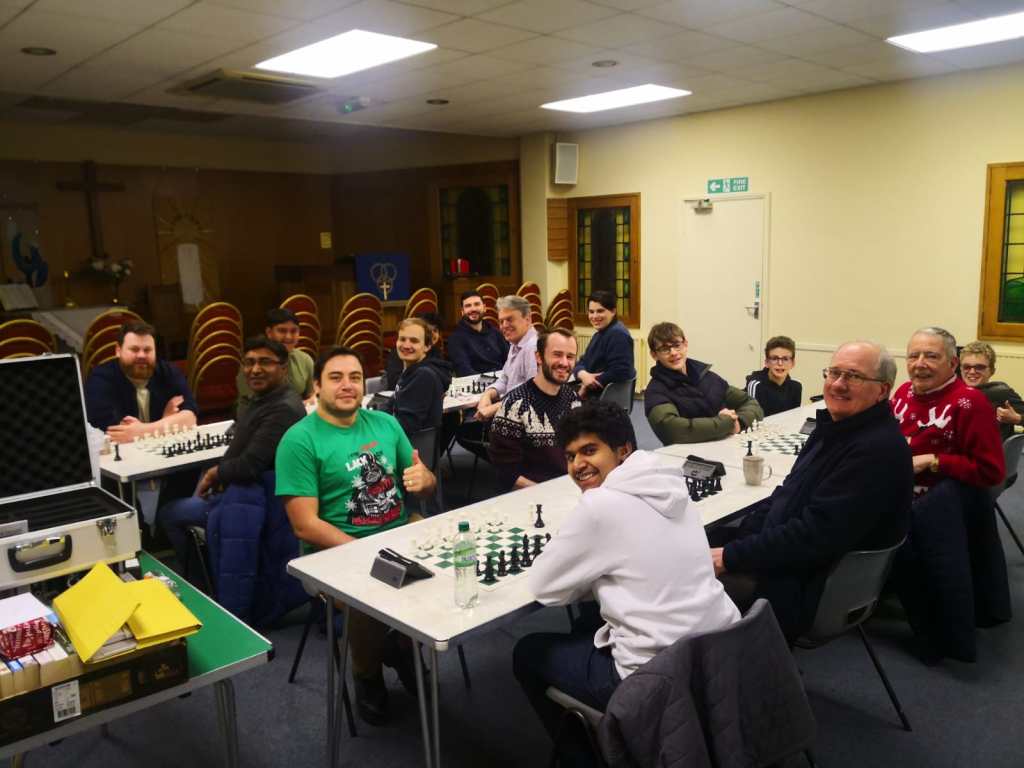
In the Anstey Chess club, the love for chess is the main driving force for everyone involved. Nevertheless, in spite of the notoriously solitary nature of the game of chess, in our club we are proud of our thriving community full of great memories and positive attitude. To promote the great relationships between our members, we have decided to introduce The Monthly Knockabout. As suggested by the name, each month our club members and supporters get together for some casual games in a suitable location in Anstey or the surrounding area – park, club, café, pub, etc. There we enjoy games of chess, including “hand and brain”, “Crazyhouse”, “Duck” chess, and various time controls. All necessary equipment such as pieces, boards and clocks is provided by the club.

This month we will be meeting on Saturday, 12th November. So far the venue is scheduled to be the Peppercorns café on the main Anstey roundabout across our club home venue. (map screenshot below) We meet at the café at 11am and we will be glad to see as many of you as possible. To ensure that there will be room and activities for all, please contact us if you are coming. All abilities welcome! All you need is a love for the great game of chess.

Basic Checkmating Patterns – Part Four

When it comes studying chess, one of the most underestimated elements of the game are the checkmating patterns. In this series we look at this very important part, focusing on the most common checkmates and characteristic patterns leading to them.

We have already looked at the majority of the pieces and their abilities to deliver checkmate. In this part of the series we take a look at the checkmating ability of the last piece we look at – the bishop. Controlling diagonals, this mighty piece always relies on the assistance of another piece, whether it would be a queen, rook, or even another bishop. Below we look at five common patterns involving a bishop and a major piece.

1. Morphy’s mate

Named after the great Paul Morphy, this checkmating pattern is one of the most popular positions in the world of chess. The pattern is executed with the combined action of the bishop and a rook.

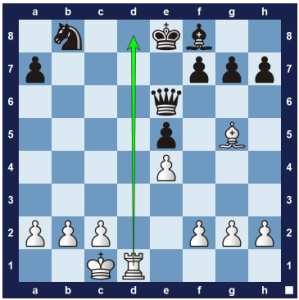
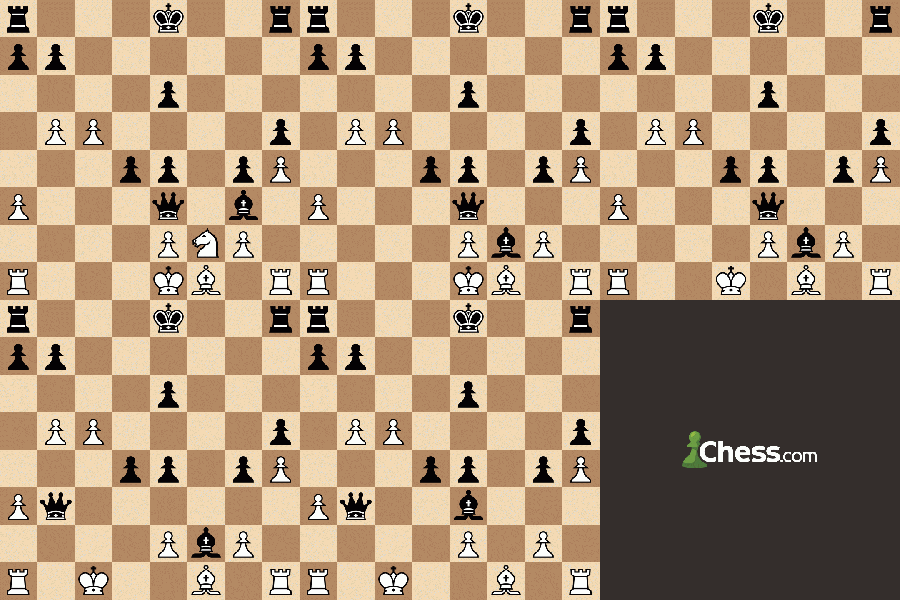
As seen from the diagram above, the black king is completely cut off on the h-file, with his own pawn preventing the king from moving around the h-file. The rook cuts off the g-file, completely restricting the king’s movement. The only thing left for the pattern to work is the bishop delivering checkmate from d4. This pattern could also be used in conjunction with a discovered attack as seen from the diagram below.

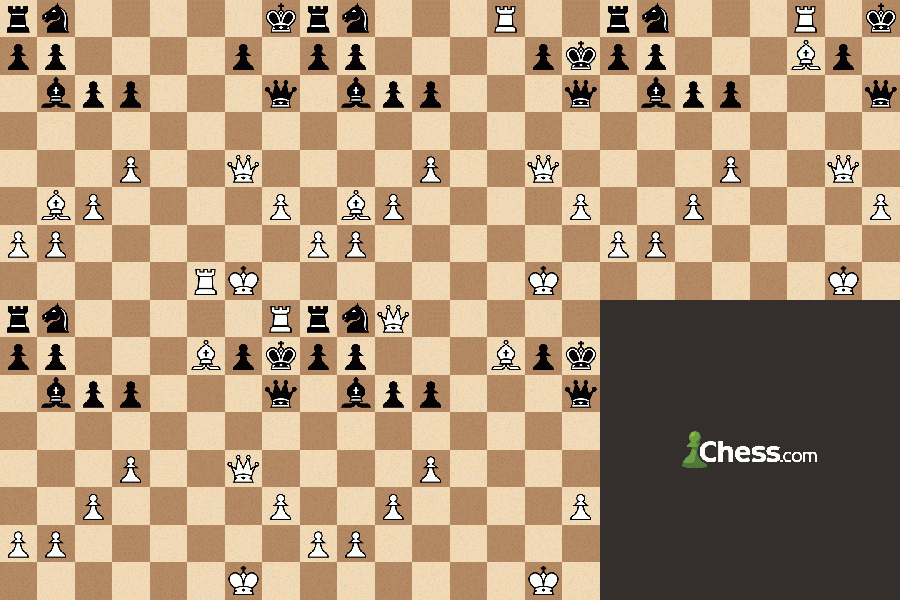
The above position is from the game Reshevsky – Shainswit, 1951. In the actual game, Black resigned after Rg3+ since, as seen above, the only moves to slow down the checkmate are giving up the queen and the rook. An interesting fact is that the checkmating pattern received its name from a game in which it did not feature – Paulsen – Morphy, 1857. The game inspired an idea for building up into the checkmating pattern using a beautiful queen sacrifice against a kingside castled king.

By taking the knight, the queen threatens mate in one with Qxg7# so taking back with the g-pawn is compulsory. This opens up the g-file, creating the opportunity for the white rook to cut the black king off with a check, followed by the lethal blow from the bishop with Bxf6#.

2. Pilsbury mate

Named after another great XIX century player in Harry Pilsbury, this checkmate pattern is quite suited to be trained alongside the abovementioned Morphy mate as they are virtually variants of the same idea. In this particular pattern, the bishop and the rook work in the same way as in the Morphy mate but this time the rook delivers the final blow, as the bishop is controlling the king’s escape.

In the example above, the bishop is controlling the long a1-h8 diagonal, and with the black king restricted by his own pieces, the rook slides over to g1, delivering checkmate. The below diagram shows one possible buildup for this checkmating pattern. The position is from Savic – Radojevic, 2006.

After the white bishop captures the black knight, it seems that the white queen is up for grabs, but capturing it, as seen above, unleashes the potential of the dark-coloured black bishop and the remaining white rook. Not controlled by the black knight anymore, the dark-squared bishop gives a check on g7, followed by a discovered check with Bf6+, and after the queen tries one last attempt to stop the checkmate, the rook captures the black lady with a crushing Rxg5#. It is worth to note that just retaking the white bishop at the first move as opposed to capturing the ‘hanging’ queen would have freed an escape square on f7 for Black, should he needed it. Another common buildup to the Pilsbury mate involves a rook/queen sacrifice.

In this case, the rook sacrifices itself on g7, thus opening the g-file for the bishop and the d1-rook. It is important to note that after the king slides over to h8, any move other than the double check Rg8+ is most likely losing for White, as the knight can block the bishop on d4, while the queen could exchange itself if needed. However, the double check means that the black king has to do something about it and the only option is to retake on g8, hence giving White the opportunity to execute checkmate with Rg1#.

3. Opera mate

The Opera checkmate pattern takes its name from a famous game called the Opera game. Unsurprisingly, the origins of this patter come from Paul Morphy again, who played against the Duke of Brunswick and Count Isouard in Paris, in 1858, while watching opera. This pattern again involves the combined action of the rook and the bishop, and is another pattern that is probably best learned in conjunction with the abovementioned Morphy and Pilsbury mates, as it relies on similar principles. The final position of the actual opera game is shown below.

The black king is cut off by his own pieces, and just like in the Pilsbury mate, the bishop is controlling his only squares. What is left for the white rook, is to deliver swiftly checkmate on d8. In the actual game, this move was preceded by a beautiful queen sacrifice well in the tradition of the great Paul Morphy.

The pattern is quite common when the enemy king is protected by a triangle pawn structure, like in the King’s Indian and Pirc defences. It is important to note, that the rook could be anywhere on the rank/file where the checkmate is delivered, as long as the opposing king is controlled by the bishop.

In this last example, the material advantage and mating threats do not help black, as the white rooks attack Black’s back rank, weakened significantly by the activity of the bishop. All the moves are forced and White emerges triumphant after 1. Rd8+ Rxd8 2. Rxd8#.

4. Balestra mate

In the last two examples, the powerful combination of the mighty queen and a bishop is looked at, starting from the Balestra mate. This checkmating pattern takes its name from a fencing term for powerful lunges, as the bishop lunges to checkmate the opposing king, restricted by the powerful queen.

As seen in the above diagram, the black king has only one square left to move, which is conveniently situated on a light square. The white bishop lunges with Bc6# swiftly delivering checkmate. In the game Bang – Sayre, 1921, Black explores this pattern to deliver checkmate on move 27.

The combined work of the queen and the bishop leads to series of forcing moves to get the white king on c1, cut off from the b-file and the d1-a4 diagonal by the black queen. The bishop performs only a small hop this time to deliver the final blow with Be3#.

5. Max Lange’s mate

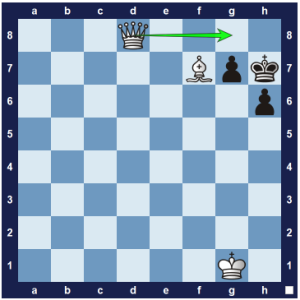
The last checkmating pattern in this article is the Max Lange’s mate, named after another player from the XIX century and involving again the queen and a bishop. This checkmating pattern exploits weak squares around the king.

In the above example, the light squares around the black king are very weak and the queen and light-squared bishop exploit them with their combined action. The bishop restricts the king on the h-file, covering the two possible escape squares g8 and g6, while the queen controls the back rank, completely restricting the black king. The queen delivers the checkmate with Qf8#. An example of a beautiful buildup and execution of this checkmate pattern is found in the game Sikorova – Quinn, 2001.

With the black queen looking to exploit the white king’s exposed position, White has to keep playing only forced moves. As seen from the diagram above, with series of checks, including a rook sacrifice, the black king is forced on h8, with the white bishop positioned perfectly on f7. The white queen jumps on c8 to deliver one check, and then slides over with a Qg8#, checkmating the black king.